#bStocksCIS @BinanceCIS For a long time, I thought dividends in Binance bStocks were simply a plus added to the balance that appears by itself.
I didn’t see the point of digging into the mechanics—why bother, if the money will come anyway. Turns out, it’s more complicated.
When Apple and IBM announced their dividends, I first observed the entire cycle live.
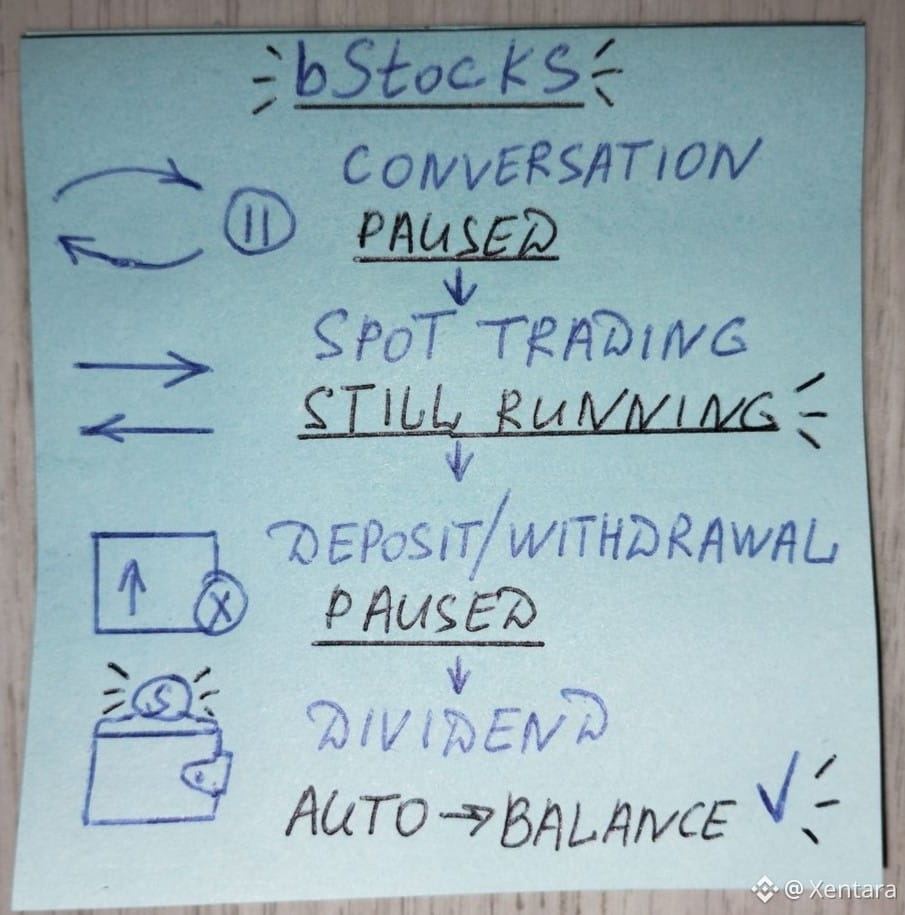
First, the conversion to the stock and back stops—that’s the first step of the processing. And the key point here is: spot trading doesn’t stop. The AAPLB/USDT and IBMB/USDT pairs keep trading without any pause. Next, deposits and withdrawals of the underlying asset are paused—during the dividend processing. How long the pause lasts depends on the action schedule. Imagine repairing one lane of a highway—traffic in the other lanes keeps moving uninterrupted. One lane is closed, the others are open, and overall movement doesn’t stop. There’s almost no bottleneck.
After processing, the net dividend—minus the withholding tax—is automatically added to the balance through the Multiplier. Without any action required from me.
Automation doesn’t save you from inattention—you can still miss the moment when the conversion stops.
Maybe the problem was never with the accrual mechanics. Or, hardest of all—learning not to interfere when the system is working on its own.
I didn’t see the point of digging into the mechanics—why bother, if the money will come anyway. Turns out, it’s more complicated.
When Apple and IBM announced their dividends, I first observed the entire cycle live.
First, the conversion to the stock and back stops—that’s the first step of the processing. And the key point here is: spot trading doesn’t stop. The AAPLB/USDT and IBMB/USDT pairs keep trading without any pause. Next, deposits and withdrawals of the underlying asset are paused—during the dividend processing. How long the pause lasts depends on the action schedule. Imagine repairing one lane of a highway—traffic in the other lanes keeps moving uninterrupted. One lane is closed, the others are open, and overall movement doesn’t stop. There’s almost no bottleneck.
After processing, the net dividend—minus the withholding tax—is automatically added to the balance through the Multiplier. Without any action required from me.
Automation doesn’t save you from inattention—you can still miss the moment when the conversion stops.
Maybe the problem was never with the accrual mechanics. Or, hardest of all—learning not to interfere when the system is working on its own.