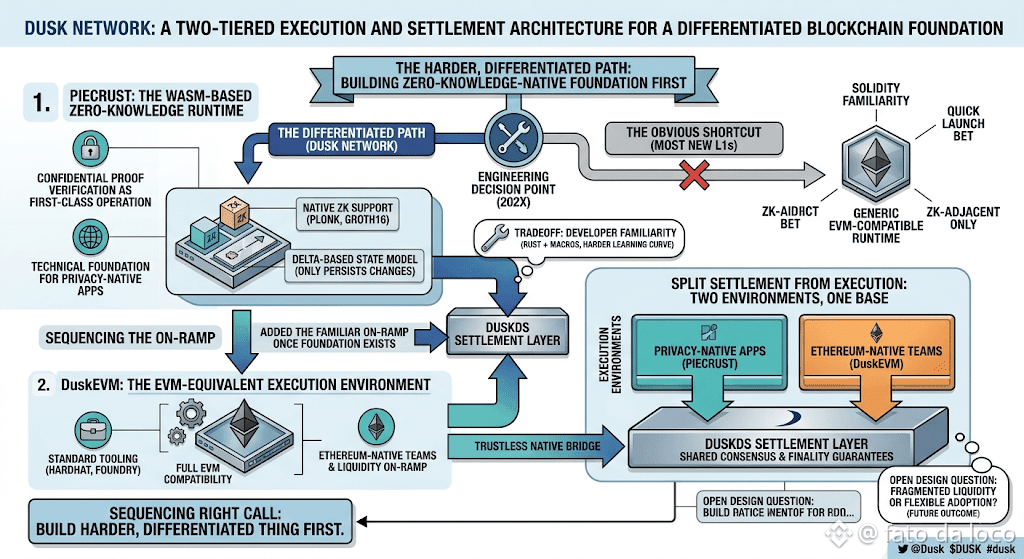
When Dusk Network's engineers had to decide how contracts would actually execute, they didn't reach for the obvious shortcut. Most new Layer-1s launched in the last few years shipped EVM-compatible from day 1, betting that Solidity familiarity would outweigh any technical cost. Dusk Network built its own virtual machine first: Piecrust, a WASM-based runtime with native support for zero-knowledge operations like PLONK and Groth16 verification, plus a delta-based state model that only persists what actually changed instead of rewriting full state every block.
That's a harder, slower path. It's also the only path that let Dusk Network's contracts be zero-knowledge-native rather than zero-knowledge-adjacent, since standard EVM environments weren't designed with confidential proof verification as a first-class operation. The tradeoff was developer familiarity: most engineers know Solidity, far fewer know Rust plus Dusk Network's contract macros, and that's a real cost the team accepted knowingly.
What's interesting is that Dusk Network didn't stay married to that tradeoff forever. DuskEVM arrived as a second execution environment, fully EVM-equivalent, settling to the same underlying DuskDS layer that Piecrust-based contracts use, with a trustless native bridge and standard tooling developers already know. Rather than picking 1 execution model and forcing every use case through it, Dusk Network split settlement from execution entirely, letting privacy-native applications live on Piecrust and Ethereum-native teams live on DuskEVM, both inheriting the same consensus and finality guarantees underneath.
I think that sequencing was the right call: build the harder, more differentiated thing first, add the familiar on-ramp once the foundation exists. Whether 2 execution environments fragment liquidity and attention instead of adding flexibility is still an open design question nobody outside Dusk Network can fully answer yet.
#dusk $DUSK @Dusk
That's a harder, slower path. It's also the only path that let Dusk Network's contracts be zero-knowledge-native rather than zero-knowledge-adjacent, since standard EVM environments weren't designed with confidential proof verification as a first-class operation. The tradeoff was developer familiarity: most engineers know Solidity, far fewer know Rust plus Dusk Network's contract macros, and that's a real cost the team accepted knowingly.
What's interesting is that Dusk Network didn't stay married to that tradeoff forever. DuskEVM arrived as a second execution environment, fully EVM-equivalent, settling to the same underlying DuskDS layer that Piecrust-based contracts use, with a trustless native bridge and standard tooling developers already know. Rather than picking 1 execution model and forcing every use case through it, Dusk Network split settlement from execution entirely, letting privacy-native applications live on Piecrust and Ethereum-native teams live on DuskEVM, both inheriting the same consensus and finality guarantees underneath.
I think that sequencing was the right call: build the harder, more differentiated thing first, add the familiar on-ramp once the foundation exists. Whether 2 execution environments fragment liquidity and attention instead of adding flexibility is still an open design question nobody outside Dusk Network can fully answer yet.
#dusk $DUSK @Dusk