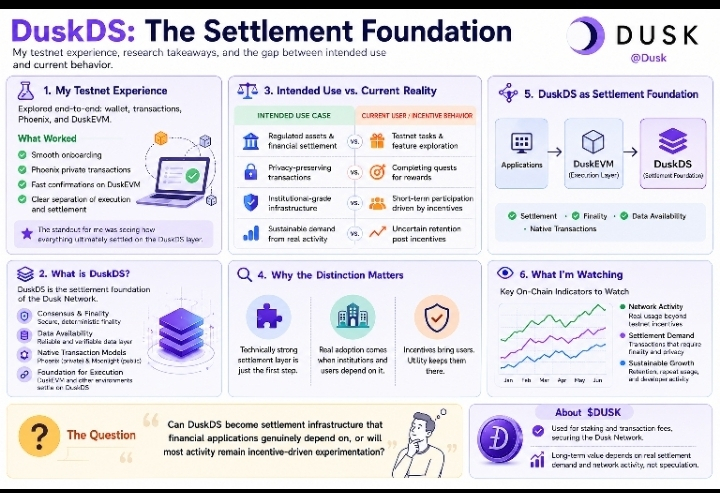
I started looking at @Dusk differently after spending more time inside its testnet.
Initially, I thought the interesting question was whether transactions worked and whether the application layer felt usable.
Then I started paying attention to what was happening underneath.
That’s where DuskDS became more interesting to me.
I think of DuskDS as the settlement layer holding the rest of the stack together: consensus, finality, data availability, and native transaction infrastructure.
DuskEVM can then sit above that foundation rather than having every application reinvent the mechanics of reliable settlement. #dusk .
It reminded me of a railway network.
Passengers notice the trains. They rarely think about the tracks, signaling, or switching systems underneath.
But when those systems work properly, the whole thing feels boring—which, for settlement infrastructure, is probably a compliment. 😄
Still, I’m cautious about what testnet activity actually proves.
People completing tasks, experimenting with features, or chasing incentives tells me there is curiosity.
It doesn’t necessarily tell me there is durable demand.
The harder question is what happens when the rewards disappear.
For regulated assets and confidential financial applications, settlement cannot depend on people showing up because there’s an incentive campaign.
The infrastructure has to become useful enough that applications need it even when nobody is handing out points.
That’s also how I’m thinking about $DUSK . Fees and staking create network utility, but long-term relevance should come from actual economic activity settling through the network.
So I’m watching one thing closely:
When the testnet incentives fade, does DuskDS still give financial applications a reason to stay?
Initially, I thought the interesting question was whether transactions worked and whether the application layer felt usable.
Then I started paying attention to what was happening underneath.
That’s where DuskDS became more interesting to me.
I think of DuskDS as the settlement layer holding the rest of the stack together: consensus, finality, data availability, and native transaction infrastructure.
DuskEVM can then sit above that foundation rather than having every application reinvent the mechanics of reliable settlement. #dusk .
It reminded me of a railway network.
Passengers notice the trains. They rarely think about the tracks, signaling, or switching systems underneath.
But when those systems work properly, the whole thing feels boring—which, for settlement infrastructure, is probably a compliment. 😄
Still, I’m cautious about what testnet activity actually proves.
People completing tasks, experimenting with features, or chasing incentives tells me there is curiosity.
It doesn’t necessarily tell me there is durable demand.
The harder question is what happens when the rewards disappear.
For regulated assets and confidential financial applications, settlement cannot depend on people showing up because there’s an incentive campaign.
The infrastructure has to become useful enough that applications need it even when nobody is handing out points.
That’s also how I’m thinking about $DUSK . Fees and staking create network utility, but long-term relevance should come from actual economic activity settling through the network.
So I’m watching one thing closely:
When the testnet incentives fade, does DuskDS still give financial applications a reason to stay?