I’ve started looking at Dusk’s security work from a different angle: not simply whether vulnerabilities exist, but how effectively the network can turn security findings into structural improvements.
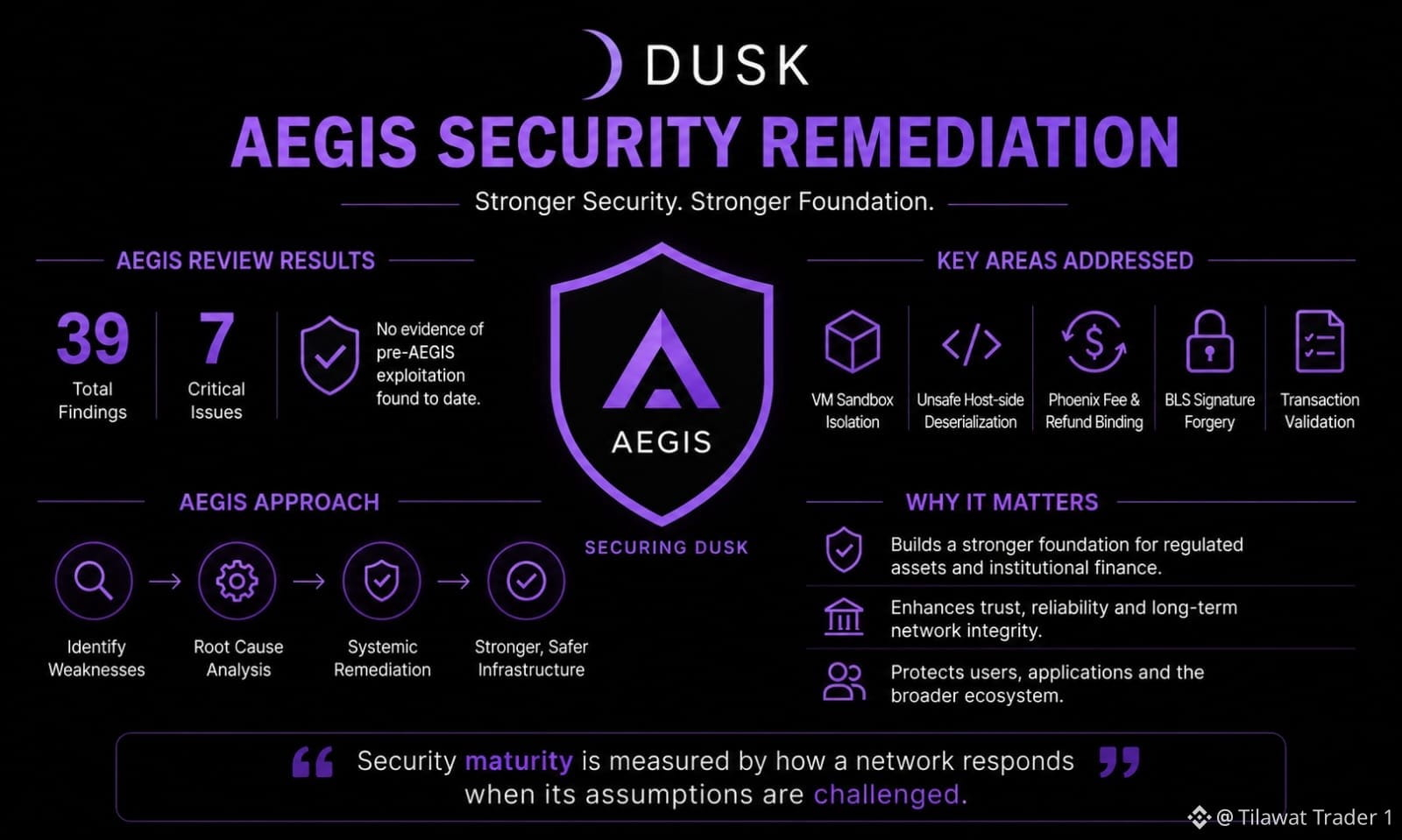
Dusk’s AEGIS remediation is interesting in that context. The review identified 39 findings, including 7 critical issues, across areas such as VM sandboxing, deserialization, transaction validation, cryptographic handling, and Phoenix-related fee logic. Dusk says the remediation addressed these issues at the root level rather than treating them only as isolated patches.
That distinction matters for financial infrastructure.
A protocol designed to support regulated assets can’t treat security as a one-time audit milestone. Its execution environment, consensus validation and transaction logic all need to remain resilient as the system becomes more complex.
The signal I’d therefore watch is what happens after the remediation.
Do future upgrades preserve the stronger security boundaries? Does the network maintain rigorous testing as new execution environments and applications are introduced? And can Dusk demonstrate that its security process scales alongside the protocol rather than reacting only after problems are discovered?
There’s also an important limitation: fixing identified vulnerabilities doesn’t prove that an entire protocol is permanently secure. New attack surfaces can emerge as architecture, integrations and usage evolve.
“Security maturity is measured by how a network responds when its assumptions are challenged.”
For Dusk, AEGIS may ultimately matter less as a list of vulnerabilities and more as a test of whether its engineering discipline can keep pace with its ambition to become financial infrastructure.
#dusk $DUSK @Dusk $GPS $TUT
Dusk’s AEGIS remediation is interesting in that context. The review identified 39 findings, including 7 critical issues, across areas such as VM sandboxing, deserialization, transaction validation, cryptographic handling, and Phoenix-related fee logic. Dusk says the remediation addressed these issues at the root level rather than treating them only as isolated patches.
That distinction matters for financial infrastructure.
A protocol designed to support regulated assets can’t treat security as a one-time audit milestone. Its execution environment, consensus validation and transaction logic all need to remain resilient as the system becomes more complex.
The signal I’d therefore watch is what happens after the remediation.
Do future upgrades preserve the stronger security boundaries? Does the network maintain rigorous testing as new execution environments and applications are introduced? And can Dusk demonstrate that its security process scales alongside the protocol rather than reacting only after problems are discovered?
There’s also an important limitation: fixing identified vulnerabilities doesn’t prove that an entire protocol is permanently secure. New attack surfaces can emerge as architecture, integrations and usage evolve.
“Security maturity is measured by how a network responds when its assumptions are challenged.”
For Dusk, AEGIS may ultimately matter less as a list of vulnerabilities and more as a test of whether its engineering discipline can keep pace with its ambition to become financial infrastructure.
#dusk $DUSK @Dusk $GPS $TUT