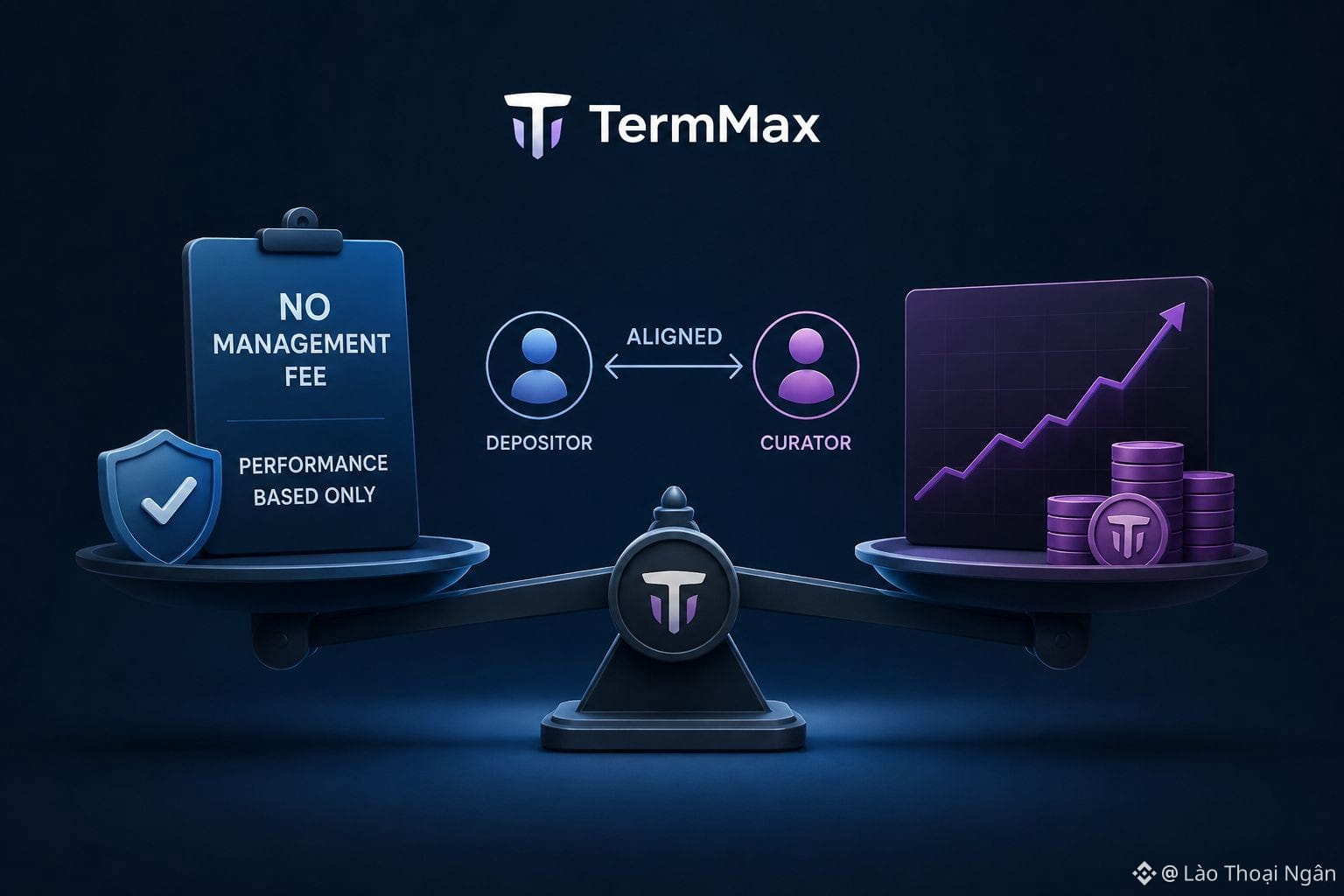
TermMax doesn't charge its curators a management fee. Read that sentence twice, because in an industry where vault managers often collect a cut regardless of performance, a purely performance based curator model is a genuinely uncommon choice, and TermMax's documentation states it plainly as a deliberate one.
The pitch is straightforward: a curator only earns when the vault earns, so a curator's interests point the same direction as a depositor's. No fee floor, no guaranteed paycheck for mediocre allocation. On paper that's about as aligned as incentive design gets in decentralized finance.
The part that pitch leaves out is simple too. Performance based pay doesn't just reward good judgment, it also rewards whoever is willing to reach further for yield when markets compress. A curator competing against other TermMax vaults for depositor capital has a real incentive to place range orders at tighter spreads or push into newer, less battle tested collateral types to keep advertised returns competitive, because a vault with mediocre numbers loses deposits to one with better numbers, fee structure aside.
TermMax's own risk disclosures acknowledge curator dependency directly: performance relies entirely on a curator's expertise, and there's no guarantee of positive returns. That's an honest admission sitting right next to a compensation model built to sharpen exactly that dependency. The asymmetric timelock TermMax uses, instant application for risk reducing changes and a delay for risk increasing ones, reads like a direct response to this exact tension, a guardrail against a curator moving too fast in the wrong direction.
The takeaway isn't that the model is broken. It's that "no management fee" describes alignment, not safety, and a depositor picking a vault should look at a curator's actual track record and risk parameters rather than assume the fee structure alone did the vetting for them.
@TermMax #TermMax $BTW $VELVET $PORTAL
The pitch is straightforward: a curator only earns when the vault earns, so a curator's interests point the same direction as a depositor's. No fee floor, no guaranteed paycheck for mediocre allocation. On paper that's about as aligned as incentive design gets in decentralized finance.
The part that pitch leaves out is simple too. Performance based pay doesn't just reward good judgment, it also rewards whoever is willing to reach further for yield when markets compress. A curator competing against other TermMax vaults for depositor capital has a real incentive to place range orders at tighter spreads or push into newer, less battle tested collateral types to keep advertised returns competitive, because a vault with mediocre numbers loses deposits to one with better numbers, fee structure aside.
TermMax's own risk disclosures acknowledge curator dependency directly: performance relies entirely on a curator's expertise, and there's no guarantee of positive returns. That's an honest admission sitting right next to a compensation model built to sharpen exactly that dependency. The asymmetric timelock TermMax uses, instant application for risk reducing changes and a delay for risk increasing ones, reads like a direct response to this exact tension, a guardrail against a curator moving too fast in the wrong direction.
The takeaway isn't that the model is broken. It's that "no management fee" describes alignment, not safety, and a depositor picking a vault should look at a curator's actual track record and risk parameters rather than assume the fee structure alone did the vetting for them.
@TermMax #TermMax $BTW $VELVET $PORTAL