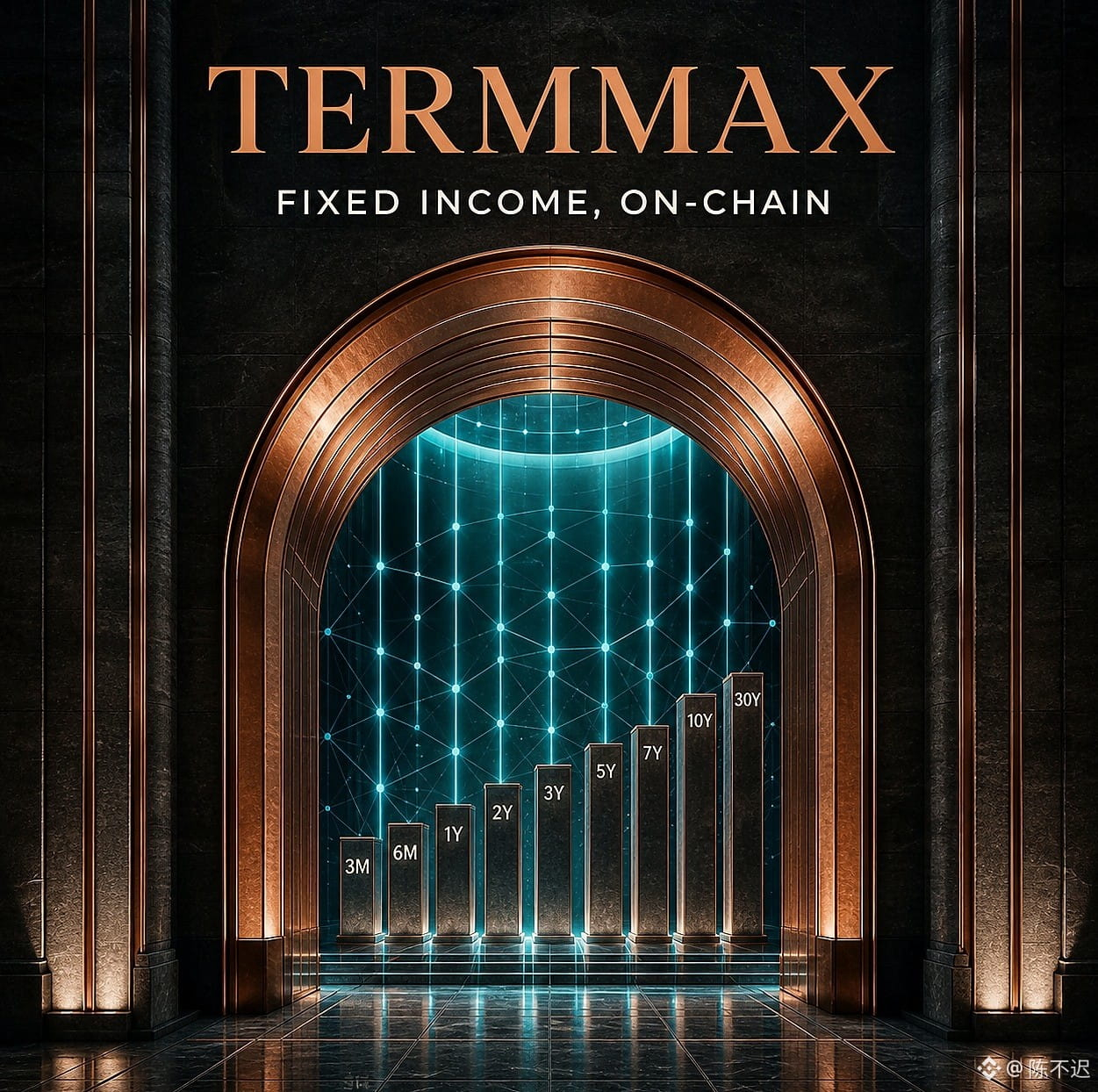
Over the past couple of days, I followed through the fixed-rate tokenization docs for @TermMax , and only then did I realize it’s not as simple as “locking the lending pool’s interest rate.” In each market, the protocol first pins down three things: what debt assets are borrowed, what collateral is posted, and what the maturity date is. After the borrower locks the collateral, they receive the GT that records the position, and then they mint the FT. Only by selling the FT at a discount do they obtain the liquidity in front of them. In other words, the rate isn’t just one APY line written in the backend—it’s the discount that the FT trades at relative to its face value at maturity.
The easiest piece to overlook in the middle is XT. The documentation lays the relationship out pretty plainly: 1 FT + 1 XT corresponds to 1 unit of debt asset. After maturity, the FT can be redeemed for the face value, and the XT goes to zero. GT isn’t a normal receipt either—it’s an ERC-721 position token, and it contains the collateral and the debt. The borrower can repay using the debt asset, or they can also buy back the FT to settle and close the position. With this breakdown, borrowing, lending, and leverage can all be compressed into a few layers of token trades—but users also need to understand when each of the three assets is actually worth something.
So I don’t really agree with the marketing line that “fixed rates are simpler.” #TermMax is truly doing something different: it replaces interest-rate uncertainty with structural complexity. Returns and costs become more predictable, but the trade-off is that you have to understand the maturity date, the FT discount, and the health of the GT—you can’t just stare at one APR. Whether this exchange is worth it depends on what users fear more: floating rates, or not understanding the three-tier token setup. Would you pick a familiar floating-rate pool, or are you willing to learn an extra structure for a known time horizon?
$ETH $STAR
The easiest piece to overlook in the middle is XT. The documentation lays the relationship out pretty plainly: 1 FT + 1 XT corresponds to 1 unit of debt asset. After maturity, the FT can be redeemed for the face value, and the XT goes to zero. GT isn’t a normal receipt either—it’s an ERC-721 position token, and it contains the collateral and the debt. The borrower can repay using the debt asset, or they can also buy back the FT to settle and close the position. With this breakdown, borrowing, lending, and leverage can all be compressed into a few layers of token trades—but users also need to understand when each of the three assets is actually worth something.
So I don’t really agree with the marketing line that “fixed rates are simpler.” #TermMax is truly doing something different: it replaces interest-rate uncertainty with structural complexity. Returns and costs become more predictable, but the trade-off is that you have to understand the maturity date, the FT discount, and the health of the GT—you can’t just stare at one APR. Whether this exchange is worth it depends on what users fear more: floating rates, or not understanding the three-tier token setup. Would you pick a familiar floating-rate pool, or are you willing to learn an extra structure for a known time horizon?
$ETH $STAR