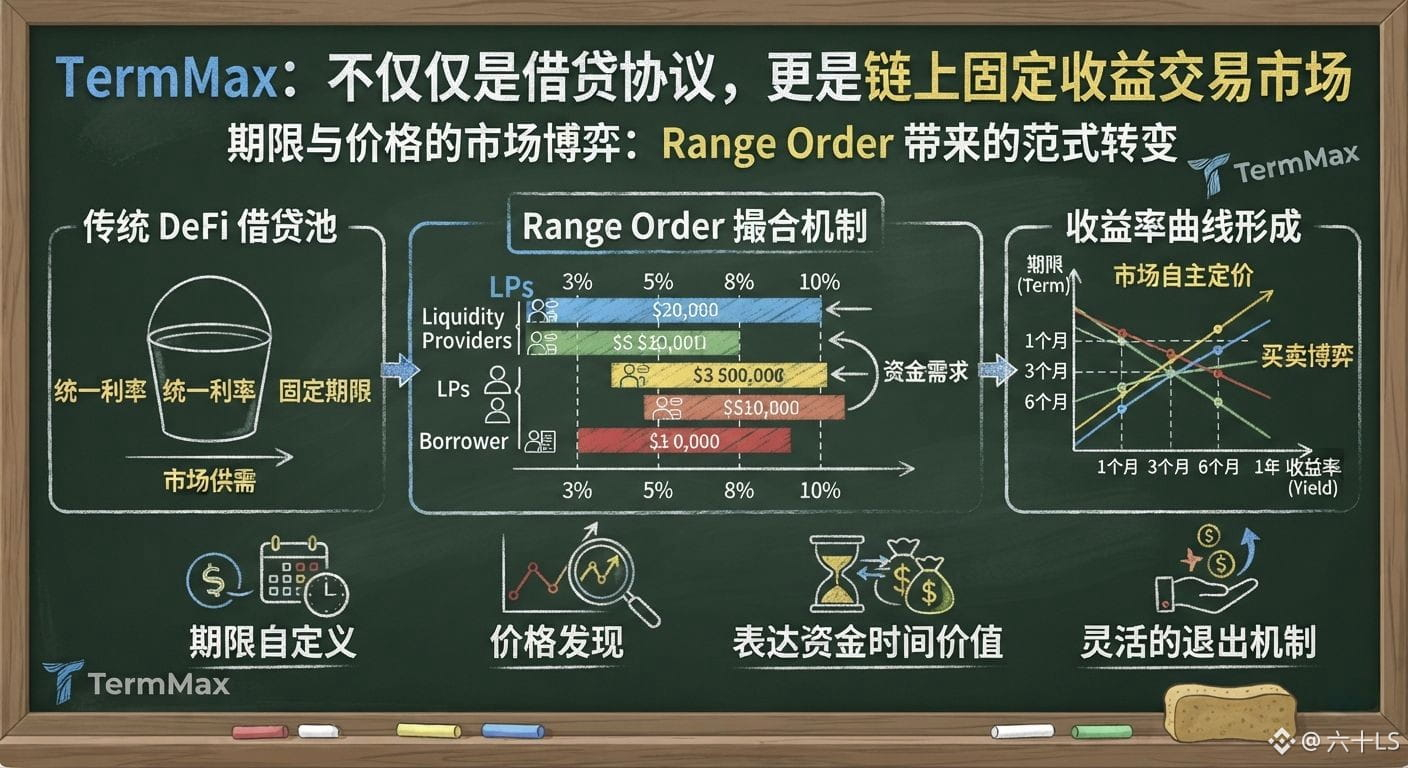

I’m starting to think that what TermMax really wants to do isn’t “lending and borrowing.”
Recently I’ve been researching @TermMax , and the more I look at it, the more I feel that if you only understand it as a fixed-rate lending protocol, you’re underestimating it a bit.
Traditional DeFi lending is relatively straightforward: funds go into a pool, borrowers take out loans, and the interest rate changes based on supply and demand. Convenient as it is, for people who want precise control over returns and terms, the choices aren’t that great.
What’s interesting about TermMax is that it gives “term” and “price” much more control to market participants themselves.
Lenders don’t have to accept a uniform interest rate set by the protocol—they can place orders based on the return rate and maturity time they’re willing to accept.
Borrowers, likewise, aren’t limited to simply choosing how much to borrow; they can also look for an appropriate term and rate based on their funding costs.
So I’m more inclined to think of it now as an on-chain fixed-income trading market.
Especially the Range Order.
It’s not just about posting a price. It provides liquidity providers with a range of interest rates, letting funds participate in matching within a certain interval.
That way, the market won’t have just one fixed answer.
As capital keeps flowing in and out and trades keep happening, prices will gradually form their own distribution, and participants will continuously adjust based on term, return, and risk.
This is somewhat similar to traditional financial markets, where buy-sell competition shapes the yield curve.
And for strategy players, what really matters has never been only whether the APY is high or not—it’s:
How long does that return correspond to?
What risks are being taken?
After interest rates move, can the capital still exit flexibly?
In the end, these questions will all show up in the market price.
So right now I care more about whether TermMax has the opportunity to become an on-chain “interest-rate market.”
If in the future stablecoins, RWA, and other assets all have mature maturity/term markets, what users will need won’t be just a lending pool, but a set of trading tools that can express the time value of money.
What TermMax is doing today—at least to some extent—is bringing that process onto the blockchain.
A mature fixed-income market shouldn’t have only one APY; it should allow the market to form its own prices.
That might be the part of TermMax that’s most worth paying attention to.#termmax
Recently I’ve been researching @TermMax , and the more I look at it, the more I feel that if you only understand it as a fixed-rate lending protocol, you’re underestimating it a bit.
Traditional DeFi lending is relatively straightforward: funds go into a pool, borrowers take out loans, and the interest rate changes based on supply and demand. Convenient as it is, for people who want precise control over returns and terms, the choices aren’t that great.
What’s interesting about TermMax is that it gives “term” and “price” much more control to market participants themselves.
Lenders don’t have to accept a uniform interest rate set by the protocol—they can place orders based on the return rate and maturity time they’re willing to accept.
Borrowers, likewise, aren’t limited to simply choosing how much to borrow; they can also look for an appropriate term and rate based on their funding costs.
So I’m more inclined to think of it now as an on-chain fixed-income trading market.
Especially the Range Order.
It’s not just about posting a price. It provides liquidity providers with a range of interest rates, letting funds participate in matching within a certain interval.
That way, the market won’t have just one fixed answer.
As capital keeps flowing in and out and trades keep happening, prices will gradually form their own distribution, and participants will continuously adjust based on term, return, and risk.
This is somewhat similar to traditional financial markets, where buy-sell competition shapes the yield curve.
And for strategy players, what really matters has never been only whether the APY is high or not—it’s:
How long does that return correspond to?
What risks are being taken?
After interest rates move, can the capital still exit flexibly?
In the end, these questions will all show up in the market price.
So right now I care more about whether TermMax has the opportunity to become an on-chain “interest-rate market.”
If in the future stablecoins, RWA, and other assets all have mature maturity/term markets, what users will need won’t be just a lending pool, but a set of trading tools that can express the time value of money.
What TermMax is doing today—at least to some extent—is bringing that process onto the blockchain.
A mature fixed-income market shouldn’t have only one APY; it should allow the market to form its own prices.
That might be the part of TermMax that’s most worth paying attention to.#termmax