A few days ago I picked up an old optical instrument at a secondhand market—half of it was already disassembled. On the inside of the casing there were yellowed sticky notes, and the core calibration module is still being debugged in the lab. The basic parts can rotate, but the piece that truly locks in precision hasn’t been separated into its own unit yet. Staring at this, I suddenly feel it’s quite similar to Dusk’s current situation.
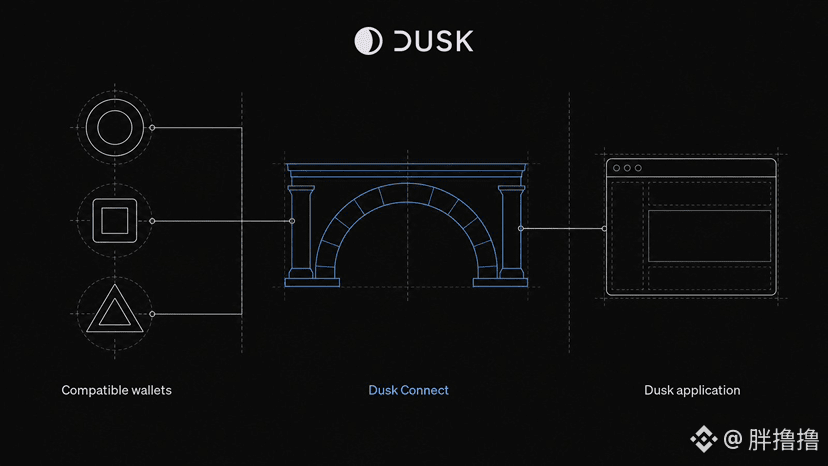
In Dusk’s three-layer architecture, DuskDS handles consensus settlement, DuskEVM provides Ethereum-compatible execution, and DuskVM is the native privacy execution layer. But DuskVM is still “coming soon.” The Piecrust virtual machine that was originally embedded in DuskDS (@Dusk ) hasn’t been extracted into an independent third layer. DuskDS is already running, DuskEVM has just gone live, and only DuskVM lacks a public timeline. This layer is the key. Zedger runs on DuskDS, Hedger runs on DuskEVM, and both native privacy contracts and the Phoenix transaction model have to wait for DuskVM to become independent before they can be used end-to-end. For now, truly high-privacy applications can’t be deployed. The Rust-based scenarios that rely on top-tier zero-knowledge proofs can only keep waiting. The internal team leads the effort, Lumos assists with infrastructure—outsiders can’t see a clear schedule. After six years, the first two layers are live. NPEX has completed three hundred million euros worth of security tokenization, and Chainlink’s CCIP has also been connected. DUSK’s market cap is around a little over twenty-six million USD, down more than 90% from its peak. $DUSK The full privacy capability that originally attracted institutions still has to wait for DuskVM. I only look for one signal: whether there’s a publicly announced go-live timeline. If there is, the three-layer story can be wrapped up; if not, the first two layers will keep turning while the most crucial layer is still “about to be.” #dusk Some people think DuskEVM is already attractive enough for developers, and that DuskVM is just an upgrade—eventually it won’t matter either way. Others say without it, native privacy contracts can’t be deployed, and the core differentiation still hasn’t truly launched. Which side do you believe more? Not investment advice—trading involves risk. Do your own research. $BTC
In Dusk’s three-layer architecture, DuskDS handles consensus settlement, DuskEVM provides Ethereum-compatible execution, and DuskVM is the native privacy execution layer. But DuskVM is still “coming soon.” The Piecrust virtual machine that was originally embedded in DuskDS (@Dusk ) hasn’t been extracted into an independent third layer. DuskDS is already running, DuskEVM has just gone live, and only DuskVM lacks a public timeline. This layer is the key. Zedger runs on DuskDS, Hedger runs on DuskEVM, and both native privacy contracts and the Phoenix transaction model have to wait for DuskVM to become independent before they can be used end-to-end. For now, truly high-privacy applications can’t be deployed. The Rust-based scenarios that rely on top-tier zero-knowledge proofs can only keep waiting. The internal team leads the effort, Lumos assists with infrastructure—outsiders can’t see a clear schedule. After six years, the first two layers are live. NPEX has completed three hundred million euros worth of security tokenization, and Chainlink’s CCIP has also been connected. DUSK’s market cap is around a little over twenty-six million USD, down more than 90% from its peak. $DUSK The full privacy capability that originally attracted institutions still has to wait for DuskVM. I only look for one signal: whether there’s a publicly announced go-live timeline. If there is, the three-layer story can be wrapped up; if not, the first two layers will keep turning while the most crucial layer is still “about to be.” #dusk Some people think DuskEVM is already attractive enough for developers, and that DuskVM is just an upgrade—eventually it won’t matter either way. Others say without it, native privacy contracts can’t be deployed, and the core differentiation still hasn’t truly launched. Which side do you believe more? Not investment advice—trading involves risk. Do your own research. $BTC