I spent three days researching TermMax, and in the end I just used 1,000 USDC to buy an FT in its V2 market—reading the documentation ten times is no match for paying once in tuition.
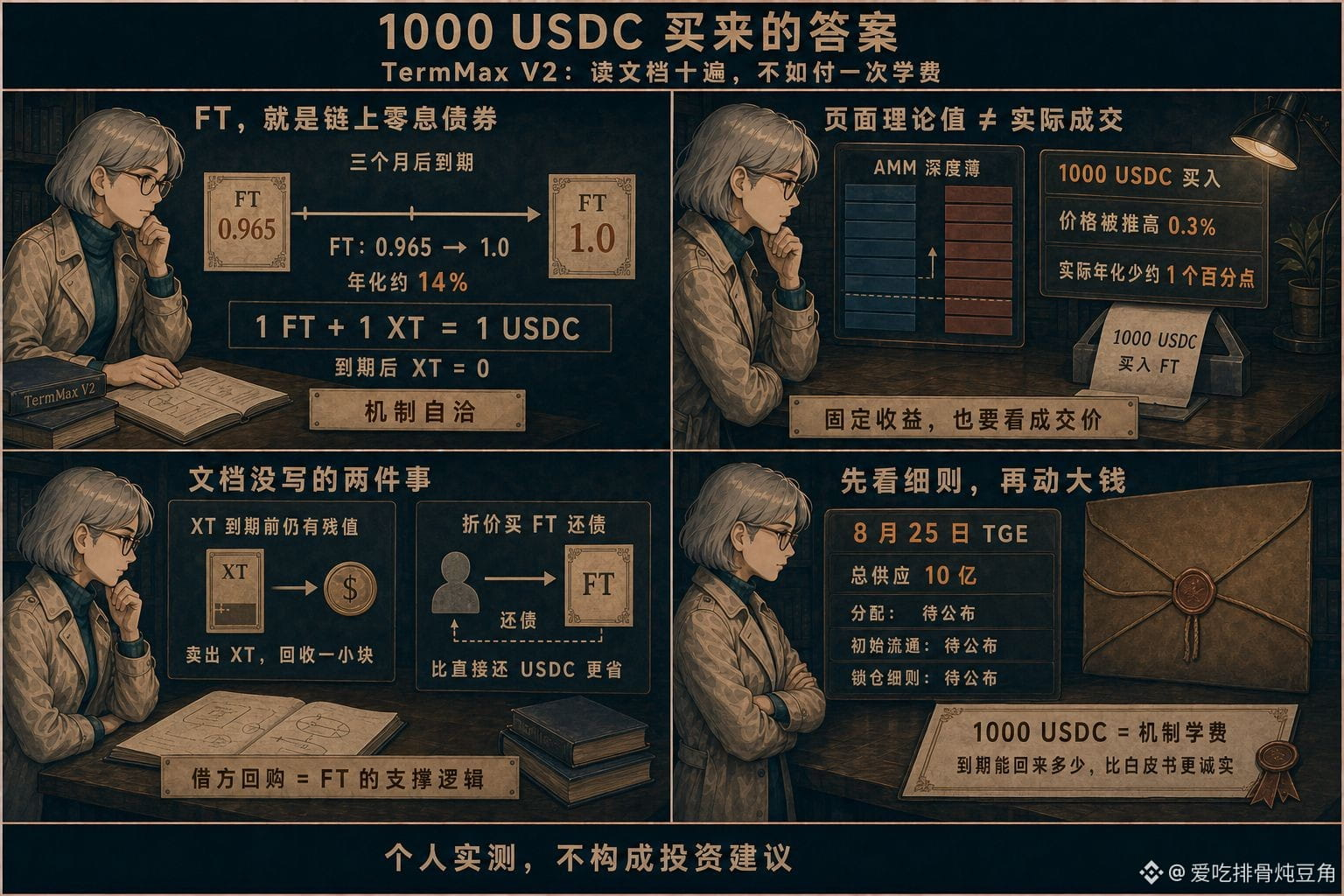
First, here are the things I confirmed at the mechanism level: TermMax’s FT is an on-chain zero-coupon bond. For example, in a USDC market that matures in three months, the FT is priced at 0.965; when it matures, it redeems for 1.0, and the annualized yield is around 14%. The accompanying XT is responsible for making up the difference, ensuring that at any moment 1 FT + 1 XT = 1 USDC. After maturity, XT goes to zero. This design logic is internally consistent, and the documents explain it clearly.
However, when I actually bought, I found three mismatches between the documentation and reality. First, the “fixed income” shown on the page is calculated using the FT face value as a theoretical value, while the FT price is determined by the AMM. In V2’s USDC market, the order book is very thin—my 1,000u entry pushed the price up by 0.3%, so the actual annualized yield was about one percentage point lower than what the page suggested. Second, XT isn’t junk—before maturity it still has residual value. I casually listed and sold the paired XT, and recovered a small amount; the documentation doesn’t mention this at all. Third, the most subtle part is the lender-borrower perspective: when repaying, it’s cheaper to buy FT at a market discount to settle than to repay USDC directly. So there’s a “borrower buyback” support logic embedded in the FT price for the long term—this is also the core game within this market.
Back to TMX itself: August 25 is the TGE. Total supply is 1 billion, but the allocation, initial circulation, and the vesting/lockup details still haven’t been released. After the lesson from DUSK, I’m not in a rush to move big money before these numbers come out. Once the details are published, I’ll compare the initial circulation ratio and the release curve, then decide. Until then, the 1,000 USDC worth of FT is the tuition I paid for understanding this entire mechanism—how much it can return at maturity is honest, more so than any whitepaper.
@TermMax #TermMax
First, here are the things I confirmed at the mechanism level: TermMax’s FT is an on-chain zero-coupon bond. For example, in a USDC market that matures in three months, the FT is priced at 0.965; when it matures, it redeems for 1.0, and the annualized yield is around 14%. The accompanying XT is responsible for making up the difference, ensuring that at any moment 1 FT + 1 XT = 1 USDC. After maturity, XT goes to zero. This design logic is internally consistent, and the documents explain it clearly.
However, when I actually bought, I found three mismatches between the documentation and reality. First, the “fixed income” shown on the page is calculated using the FT face value as a theoretical value, while the FT price is determined by the AMM. In V2’s USDC market, the order book is very thin—my 1,000u entry pushed the price up by 0.3%, so the actual annualized yield was about one percentage point lower than what the page suggested. Second, XT isn’t junk—before maturity it still has residual value. I casually listed and sold the paired XT, and recovered a small amount; the documentation doesn’t mention this at all. Third, the most subtle part is the lender-borrower perspective: when repaying, it’s cheaper to buy FT at a market discount to settle than to repay USDC directly. So there’s a “borrower buyback” support logic embedded in the FT price for the long term—this is also the core game within this market.
Back to TMX itself: August 25 is the TGE. Total supply is 1 billion, but the allocation, initial circulation, and the vesting/lockup details still haven’t been released. After the lesson from DUSK, I’m not in a rush to move big money before these numbers come out. Once the details are published, I’ll compare the initial circulation ratio and the release curve, then decide. Until then, the 1,000 USDC worth of FT is the tuition I paid for understanding this entire mechanism—how much it can return at maturity is honest, more so than any whitepaper.
@TermMax #TermMax