Revisit @TermMax —at first I just wanted to figure out why it had to use a fixed interest rate. But once I took the materials apart, what’s really worth stopping to look at isn’t the outcome of “fixed income” itself; it’s the way it restructures the interest rate market across the chain.#TermMax
DeFi lending in the past has already shown that capital can flow on-chain, but interest rates always move with the market. Users are therefore facing volatile funding costs, making it difficult to plan certainty in advance. What’s interesting about TermMax is that it didn’t stop at the fixed-income product itself; instead, it re-examines the relationship between maturity, interest rates, and the debt structure.
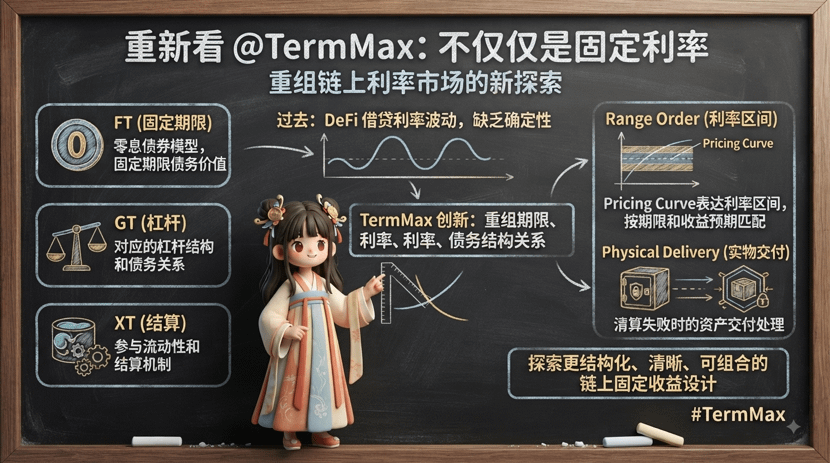
The part that takes the most time to compare is the relationship among FT, GT, and XT. FT is the debt value under a fixed term, similar to a zero-coupon bond in traditional finance. But TermMax isn’t simply copying a bond model. In the borrowing process, different asset structures each take on different roles—fixed-term debt, leverage relationships, and value conversion within the protocol.
Borrowers mint and sell FT to obtain liquidity. GT represents the corresponding leverage structure and debt relationship, while XT participates in the protocol’s liquidity and settlement mechanisms. Only after seeing this did I realize that what TermMax is solving isn’t merely “issuing a fixed-income token,” but rather reconfiguring the value relationships within the fixed-income market.
Range Order is another aspect I find particularly interesting. It uses a Pricing Curve to express an interest-rate range, allowing participants to match by maturity and yield expectations, rather than relying on pricing from a single liquidity pool.
Then there’s Physical Delivery. Under normal protocol operation, you can’t tell the difference. What the design tests is the edge case: when liquidation fails, TermMax enters the Physical Delivery process, handling the remaining debt via asset delivery—so the extreme path is thought through in advance.
When you put it all together, my understanding of TermMax shifts from “a fixed-rate protocol” to: it’s exploring a more structured on-chain fixed-income market design. It’s not only about how to make yields determinate—it’s also about whether future DeFi interest-rate markets can have clearer, composable ways of expressing themselves.
DeFi lending in the past has already shown that capital can flow on-chain, but interest rates always move with the market. Users are therefore facing volatile funding costs, making it difficult to plan certainty in advance. What’s interesting about TermMax is that it didn’t stop at the fixed-income product itself; instead, it re-examines the relationship between maturity, interest rates, and the debt structure.
The part that takes the most time to compare is the relationship among FT, GT, and XT. FT is the debt value under a fixed term, similar to a zero-coupon bond in traditional finance. But TermMax isn’t simply copying a bond model. In the borrowing process, different asset structures each take on different roles—fixed-term debt, leverage relationships, and value conversion within the protocol.
Borrowers mint and sell FT to obtain liquidity. GT represents the corresponding leverage structure and debt relationship, while XT participates in the protocol’s liquidity and settlement mechanisms. Only after seeing this did I realize that what TermMax is solving isn’t merely “issuing a fixed-income token,” but rather reconfiguring the value relationships within the fixed-income market.
Range Order is another aspect I find particularly interesting. It uses a Pricing Curve to express an interest-rate range, allowing participants to match by maturity and yield expectations, rather than relying on pricing from a single liquidity pool.
Then there’s Physical Delivery. Under normal protocol operation, you can’t tell the difference. What the design tests is the edge case: when liquidation fails, TermMax enters the Physical Delivery process, handling the remaining debt via asset delivery—so the extreme path is thought through in advance.
When you put it all together, my understanding of TermMax shifts from “a fixed-rate protocol” to: it’s exploring a more structured on-chain fixed-income market design. It’s not only about how to make yields determinate—it’s also about whether future DeFi interest-rate markets can have clearer, composable ways of expressing themselves.