After studying @Dusk for a while, I increasingly stopped thinking of it as "just another privacy project."
A lot of discussions eventually come down to "how to hide transactions." What really made me pause about Dusk was something different: it tries to answer whether, when regulated digital assets truly move on-chain, there can be a path that is not a binary choice between public verifiability, data protection, and programmable finance.
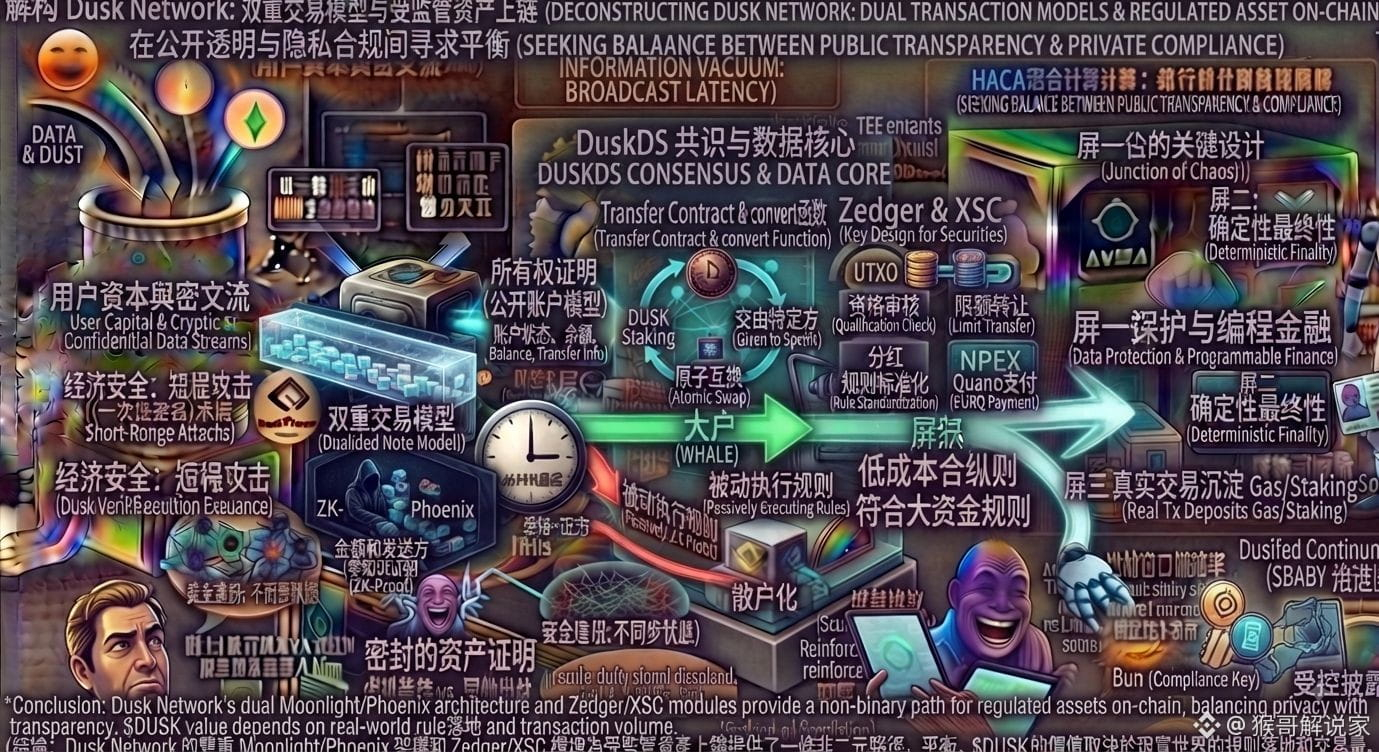
DuskDS natively supports two transaction models. Moonlight is a public account-based model, where account state, balances, and transfer information are visible; Phoenix is a shielded note model that uses zero-knowledge proofs to verify transaction validity, sufficient funds, and the absence of double spending, while not exposing amounts or senders. What is truly interesting is that they do not merely coexist in parallel: they can be atomically swapped through the Transfer Contract's convert function. Users only need to prove ownership of the account or address, and the process does not get stuck in an intermediate state. A viewing key turns disclosure into a controlled capability as well — not public by default, and only shared with specific parties when needed under the rules.
Further up the stack, Zedger and XSC are the key designs for securities. Zedger combines UTXO and account capabilities to handle compliance details such as eligibility checks, transfer limits, and dividends; XSC standardizes these rules. convert handles native token circulation, while Zedger/XSC handle securities compliance. They share the Phoenix underlying layer, but their responsibilities are different and should not be conflated.
Architecturally, DuskDS handles consensus, finality, and data availability; DuskVM runs Rust/WASM; and DuskEVM is compatible with the EVM toolchain. Succinct Attestation forms deterministic finality after Ratification, which is crucial for securities trading.
As a Dutch-licensed MTF, NPEX already has more than 200 million euros in financing scale and over 17,500 active investors. Dusk is working with it to explore bringing listed stocks and bonds on-chain, while Quantoz's EURQ complements MiCA-compliant euro payments. These partnerships cannot be taken as proof of demand by themselves, but they do provide a real testing ground.
So when I look at $DUSK now, I am no longer focused only on privacy technology, but on whether the rules can truly be implemented, and whether real trading activity can translate into gas and staking demand. The former determines whether the product can be used; the latter determines whether network value can remain.
#dusk $DUSK @Dusk
A lot of discussions eventually come down to "how to hide transactions." What really made me pause about Dusk was something different: it tries to answer whether, when regulated digital assets truly move on-chain, there can be a path that is not a binary choice between public verifiability, data protection, and programmable finance.
DuskDS natively supports two transaction models. Moonlight is a public account-based model, where account state, balances, and transfer information are visible; Phoenix is a shielded note model that uses zero-knowledge proofs to verify transaction validity, sufficient funds, and the absence of double spending, while not exposing amounts or senders. What is truly interesting is that they do not merely coexist in parallel: they can be atomically swapped through the Transfer Contract's convert function. Users only need to prove ownership of the account or address, and the process does not get stuck in an intermediate state. A viewing key turns disclosure into a controlled capability as well — not public by default, and only shared with specific parties when needed under the rules.
Further up the stack, Zedger and XSC are the key designs for securities. Zedger combines UTXO and account capabilities to handle compliance details such as eligibility checks, transfer limits, and dividends; XSC standardizes these rules. convert handles native token circulation, while Zedger/XSC handle securities compliance. They share the Phoenix underlying layer, but their responsibilities are different and should not be conflated.
Architecturally, DuskDS handles consensus, finality, and data availability; DuskVM runs Rust/WASM; and DuskEVM is compatible with the EVM toolchain. Succinct Attestation forms deterministic finality after Ratification, which is crucial for securities trading.
As a Dutch-licensed MTF, NPEX already has more than 200 million euros in financing scale and over 17,500 active investors. Dusk is working with it to explore bringing listed stocks and bonds on-chain, while Quantoz's EURQ complements MiCA-compliant euro payments. These partnerships cannot be taken as proof of demand by themselves, but they do provide a real testing ground.
So when I look at $DUSK now, I am no longer focused only on privacy technology, but on whether the rules can truly be implemented, and whether real trading activity can translate into gas and staking demand. The former determines whether the product can be used; the latter determines whether network value can remain.
#dusk $DUSK @Dusk