I assumed staking was simple by design: you lock $DUSK , run a node, and earn rewards. Looking closer at Dusk's Hyperstaking, that assumption didn't hold.
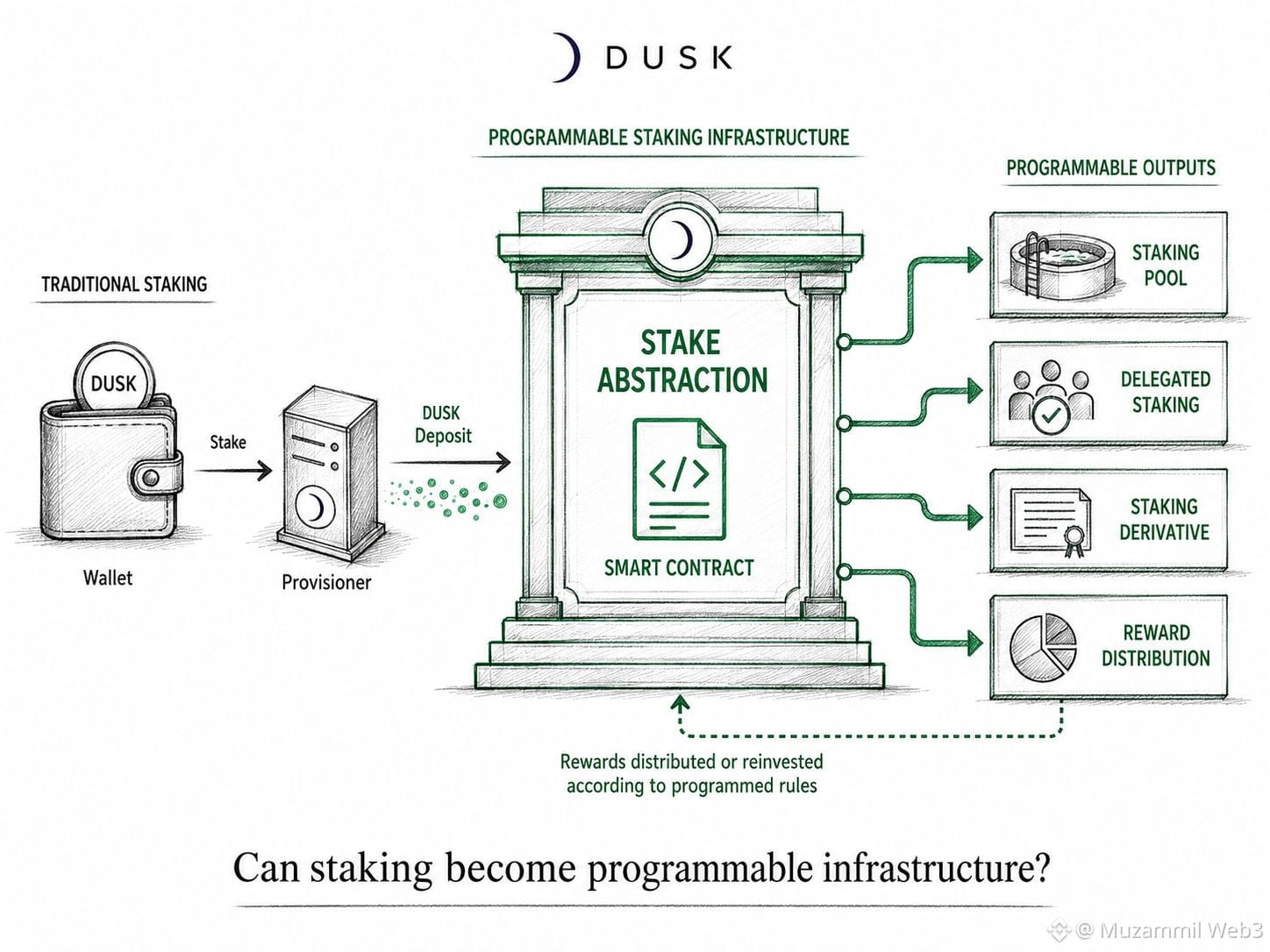
Dusk's own documentation describes Stake Abstraction as a way for smart contracts to participate in staking and manage rewards with on-chain logic. A contract can accept deposits, stake on behalf of depositors, and distribute or reinvest rewards according to its own rules.
That changed how I think about staking on Dusk. It isn't limited to an individual running a provisioner.
The staking layer can also support things like staking pools, delegated staking services, staking derivatives, and automated reward distribution.
What I find interesting is that the staking logic doesn't have to live entirely at the individual wallet level; Dusk's design allows smart contracts to handle parts of that process through on-chain logic.
I still don't know how much these models will matter as more applications start using them. But making staking programmable rather than purely wallet-driven is one of the parts of Dusk I want to keep watching.
@Dusk #dusk $DUSK
Dusk's own documentation describes Stake Abstraction as a way for smart contracts to participate in staking and manage rewards with on-chain logic. A contract can accept deposits, stake on behalf of depositors, and distribute or reinvest rewards according to its own rules.
That changed how I think about staking on Dusk. It isn't limited to an individual running a provisioner.
The staking layer can also support things like staking pools, delegated staking services, staking derivatives, and automated reward distribution.
What I find interesting is that the staking logic doesn't have to live entirely at the individual wallet level; Dusk's design allows smart contracts to handle parts of that process through on-chain logic.
I still don't know how much these models will matter as more applications start using them. But making staking programmable rather than purely wallet-driven is one of the parts of Dusk I want to keep watching.
@Dusk #dusk $DUSK