


Text|RedCan Network, Guo Jiaqiao
Editor|Jingxue
In 2013, Cha Yan Yue Se opened its first store in Changsha. With the boom of the new tea beverage industry, it gradually became a representative consumption symbol of Changsha, and many out-of-town consumers even made a special trip to Changsha just to check it out.
In those years, the market was all waiting for it to expand beyond Hunan.
But Cha Yan Yue Se stayed in Changsha for a “lie” of seven or eight years—until 2020, when it finally moved beyond Hunan and opened its first store in Wuhan. From Wuhan to Chongqing, and then to Nanjing and Wuxi, the pace of Cha Yan Yue Se’s store expansion has always been restrained. In China’s new tea market, it has even been somewhat slow.
However, this slow-moving company suddenly began to accelerate this year.
From the opening in Shenzhen in April to the official announcement of Guangzhou in July, the time gap is only 99 days. And these two cities happen to be the most brutal red ocean in tea beverage competition nationwide.
Among the top five cities by number of tea beverage shops nationwide, Guangzhou ranks first and Shenzhen second. Local brands have worked deeply for many years, and leading brands are all firmly in place. No matter how you look at it, it’s not an easy market to expand into.
A first-generation internet darling that once built nationwide recognition through geographic scarcity has proactively entered the core cities with the highest competition intensity—Tea颜悦色 is leaving its comfort zone. When it begins to face its rivals head-on, does it have a good chance of winning?
A conservative choice beneath the red ocean
First, let’s look at the latest officially announced first store in Guangzhou.
Rumor has it this store will be placed at Bai’e-tan Vientiane City, with an opening expected at the end of September. When asked about the reasons for entering Guangzhou, Tea颜悦色 said, “Guangzhou is the top battleground for tea beverage competition nationwide. We want to throw ourselves into this lively ‘high-level experts’ arena and see what our product strength and organizational strength are really like.”
The red ocean with the highest number of stores nationwide is tangled with local brands, and all out-of-town top players are already in place—no matter how you look at it, it’s not a comfort zone for expansion. But a supply-side red ocean doesn’t mean it’s a demand-side dead sea.
According to data from Guangzhou Daily, in 2025 Guangzhou’s “beverage and cold drinks service” revenue grew 22.8% year over year. It is the fastest-growing segment among catering consumption, with a growth rate significantly higher than the average for total retail sales of social consumer goods.
This means Guangzhou is not just a “zero-sum” stock cake; it’s a mature market where supply and demand both expand at the same time.
The demand base in the Shenzhen market is also solid. In a sense, Guangzhou and Shenzhen are also the “acid tests” for brands in the tea beverage industry with the highest gold content.
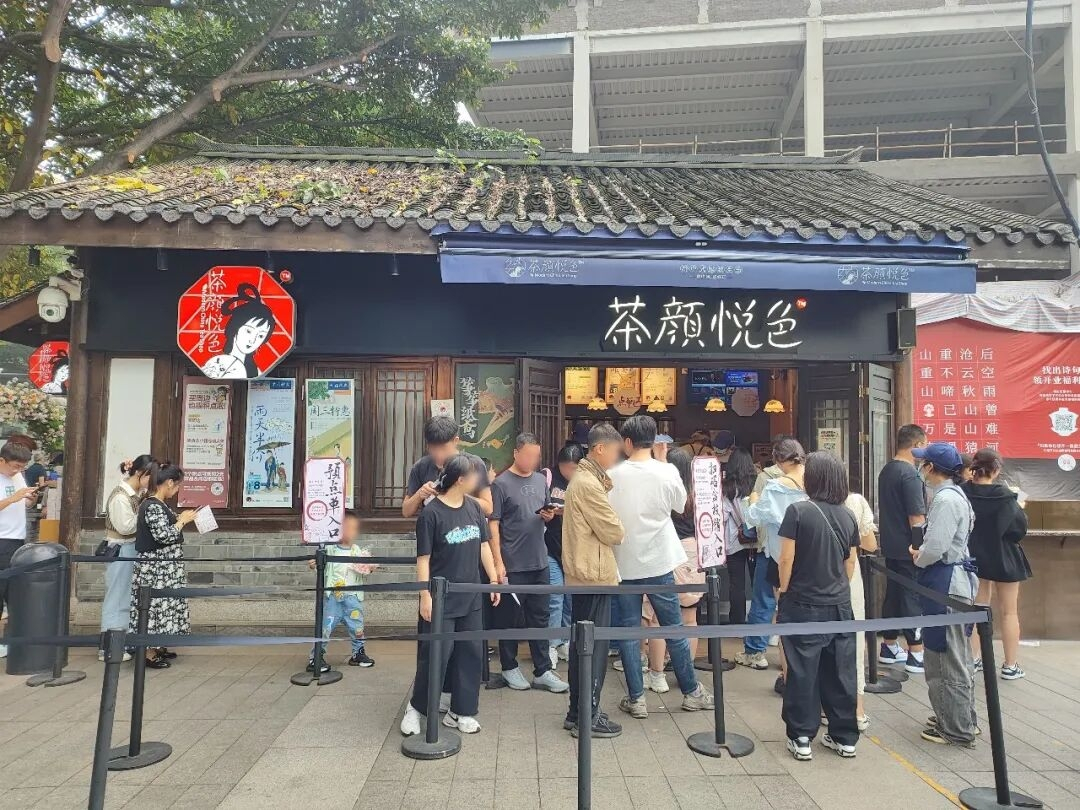
In these two cities, tea beverage category supply is extremely abundant. Sub-sectors such as fresh fruit tea, fresh milk tea, lemon tea, and regionally distinctive tea beverages all have mature players. Consumers have plenty of choice and low dependence on any single brand. The rate at which the novelty of viral hits fades is far faster than in lower-tier markets where information asymmetry is greater.
It isn’t a big deal to blow up in a single market just based on scarcity. If Tea颜悦色 wants to prove itself, it can only verify whether the brand recognition it built in Changsha can continue to deliver brand value in mature, high-tier cities in a market with full competition and transparent information. The conclusion would then have nationwide universality.
Also, back in January this year—before Tea颜悦色 had even officially announced its Shenzhen stores—recruitment platforms already listed a position for a Shenzhen warehouse supervisor. Clearly, this fully self-operated brand has already invested warehousing and city-management resources in Guangdong.
Shenzhen and Guangzhou are both in the Greater Bay Area. The logistics radius is short, and the supply-chain system can be directly reused. Quality-control fluctuations and logistics costs are far lower than expanding into entirely new provinces.
As for site selection, Tea颜悦色 also has its own logic. Take the first store in Guangzhou as an example: it is currently rumored that the store will be located at Bai’e-tan Vientiane City. Bai’e-tan Vientiane City is Guangzhou’s first Vientiane City, positioned as an M1-level ultra-luxury commercial complex and also a city-level flagship project that China Resources is building in Guangzhou. The mall plans to open at the end of September, which basically matches the Guangzhou store-opening timeframe announced by Tea颜悦色.

Many netizens complain that the place is “too far from the center.” Actually, it’s measured against Tianhe’s core business district as the yardstick for a new business district.
From an operating perspective, commercial projects in the core business district of Tianhe already have stable foot traffic, and rents fully reflect the value of a mature location. Brands such as Heytea, Nai Xue’s Tea, and Bawang Chaqi have been operating there for a long time; quality locations and consumers’ habits have long been established. If Tea颜悦色 enters, it needs to use higher costs to compete for a chunk of foot traffic that has already been fully diverted.
As for Bai’e-tan Vientiane City, it is in its opening-and-tenant-signup period. The first-store effect and the mall’s opening traffic are concentrated and released. On the one hand, Tea颜悦色 can reduce customer-acquisition spending in the early stage of entering Guangzhou. On the other hand, it also helps it avoid the most direct point-of-location competition with mature business districts in Tianhe.
The deeper logic is that Tea颜悦色 is tied to and replicates the China Resources (Huāruì) commercial system.
The two first stores that Tea颜悦色 opened in Shenzhen entered Shenzhen Bay Vientiane City and Nanshan Vientiane. After that, it also opened a store in Buji Vientiane Hui.
All three commercial projects are under China Resources Land (Huāruì Zhìdì) or operated by it. And Bai’e-tan Vientiane City is also within the China Resources commercial system.
After continuously entering multiple China Resources projects, Tea颜悦色 has formed a cooperative foundation with this commercial system. There are reusable experiences in store construction, opening coordination, and mall operations. Communication and execution costs are also lower than finding other commercial partners again.
Guangzhou and Shenzhen face fierce competition, but consumer demand has also been repeatedly validated through tens of thousands of tea beverage shops. For Tea颜悦色, this is a market that is expensive yet relatively easy to calculate.
There’s no remaining room to slow down.
“I’m more pessimistic. Either expansion kills us, or not expanding kills us. We feel that not expanding in this way is more dignified.” Lü Liang described the dilemma Tea颜悦色 faces when it comes to expansion like this.
For a long time, Tea颜悦色 really preferred the latter option.
But in recent years, Tea颜悦色 has changed.
On August 3, Tea颜悦色 opened two stores in Hefei at the same time. During the queueing for the two “Garden Party” themed stores, the waiting time at one point nearly reached 5 hours. The brand also said it plans to increase the number of local stores to 5 within the year.
Going further back, since the end of December 2024, Yichang, Huanggang, Changzhou, Ezhou, Yangzhou, Jingzhou, Taizhou, and Nantong have already entered Tea颜悦色’s expansion map one after another.
This kind of pace is not common in the more than ten-year expansion history of Tea颜悦色.
After it was founded in 2013, it took seven years to get out of Hunan. After entering Wuhan, it waited nearly two more years before opening stores in Chongqing and Nanjing. In the past, it would take one or two years to push outward one city. Now, it has started to develop multiple regions at the same time.
Behind the faster expansion is the fact that the space Hunan has left for Tea颜悦色 is becoming increasingly limited.
Undeniably, Changsha is still the market with the densest Tea颜悦色 store presence and the strongest brand awareness. But Tea颜悦色 has already gradually covered all 14 cities in Hunan. If it wants to add more stores in Hunan, it means either increasing density in existing business districts, or entering county-level markets with smaller capacity.
The former choice would cause diversion among stores, while the latter is hard to provide a high-enough revenue ceiling for a fully self-operated model.
In addition, over the past few years, Tea颜悦色 has also been trying to make the Changsha market “thicker.”
In 2022, Yuan Yang Coffee was launched. Then Gudemo Ningchai and Day and Night Poetry & Wine Tea opened as well. Coffee, lemon tea, and low-alcohol tea drinks almost covered the hottest directions in the beverage industry at the time.
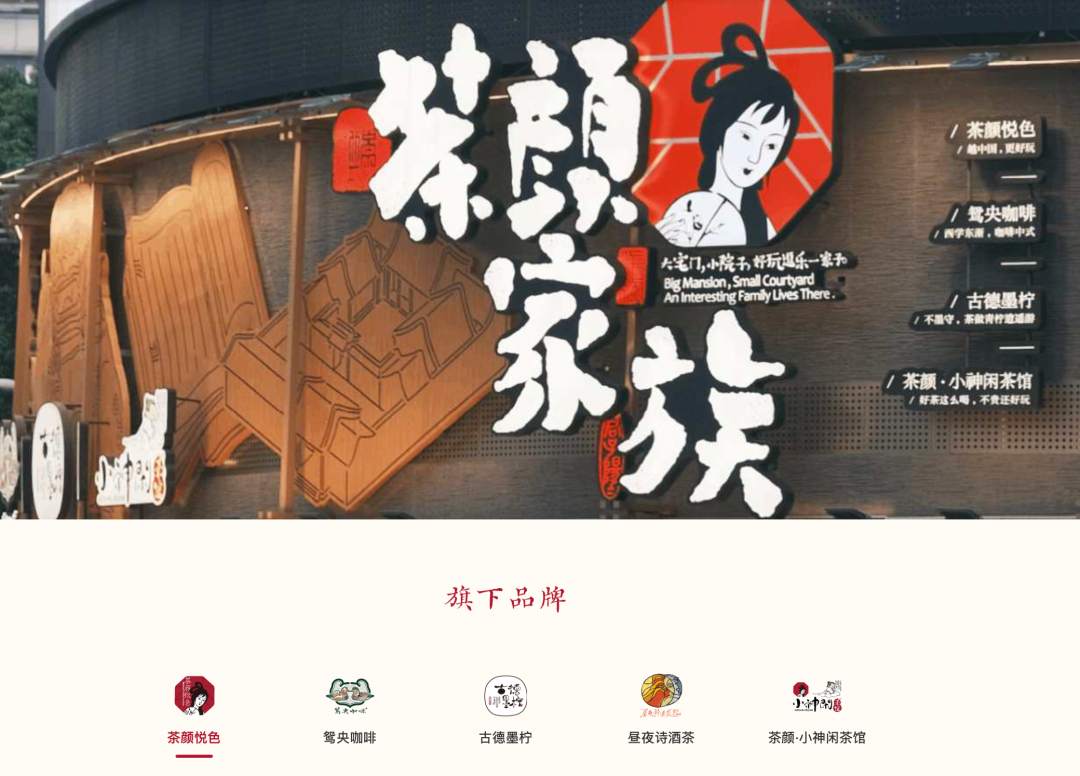
The sub-brand has borrowed Tea颜悦色’s membership system and brand traffic; its start-up speed isn’t slow. However, as of now, only Gudemo Ningchai has exceeded 100 stores, and the scale of Yuan Yang Coffee and Day and Night Poetry & Wine Tea remains limited. Together, the three have not yet moved beyond the Changsha market.
Since the sub-brand couldn’t take over the growth task, and the main brand moved into more provinces, it has gradually become an unavoidable choice.
Moreover, tea beverage competition in Hunan is also continuously intensifying. Brands like CoCo? (Actually “Guming/Gu Ming” is Gu Jin? Here: 古茗 = Guming; keep translated as Gu Ming) Gu Ming and Bawang Chaqi have been densifying their locations in Hunan in recent years, expanding from core business districts to community and county-level markets, directly diverting local daily consumption customers.
A few years ago, “Going to Changsha to queue up and drink Tea颜悦色” was still a standard item on many people’s travel lists. With geographic scarcity plus a viral halo, Tea颜悦色 became a true “city specialty,” and cross-city pre-ordering and queue-for-you services were once the norm. But now, as competitors’ locations continue to penetrate, this advantage is being gradually diluted.
On the product side, original-leaf tea was once the biggest advantage Tea颜悦色 used to build brand identity early on—an offering combining fresh-made tea bases, fresh milk, and a cream cap with crushed nuts. Paired with a naming system that reinforces a Chinese-style flavor, it created strong market recognizability. But in the years when it tried coffee, lemon tea, and snacks, the market for original-leaf fresh milk tea has already changed its leading players.
Among competitors in the same sector, Mixue? (Wait—wrong: it is “Overlord Tea” / Bawang Chaji—here: “Bawang Chaqi”) Bawang Chaqi listed on Nasdaq in 2025. In the first quarter of 2026, the brand’s global store count reached 7,531, including 374 overseas stores.
The brand, which was founded later than Tea颜悦色 by 4 years, has already overtaken Tea颜悦色 in both scale and overseas business.
With competitors in the same sector still charging forward without stopping, the time and space left for Tea颜悦色 will only become narrower.
The road in front of Tea颜悦色 isn’t that easy to walk.
There are many competitors in Guangzhou, and there’s plenty of ready-made business to go around. A new mall opening comes with a rush of foot traffic, and combined with the brand’s first-store effect, queuing at opening is almost inevitable.
But the real watershed is whether, after the peak of check-in trends fades, daily spending around the area can support stores to operate steadily—this is the final test.
It’s not uncommon for new tea beverage brands to show differences in performance across cities. For example, A’ma Hand-made has been in a state of one cup hard to get in Shenzhen for a long time. After entering Guangzhou, it has stable topic-ability, but it has never reached the same level of explosive popularity.
Differences in consumer habits will also further raise the operational threshold. The tea beverage market in Guangzhou has a stronger daily “necessity” attribute, and the delivery penetration rate is among the highest nationwide. Local consumers are more inclined to buy nearby or order online; their willingness to travel across regions just to check in and queue for a long time is relatively lower.
Tea颜悦色 has historically leaned toward an operating logic that is offline-first with light delivery. In Changsha, this can form part of the check-in experience. But in markets with stronger “daily consumption” attributes, it would instead raise consumers’ decision-making costs.
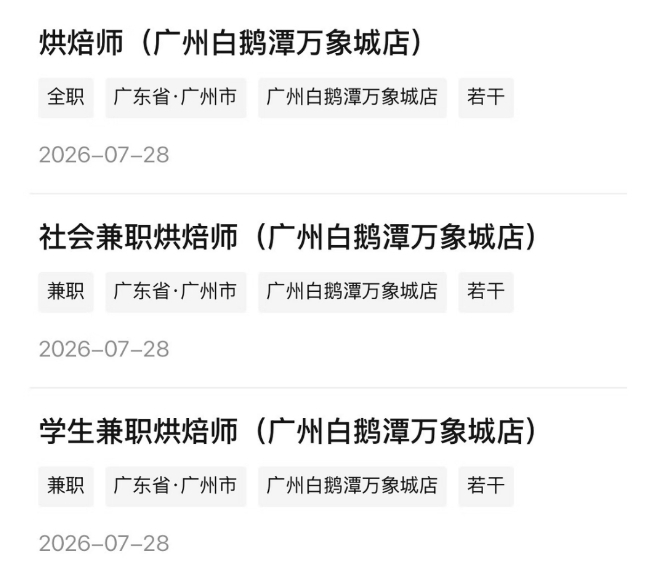
It’s worth noting that even if Tea颜悦色 chooses Bai’e-tan Vientiane City, which is still in its business cultivation period, it still can’t avoid direct competition. There are rumors that Heytea will enter the same project in the form of a lab store. Recruitment-platform information shows that the relevant bakery positions began hiring at the end of July.
The deeper challenge lies in rebuilding brand value.
Tea颜悦色’s early brand premium was largely built on geographic scarcity. Consumers’ behavior of going out specifically to check in gave the brand extra emotional value. As stores continue to spread nationwide, this scarcity will be diluted over time, and the brand’s momentum in terms of discussion will also decline accordingly.
According to the Red Dinner supply chain guide, in cities that entered earlier such as Chongqing and Wuhan, store popularity has now shown declines to varying degrees. Meanwhile, Tea颜悦色’s brand’s core bestsellers are still mainly the few products from its early founding period, with no essential change in its product framework.
When the original-leaf fresh milk tea became a common category in the industry, the differentiated advantage on the product side continued to narrow. The brand can hardly build a long-term moat by product form anymore.
Not to mention the fully self-operated model that Tea颜悦色 has consistently insisted on.
The single-store operating model in Changsha’s core business districts is built on high-density foot traffic. Guangzhou’s commercial landscape is more dispersed: foot traffic is spread across multiple business districts and community-commercial nodes. If Tea颜悦色 wants to increase consumer reach, it needs to add more store locations across multiple areas.
Under a fully self-operated model, fixed costs such as rent and labor must be fully borne by the brand. The difficulty of reaching a single-store break-even point is significantly higher than for franchise brands. If the number of stores can’t grow, the costs of local warehousing and management teams can’t be diluted quickly, and the store-expansion rhythm is prone to becoming passive.
For Tea颜悦色, the barrier of Guangzhou has never been about opening-day buzz. Instead, it’s about the brand’s real ability to survive once it’s separated from the soil of Changsha. Tea颜悦色’s national expansion has no way back. This Guangzhou ‘high-level experts’ arena is both the checkpoint it has to break through and the key test of whether its model can detach from regional soil.