

As AI compute demand continues to grow, competition among new cloud companies is shifting from "who has more GPUs" to "who can control the full technology stack from hardware to software." As renting raw compute becomes increasingly difficult to escape price competition, a more critical question emerges: in determining the value of AI infrastructure, is it the GPUs themselves, or the software layer that schedules, orchestrates, and optimizes GPU runtime efficiency?
Nscale, acquiring Anyscale for about USD 1.65 billion; Nebius acquiring Eigen AI; CoreWeave acquiring Weights & Biases; IREN acquiring Mirantis, and other transactions. These five acquisitions point to the same trend: new cloud companies that have GPUs, power, and data centers are collectively extending into the MLOps and AI orchestration layers.
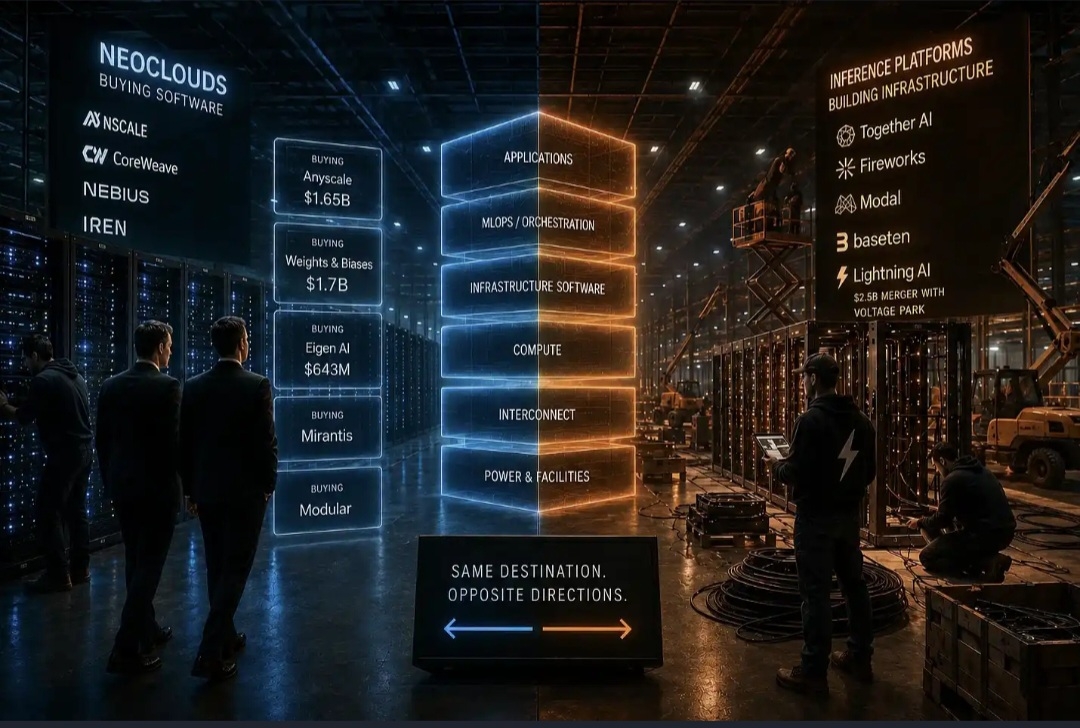
What New Cloud Company bought is not just a bundle of software or a set of customers, but the ability to shift from “charging by GPU hours” to “competing based on task outcomes.” The scheduling system determines how many GPU hours a task consumes, and it in turn affects compute utilization, customer costs, and platform profit. Once a vendor controls both layers of software and hardware, it can pursue coordinated optimization, and it can also raise customer switching costs through deeper system integration—capturing the gains from improved efficiency within the platform.
Meanwhile, integration is also happening in the opposite direction. Lightning AI has merged with GPU provider Voltage Park, and inference platforms such as Fireworks, Modal, Baseten, and others are building or gaining control of underlying compute power to varying degrees. Infrastructure companies are acquiring software upward, while inference platforms are expanding into hardware downward. Both sides are moving from opposite directions toward the same end point: jointly owning compute assets and orchestration software.
This means that in the next phase, New Cloud’s competition is no longer just about the number of GPUs, power contracts, and delivery speed, but about winning control over the entire AI workload. The real barrier likely comes from who can integrate chips, clusters, scheduling, and inference services into a more efficient system that is harder for customers to leave. However, while the two paths share the same destination, their cost structures are completely different: New Cloud can acquire software to fill gaps, whereas an inference platform that wants to build downward into infrastructure must shoulder heavier capital expenditures. This also leaves a key question for the second part: when all companies want to control the full technology stack, who can find sufficiently cheap funding to fuel this expansion?
