#bstockscis @BinanceCIS
🔎 I decided to figure out what’s happening with dividends on bStocks $SPCXB
Of course, I’d already seen dividends in regular stocks. But the mechanics in bStocks turned out to be more interesting 😊
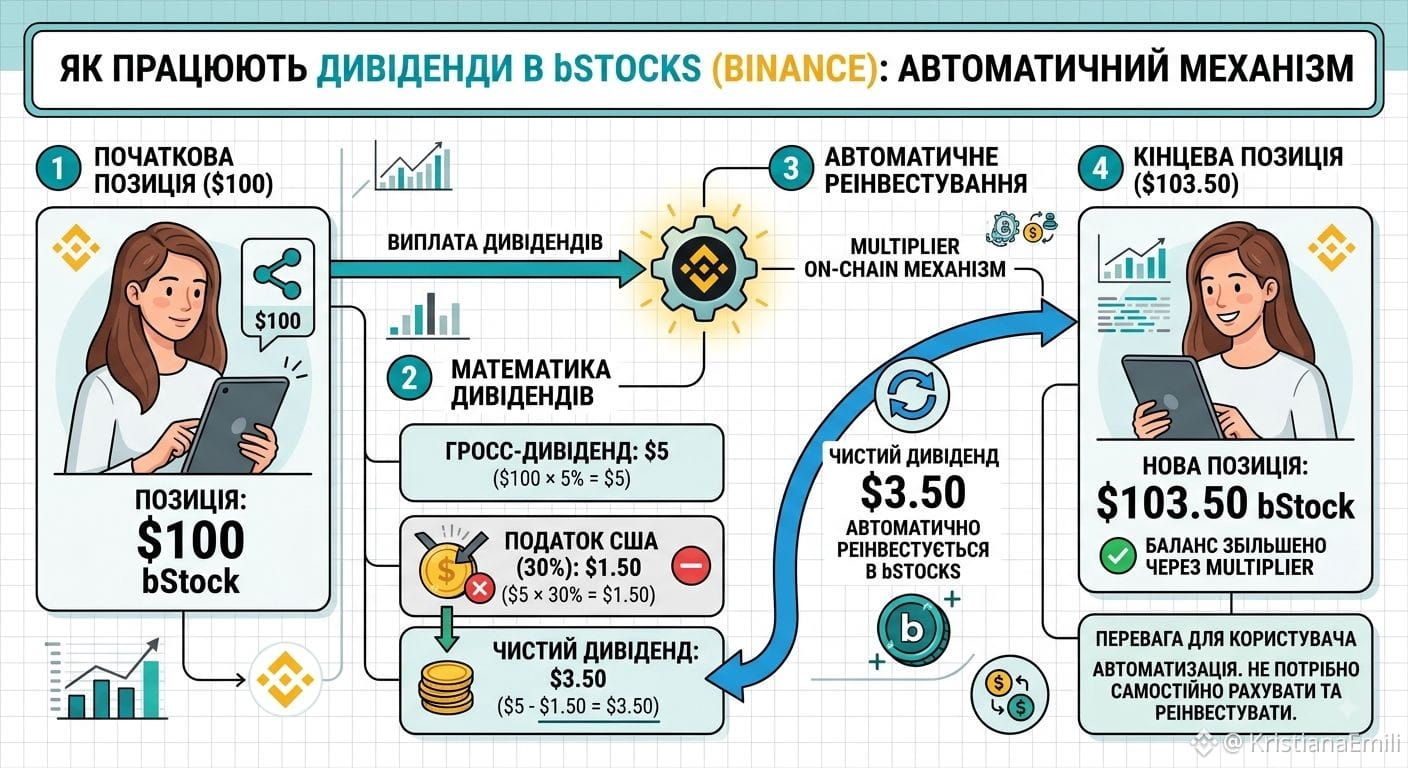
Binance uses a special on-chain mechanism called the Multiplier, which automatically processes corporate actions like dividends and splits.
And now the simple math:
Suppose I have a position worth $100, and the company pays conditional 5% dividends.
$100 × 5% = $5
But the dividend is subject to a 30% withholding tax from the US:
$5 × 30% = $1.50
So after withholding, the remainder is:
$5 − $1.50 = $3.50
These $3.50 don’t just arrive to me as a separate payment. Binance states that the net dividend is automatically reinvested into the underlying stock, and the bStock balance increases accordingly through the Multiplier.
So, conditional $100 → $103.50 thanks to the dividend mechanism itself.
Of course, this is just an example: the actual dividend depends on the specific company, and the stock price can also change.
But what I liked was something else: the user doesn’t need to calculate and reinvest the dividend themselves—the mechanism works automatically. 📊
It seems to me that these kinds of technical details best show how bStocks work not only “from the outside,” but also from the inside 🔎