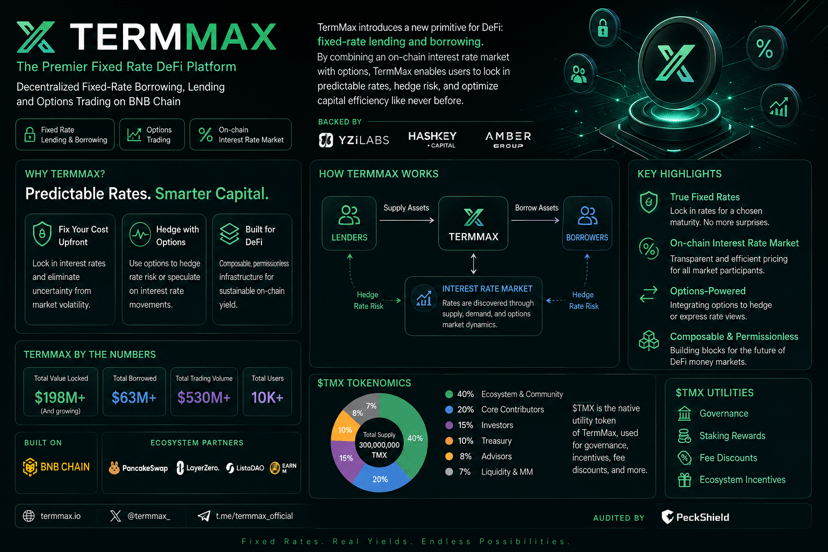
“Brothers, after so many years of DeFi lending and borrowing development, why are we still accepting unpredictable floating interest rates?”
This question naturally brings fixed interest rates, terms, and risk management into the spotlight, and it is highly aligned with TermMax’s positioning.
After so many years of DeFi development, lately I’ve actually started to think about a very basic question:
Why does on-chain lending interest have to keep changing?
In the past, we were used to the model of lending markets like Aave and Compound—when capital utilization changes, lending rates change as well. When capital demand rises in a bull market, the borrowing cost that once looked low can increase rapidly.
But if DeFi really wants to gradually evolve from an “on-chain casino” into a mature financial market, I think fixed interest rates and clearly defined terms are a step that can’t be avoided.
That’s also what recently piqued my interest while researching @TermMax .
TermMax attempts to combine fixed-rate lending with an options mechanism. For me, what truly deserves attention isn’t just that it’s “another DeFi lending protocol,” but that it’s trying to solve a very real problem:
Before taking out a loan, can I know in advance how much it will ultimately cost?
That’s normal in traditional finance, but in the DeFi world it still hasn’t become the most mainstream experience.
If, in the future, the scale of on-chain capital continues to grow, I believe competition won’t be only about “who has the higher APY,” but also about who can offer more predictable interest rates, clearer terms, and more mature risk management tools.
From this perspective, fixed-rate lending may be the next piece of the puzzle in DeFi lending worth paying attention to.
#termmax @TermMax
This question naturally brings fixed interest rates, terms, and risk management into the spotlight, and it is highly aligned with TermMax’s positioning.
After so many years of DeFi development, lately I’ve actually started to think about a very basic question:
Why does on-chain lending interest have to keep changing?
In the past, we were used to the model of lending markets like Aave and Compound—when capital utilization changes, lending rates change as well. When capital demand rises in a bull market, the borrowing cost that once looked low can increase rapidly.
But if DeFi really wants to gradually evolve from an “on-chain casino” into a mature financial market, I think fixed interest rates and clearly defined terms are a step that can’t be avoided.
That’s also what recently piqued my interest while researching @TermMax .
TermMax attempts to combine fixed-rate lending with an options mechanism. For me, what truly deserves attention isn’t just that it’s “another DeFi lending protocol,” but that it’s trying to solve a very real problem:
Before taking out a loan, can I know in advance how much it will ultimately cost?
That’s normal in traditional finance, but in the DeFi world it still hasn’t become the most mainstream experience.
If, in the future, the scale of on-chain capital continues to grow, I believe competition won’t be only about “who has the higher APY,” but also about who can offer more predictable interest rates, clearer terms, and more mature risk management tools.
From this perspective, fixed-rate lending may be the next piece of the puzzle in DeFi lending worth paying attention to.
#termmax @TermMax