I realized something when I tried asking a question: if privacy is only a “supplementary tooling” feature on Dusk’s EVM testnet, then what would make a real developer choose to use it instead of skipping it.
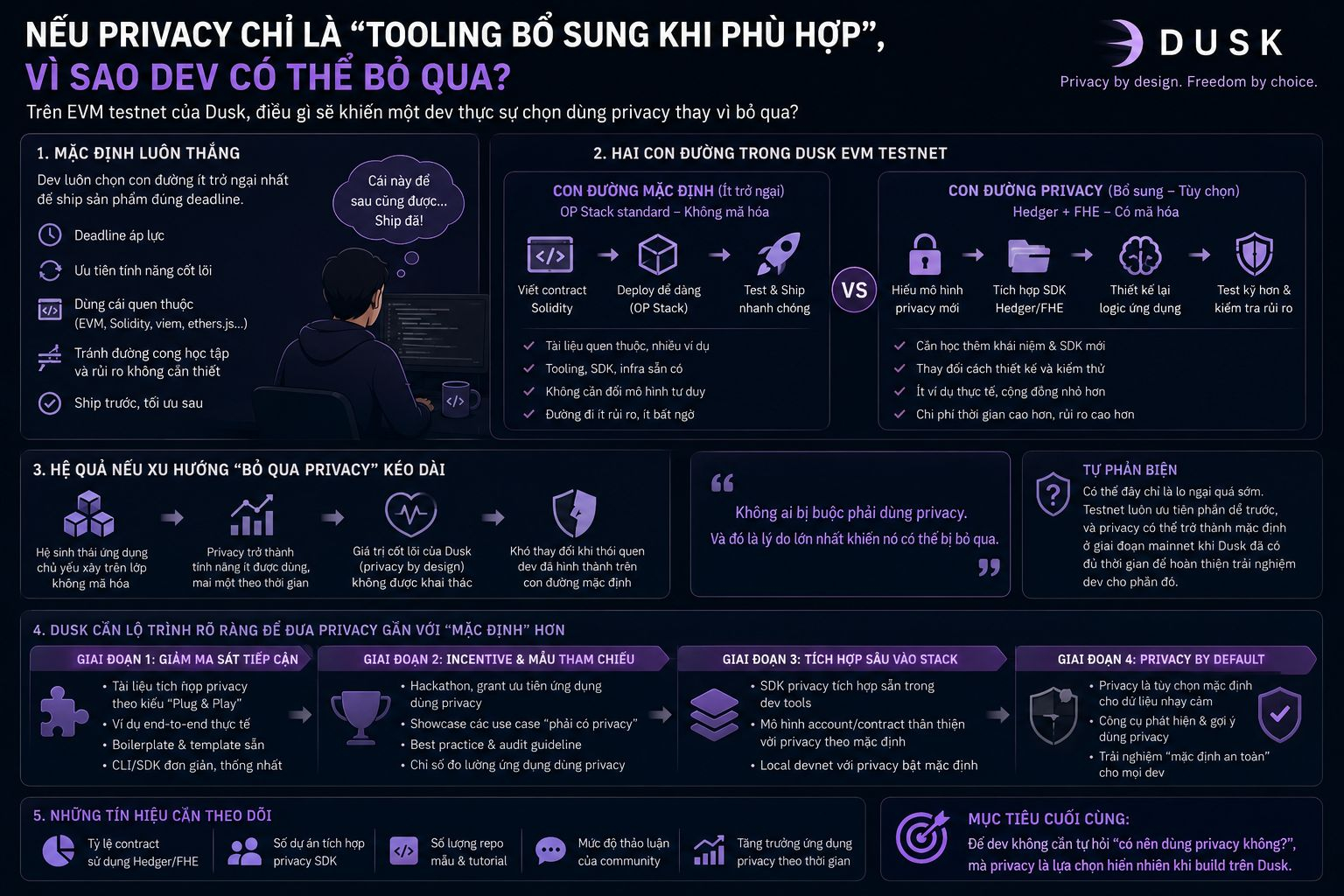
For most developers, the default always wins—not because they don’t care about advanced features, but because the default is the least obstacle-filled path when they’re trying to ship a product before the deadline. A feature that lives in separate documentation, requires learning a separate SDK, and demands a different way of thinking than the familiar EVM will always be pushed down the “to do later” list unless there’s a truly urgent reason to prioritize it right away.
This is a behavior problem more than a technical one. No matter how powerful Hedger mechanisms or @Dusk homomorphic encryption code are from a design standpoint, if the default path remains a standard, unencrypted OP Stack chain, then most applications built on this testnet in the early stage are unlikely to use that privacy layer—simply because nobody is forced to.
If this continues onto mainnet, the consequence could be an application ecosystem that largely fails to fully leverage the core value that $DUSK was designed to deliver.
Self-critique: maybe these concerns are just too early—testnets always prioritize the easier parts first, and privacy could become the default in the mainnet stage once Dusk has had enough time to polish the developer experience for that portion.
I’m waiting to see whether Dusk publishes a concrete roadmap for turning privacy from “supplementary tooling” into something closer to the default, before the application ecosystem takes shape in the opposite direction.
#dusk $AKE $BTC
For most developers, the default always wins—not because they don’t care about advanced features, but because the default is the least obstacle-filled path when they’re trying to ship a product before the deadline. A feature that lives in separate documentation, requires learning a separate SDK, and demands a different way of thinking than the familiar EVM will always be pushed down the “to do later” list unless there’s a truly urgent reason to prioritize it right away.
This is a behavior problem more than a technical one. No matter how powerful Hedger mechanisms or @Dusk homomorphic encryption code are from a design standpoint, if the default path remains a standard, unencrypted OP Stack chain, then most applications built on this testnet in the early stage are unlikely to use that privacy layer—simply because nobody is forced to.
If this continues onto mainnet, the consequence could be an application ecosystem that largely fails to fully leverage the core value that $DUSK was designed to deliver.
Self-critique: maybe these concerns are just too early—testnets always prioritize the easier parts first, and privacy could become the default in the mainnet stage once Dusk has had enough time to polish the developer experience for that portion.
I’m waiting to see whether Dusk publishes a concrete roadmap for turning privacy from “supplementary tooling” into something closer to the default, before the application ecosystem takes shape in the opposite direction.
#dusk $AKE $BTC