Blockchain was built around transparency.
But finance needs something more nuanced.
Not every piece of financial data should be public.
Yet every important claim still needs verification.
That is where Dusk becomes interesting.
Dusk is focused on privacy-preserving financial infrastructure.
Its approach starts with programmable privacy.
Privacy is not treated as an afterthought.
It can be built into smart-contract logic itself.
That changes how on-chain finance can work.
An investor may need to prove eligibility.
But revealing their entire financial profile may be unnecessary.
A company may need to prove asset ownership.
But exposing sensitive business information adds risk.
A transaction may need to satisfy regulations.
But compliance does not always require total disclosure.
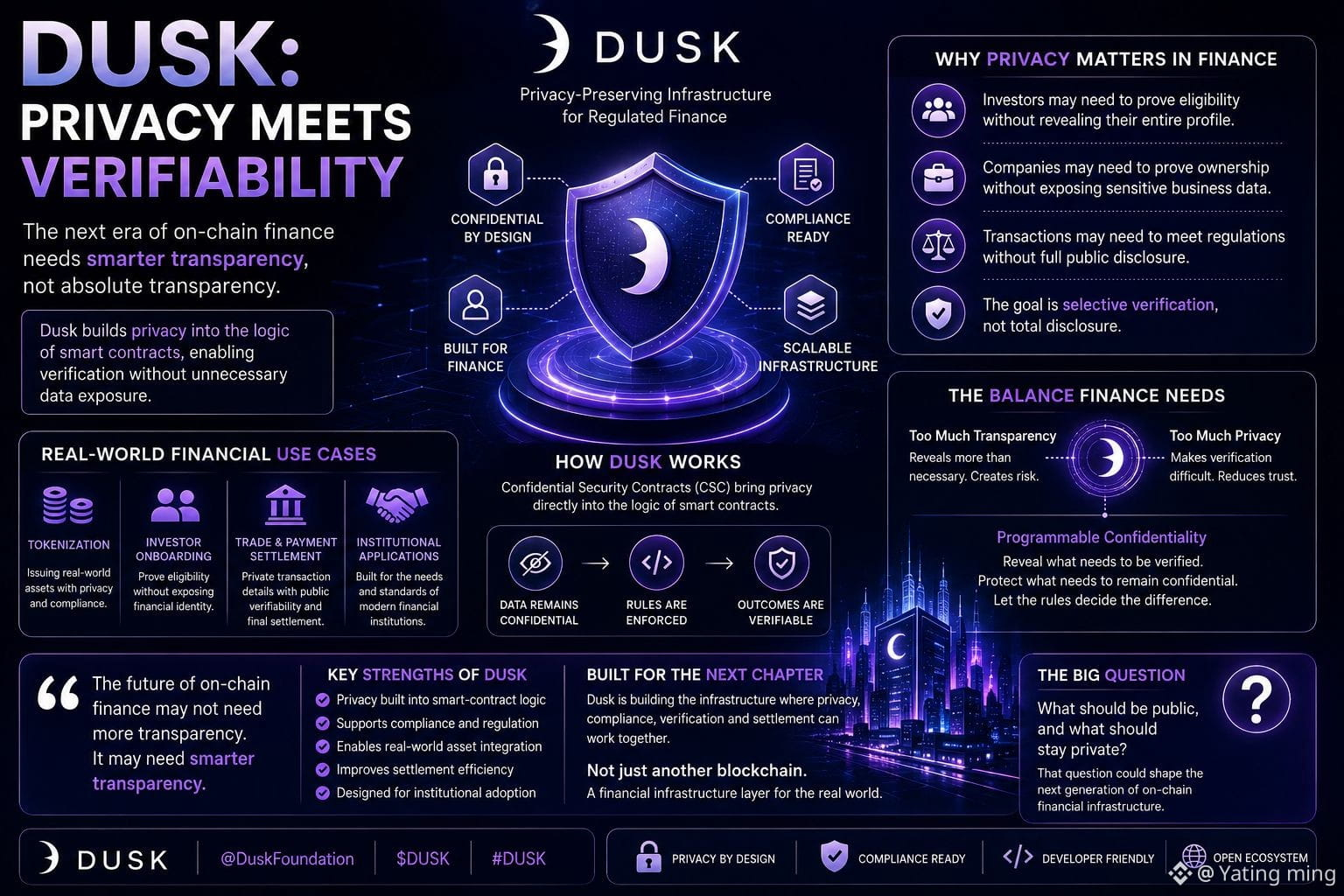
The real goal is selective verification.
Reveal what needs to be verified.
Protect what needs to remain confidential.
Let the rules determine what becomes visible.
This is more practical than choosing between public and private systems.
It creates a potential middle ground for regulated finance.
Dusk’s Confidential Security Contracts are part of this vision.
Privacy becomes connected to application logic.
Compliance can remain part of the design.
Verification can happen without unnecessary exposure.
That matters for institutional adoption.
It matters for tokenized real-world assets.
It matters for investor onboarding.
It matters for settlement and financial applications.
Because putting assets on-chain is only one part of the challenge.
Those assets also need rules.
They need ownership verification.
They need compliance mechanisms.
They need controlled transfers.
And they need confidentiality.
A fully transparent system may reveal too much.
A fully private system may make verification difficult.
The stronger model could be programmable confidentiality.
Dusk is exploring that model at the infrastructure level.
The biggest question is not whether privacy is useful.
It is whether privacy can work at financial scale.$DUSK @Dusk #dusk
But finance needs something more nuanced.
Not every piece of financial data should be public.
Yet every important claim still needs verification.
That is where Dusk becomes interesting.
Dusk is focused on privacy-preserving financial infrastructure.
Its approach starts with programmable privacy.
Privacy is not treated as an afterthought.
It can be built into smart-contract logic itself.
That changes how on-chain finance can work.
An investor may need to prove eligibility.
But revealing their entire financial profile may be unnecessary.
A company may need to prove asset ownership.
But exposing sensitive business information adds risk.
A transaction may need to satisfy regulations.
But compliance does not always require total disclosure.
The real goal is selective verification.
Reveal what needs to be verified.
Protect what needs to remain confidential.
Let the rules determine what becomes visible.
This is more practical than choosing between public and private systems.
It creates a potential middle ground for regulated finance.
Dusk’s Confidential Security Contracts are part of this vision.
Privacy becomes connected to application logic.
Compliance can remain part of the design.
Verification can happen without unnecessary exposure.
That matters for institutional adoption.
It matters for tokenized real-world assets.
It matters for investor onboarding.
It matters for settlement and financial applications.
Because putting assets on-chain is only one part of the challenge.
Those assets also need rules.
They need ownership verification.
They need compliance mechanisms.
They need controlled transfers.
And they need confidentiality.
A fully transparent system may reveal too much.
A fully private system may make verification difficult.
The stronger model could be programmable confidentiality.
Dusk is exploring that model at the infrastructure level.
The biggest question is not whether privacy is useful.
It is whether privacy can work at financial scale.$DUSK @Dusk #dusk