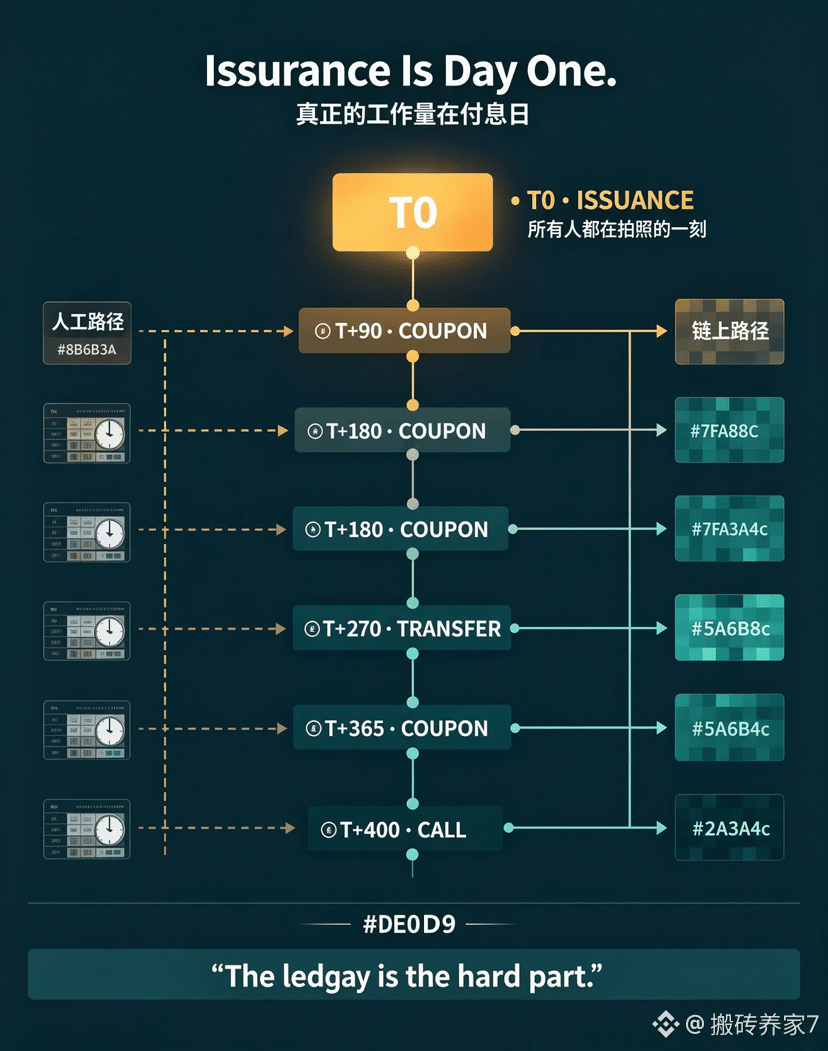
I spent a few years doing bond settlement in a securities firm’s back office. The most torturous part isn’t the issuance—it’s the interest payment date.
Once a bond is issued, the real workload comes afterward: calculating interest for each period, distributing payments based on the holdings snapshot on the record date, handling proportional repayment when there’s an early redemption, and even determining who is entitled to the interest for that period when bondholders change hands. In traditional systems, this kind of work is called “corporate action,” and it’s the main source of overtime for the settlement team.
RWA nowadays mostly only solves the first step. Tokenize the asset and send it out—it looks great, but how do you handle interest payments? Most proposals have the issuer prepare the spreadsheets themselves, then manually transfer USDC. In effect, you hand the most tedious part back to humans.
That’s also why I stopped at Zedger when looking at @Dusk . It isn’t just a transfer standard—it models the entire lifecycle of a security in the contract—issuance, registration, transfer, interest payments, and redemption. The holder registry is maintained on-chain, but its contents are kept confidential. Distributions execute using on-chain snapshots, not by manual reconciliation.
The key is the “registry.” ERC-20 only has balances and no concept of a registry, so any actions that depend on proportional holdings must be recalculated off-chain. Zedger, on the other hand, treats the registry as a first-class citizen.
Issuance is only the beginning—whether you can automate interest payments is what determines whether this approach can actually be used.
You also have to talk about the weak points. Encrypting and maintaining the registry means that as the number of entries grows, the cost of state updates and proof generation will increase too—this is why Rusk is building custom data structures. And the types of corporate actions are extremely diverse—dividends, stock splits, tender offers, debt restructuring. How many of these can be covered by a contract? There are still too few public cases to make a solid judgment.
So what do you think is really blocking RWA: the issuance tooling, or all those messy jobs nobody wants to take over after the asset is issued?
#dusk $DUSK
Once a bond is issued, the real workload comes afterward: calculating interest for each period, distributing payments based on the holdings snapshot on the record date, handling proportional repayment when there’s an early redemption, and even determining who is entitled to the interest for that period when bondholders change hands. In traditional systems, this kind of work is called “corporate action,” and it’s the main source of overtime for the settlement team.
RWA nowadays mostly only solves the first step. Tokenize the asset and send it out—it looks great, but how do you handle interest payments? Most proposals have the issuer prepare the spreadsheets themselves, then manually transfer USDC. In effect, you hand the most tedious part back to humans.
That’s also why I stopped at Zedger when looking at @Dusk . It isn’t just a transfer standard—it models the entire lifecycle of a security in the contract—issuance, registration, transfer, interest payments, and redemption. The holder registry is maintained on-chain, but its contents are kept confidential. Distributions execute using on-chain snapshots, not by manual reconciliation.
The key is the “registry.” ERC-20 only has balances and no concept of a registry, so any actions that depend on proportional holdings must be recalculated off-chain. Zedger, on the other hand, treats the registry as a first-class citizen.
Issuance is only the beginning—whether you can automate interest payments is what determines whether this approach can actually be used.
You also have to talk about the weak points. Encrypting and maintaining the registry means that as the number of entries grows, the cost of state updates and proof generation will increase too—this is why Rusk is building custom data structures. And the types of corporate actions are extremely diverse—dividends, stock splits, tender offers, debt restructuring. How many of these can be covered by a contract? There are still too few public cases to make a solid judgment.
So what do you think is really blocking RWA: the issuance tooling, or all those messy jobs nobody wants to take over after the asset is issued?
#dusk $DUSK