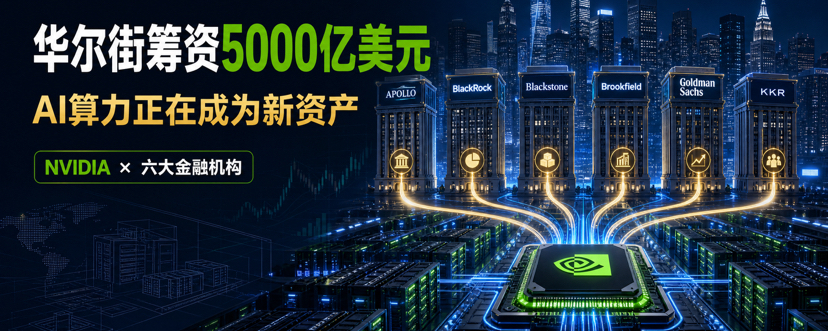

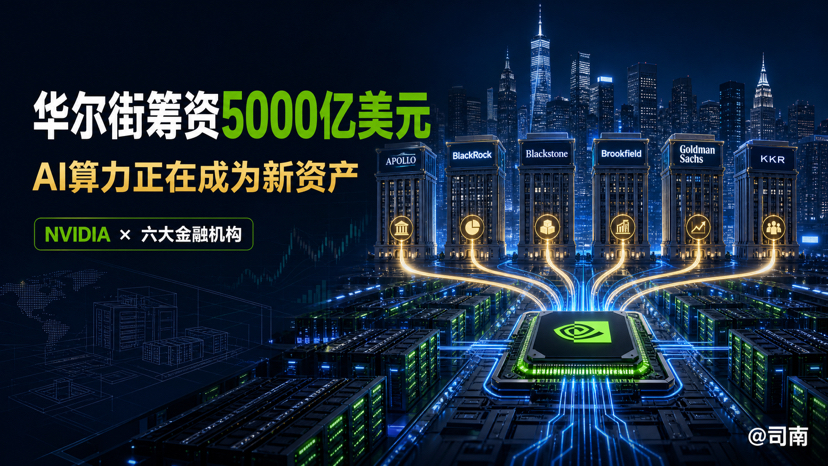
Nvidia recently announced that it has signed a memorandum of understanding with Apollo, BlackRock, Blackstone, Brookfield, Goldman Sachs, and KKR to establish an independent AI compute financing platform, with plans to mobilize more than $500 billion in third-party capital in the future to support the construction of data centers, AI compute power, and related infrastructure.$NVDA.US
First, clarify the most easily misinterpreted part: the $500 billion is the target mobilization amount, not the financing that has already been received.
Based on currently available public information, what the parties have signed are memoranda of understanding, and the final agreements still need to be carried out. Nvidia has not disclosed the specific commitment amounts from each institution, financing terms, or a timeline for capital deployment. Reuters also reported that Nvidia CEO Jensen Huang said the company can choose to provide up to $125 billion in backup support for potential transactions, representing about 25% of the potential deal size—but this, too, is not cash that has already been paid.
What’s truly important about this cooperation isn’t the huge number—it’s that Wall Street is trying to reprice “compute capacity.”
In the past, GPUs were more like rapidly iterating hardware, facing depreciation and technological obsolescence. But Nvidia wants to package compute capacity as an infrastructure asset that can generate revenue, be used long term, and be transferable and reusable. CNBC’s coverage compares it to assets that can be financed and collateralized—like commercial real estate or toll roads.
If this model works, the financing approach for AI infrastructure may change: data center operators, cloud service providers, AI labs, and large enterprises don’t have to rely entirely on their own cash flow to build compute capacity; they could also leverage institutional credit, private capital, and long-term infrastructure funding for early deployment.
The roles of the six participating institutions are also quite representative.
Apollo, Blackstone, and KKR represent alternative assets and long-term capital; BlackRock represents global asset management and the channels that allocate funds; Brookfield is strong in infrastructure investing; and Goldman Sachs can provide investment banking, credit, and capital market services. What Nvidia provides is not just chips—it also includes a complete asset narrative built around the CUDA ecosystem, customer demand, and compute usage scenarios.
But there’s also a problem that can’t be ignored here: turning GPUs into “financable assets” doesn’t automatically eliminate risk.
If the next generation of chips iterates quickly, the residual value of the previous-generation equipment may decline. If data center utilization doesn’t meet expectations, compute revenue may be insufficient to cover interest, operations and maintenance, and depreciation. And if AI companies keep adding debt, capital expenditures could shift from being a growth engine to a cash-flow pressure.
Earlier, the market had already started discussing whether the scale of AI capital expenditures by large tech companies can generate sufficient returns. Now, Wall Street’s involvement may help capital flow into AI infrastructure faster, but it may also raise leverage ratios and increase financial linkages across the industry in parallel.
For the crypto market, the impact of this news is more like an indirect transmission effect, rather than a direct positive catalyst for any specific coin.
As AI compute financing expands, it may boost market attention to data centers, the power sector, the chip supply chain, and decentralized compute. RWA may also further explore representing data center revenues, compute rentals, and infrastructure cash flows on-chain. But all of this is an industry extension and market scenario building—it cannot be directly equated with BTC, ETH, or any specific AI token necessarily going up.
My view is: this is not just a simple story about “Nvidia getting $500 billion”—it’s that Wall Street is pushing AI from a technology growth narrative into a stage of infrastructure financialization.
The truly important thing to watch next is not the $500 billion mentioned in the news headline, but when the final agreement will be implemented, who will bear the funding, who will use the compute capacity, how revenue will be used to service the debt, and whether the next generation of chips can maintain a sufficiently long lifecycle.
If the answer is yes, AI compute power could become a new long-term asset class; if not, this capital could also amplify valuations and credit risks in the AI industry.