I’ve watched enough cycles to know most privacy talk in crypto is just marketing layered over the same public ledger problems. Full transparency kills real finance. Full secrecy kills trust and compliance. Most projects pick one and call it solved.
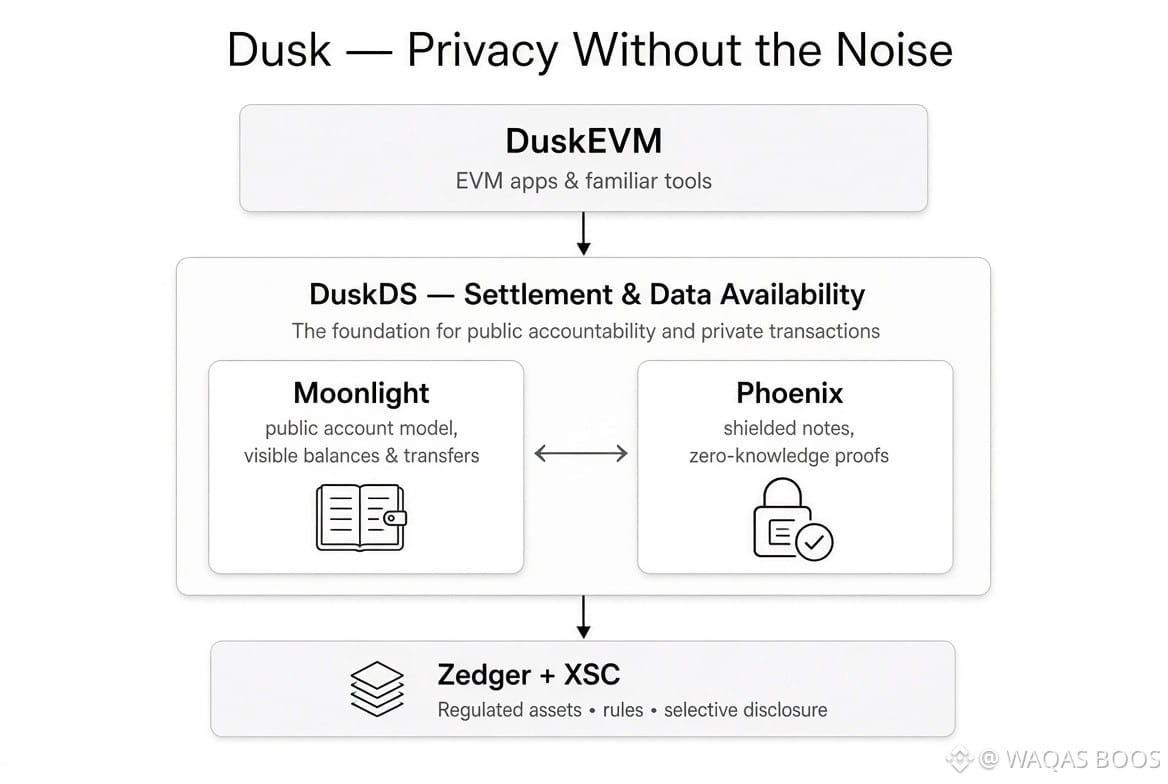
Dusk keeps circling something different. Moonlight keeps accounts and balances public when you need verification. Phoenix shields the notes and proves validity with zero-knowledge without broadcasting amounts or paths. Zedger and XSC sit on top for the messy part issuance, ownership limits, corporate actions where rules have to exist without turning every position into public data.
I’ve seen this architecture before in theory. The friction usually shows up when the pieces have to live together. Selective disclosure sounds clean until someone actually has to enforce it under real regulation. Still, the separation feels intentional rather than bolted on. DuskDS handles settlement and the dual models; the EVM layer sits above it for the applications people already know how to build.
I’m not sure yet if the trade-offs hold under volume or institutional pressure. Most things that look thoughtful on paper still collapse when incentives and regulators meet. But the problem they’re actually naming the one where assets need to be verified without every detail becoming public is the one that keeps coming back every cycle. Something about the way they split the responsibilities feels less like another privacy feature and more like an attempt to stop fighting the contradiction.
@Dusk #dusk $DUSK