
小菲Faye
472 Posts

小菲Faye
Report
Block User
小菲财经;X、ins、YouTube:chainbeautyfaye
280 Following
23.3K+ Followers
15.3K+ Liked
Posts
All
Quotes
Videos
·
--
Founder of Plump-Thin Aesthetics, Faye, has increasingly come to believe that proportions matter a hundred times more than weight.
With the same 100 jin, some people look exquisite and well-shaped, with a clearly defined waistline; others, however, seem rather ordinary.
The difference lies in the curve-to-proportion ratio.
So I propose a new era concept for women’s body aesthetics:
“Plump-Thin Ratio”
The calculation is simple:
Plump-Thin Ratio = (Bust × 40% + Hip × 60%) ÷ Waist
A great women’s curve isn’t just about chasing thinness, nor is it about making one particular area stand out more and more.
What matters is a natural sense of curves—overall coordinated with gentle rise and fall, but not overly exaggerated.
Plump-Thin Ratio:
<1.25
Straight-line type|Overall outline is relatively straight
1.25–1.30
Light-curve type|Leaner, beginning to show a waistline
1.30–1.34
Natural-curve type|Comfortable proportions; curves look natural
1.34–1.39
Golden Plump-Thin Zone|Slim, with a waist and curves; overall most harmonious and easy to look at
1.39–1.44
High Plump-Thin type|Curves are more pronounced
>1.44
Strong-curve type|A very strong visual contrast, but it’s not the case that the higher the better
What aligns with human aesthetics should be: where it should be plump, let it have soft curves; where it should be thin, let it be light enough.
Girls, don’t let yourselves be trapped by numbers like “90 jin, 100 jin, 110 jin, 120 jin” anymore.
Next time, don’t just ask “How many jin?”
You can figure it out: what’s your Plump-Thin Ratio?
#PlumpThinRatio #PlumpThinAesthetics
Founder of Plump-Thin Aesthetics, Faye, has increasingly come to believe that proportions matter a hundred times more than weight.
With the same 100 jin, some people look exquisite and well-shaped, with a clearly defined waistline; others, however, seem rather ordinary.
The difference lies in the curve-to-proportion ratio.
So I propose a new era concept for women’s body aesthetics:
“Plump-Thin Ratio”
The calculation is simple:
Plump-Thin Ratio = (Bust × 40% + Hip × 60%) ÷ Waist
A great women’s curve isn’t just about chasing thinness, nor is it about making one particular area stand out more and more.
What matters is a natural sense of curves—overall coordinated with gentle rise and fall, but not overly exaggerated.
Plump-Thin Ratio:
<1.25
Straight-line type|Overall outline is relatively straight
1.25–1.30
Light-curve type|Leaner, beginning to show a waistline
1.30–1.34
Natural-curve type|Comfortable proportions; curves look natural
1.34–1.39
Golden Plump-Thin Zone|Slim, with a waist and curves; overall most harmonious and easy to look at
1.39–1.44
High Plump-Thin type|Curves are more pronounced
>1.44
Strong-curve type|A very strong visual contrast, but it’s not the case that the higher the better
What aligns with human aesthetics should be: where it should be plump, let it have soft curves; where it should be thin, let it be light enough.
Girls, don’t let yourselves be trapped by numbers like “90 jin, 100 jin, 110 jin, 120 jin” anymore.
Next time, don’t just ask “How many jin?”
You can figure it out: what’s your Plump-Thin Ratio?
#PlumpThinRatio #PlumpThinAesthetics
With the same 100 jin, some people look exquisite and well-shaped, with a clearly defined waistline; others, however, seem rather ordinary.
The difference lies in the curve-to-proportion ratio.
So I propose a new era concept for women’s body aesthetics:
“Plump-Thin Ratio”
The calculation is simple:
Plump-Thin Ratio = (Bust × 40% + Hip × 60%) ÷ Waist
A great women’s curve isn’t just about chasing thinness, nor is it about making one particular area stand out more and more.
What matters is a natural sense of curves—overall coordinated with gentle rise and fall, but not overly exaggerated.
Plump-Thin Ratio:
<1.25
Straight-line type|Overall outline is relatively straight
1.25–1.30
Light-curve type|Leaner, beginning to show a waistline
1.30–1.34
Natural-curve type|Comfortable proportions; curves look natural
1.34–1.39
Golden Plump-Thin Zone|Slim, with a waist and curves; overall most harmonious and easy to look at
1.39–1.44
High Plump-Thin type|Curves are more pronounced
>1.44
Strong-curve type|A very strong visual contrast, but it’s not the case that the higher the better
What aligns with human aesthetics should be: where it should be plump, let it have soft curves; where it should be thin, let it be light enough.
Girls, don’t let yourselves be trapped by numbers like “90 jin, 100 jin, 110 jin, 120 jin” anymore.
Next time, don’t just ask “How many jin?”
You can figure it out: what’s your Plump-Thin Ratio?
#PlumpThinRatio #PlumpThinAesthetics

2
403
·
--
hellokitty afternoon tea is super cute today 🐱
hellokitty afternoon tea is super cute today 🐱

1
3
200

·
--
Verified
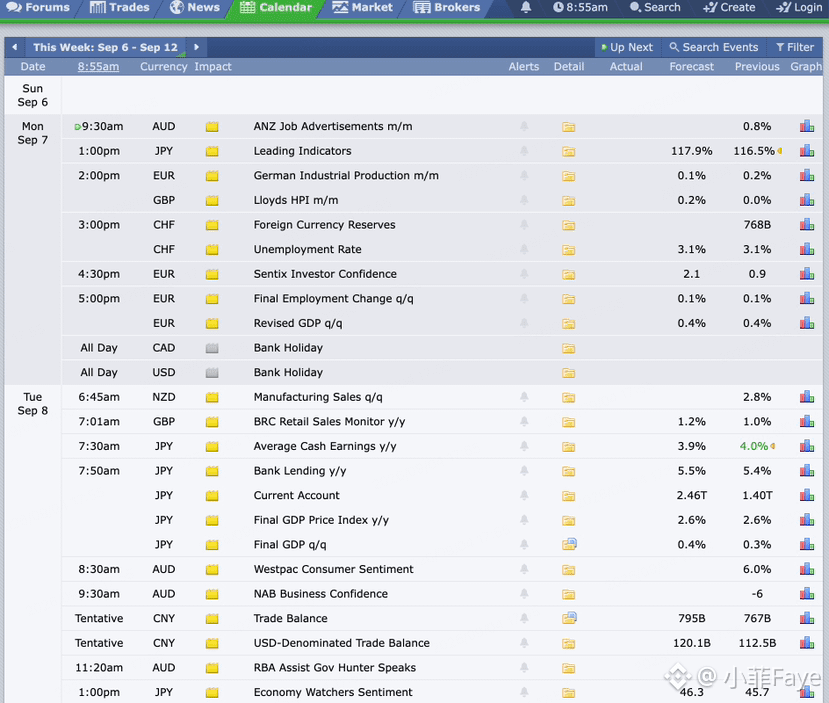
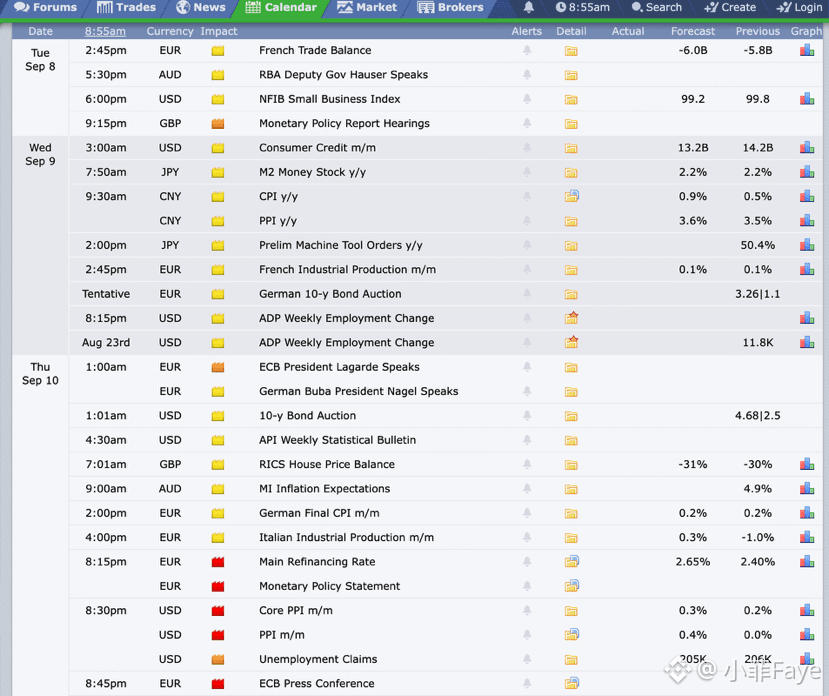
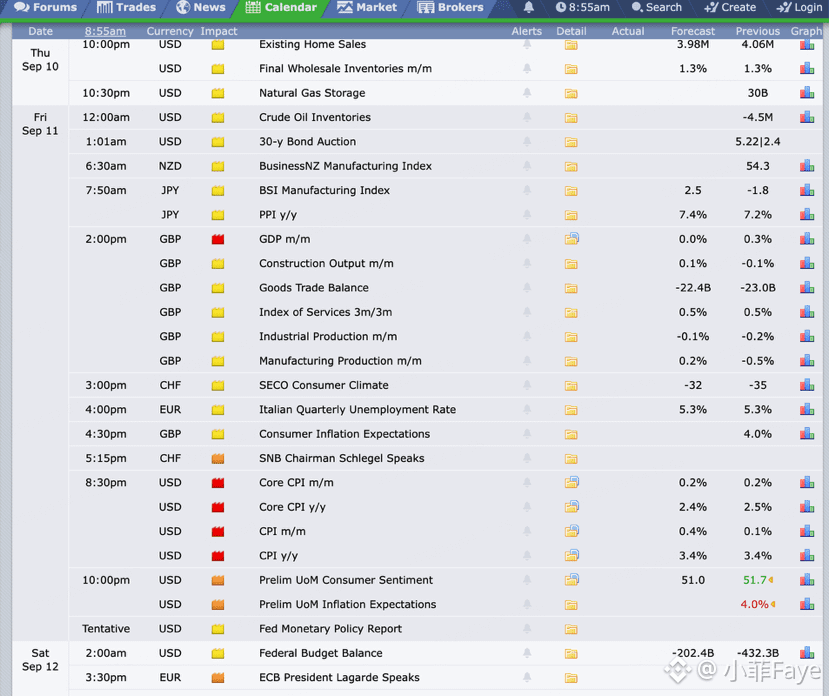
GMGM🌞This week's global macro calendar:
The U.S. will first release PPI and initial jobless claims on Thursday, then CPI on Friday. Current market expectations are for core CPI to rise 2.4% year over year, down from 2.5% previously; headline CPI is expected to be unchanged at 3.4% year over year, but month over month is expected to be 0.4%, above the previous 0.1%.
My view: it is not easy for headline CPI to show a clear downside surprise this week. With oil prices rising again recently, inflation pressure is still there. But whether core CPI can continue falling from 2.5% to 2.4% is the key factor that will determine the Fed's stance. Last week's nonfarm payrolls added 162,000 jobs, clearly stronger than expected, and the unemployment rate stayed at 4.1%. Market pricing for a September rate hike has already heated up again, so this CPI report is essentially the last major confirmation.
If CPI, especially core CPI, comes in above expectations, rate-hike expectations from the Fed will strengthen further. U.S. Treasury yields and the dollar would likely stay relatively strong, which would be negative for the Nasdaq, AI tech stocks, and high-liquidity-sensitive assets like crypto. If CPI comes in below expectations, it would ease rate-hike pressure, and U.S. growth stocks and Crypto would be more likely to see a round of risk appetite recovery. What the market fears most right now is strong employment plus high inflation at the same time, which is very unfriendly for risk assets. $BTC $NVDAB $AAPLB
GMGM🌞This week's global macro calendar:
The U.S. will first release PPI and initial jobless claims on Thursday, then CPI on Friday. Current market expectations are for core CPI to rise 2.4% year over year, down from 2.5% previously; headline CPI is expected to be unchanged at 3.4% year over year, but month over month is expected to be 0.4%, above the previous 0.1%.
My view: it is not easy for headline CPI to show a clear downside surprise this week. With oil prices rising again recently, inflation pressure is still there. But whether core CPI can continue falling from 2.5% to 2.4% is the key factor that will determine the Fed's stance. Last week's nonfarm payrolls added 162,000 jobs, clearly stronger than expected, and the unemployment rate stayed at 4.1%. Market pricing for a September rate hike has already heated up again, so this CPI report is essentially the last major confirmation.
If CPI, especially core CPI, comes in above expectations, rate-hike expectations from the Fed will strengthen further. U.S. Treasury yields and the dollar would likely stay relatively strong, which would be negative for the Nasdaq, AI tech stocks, and high-liquidity-sensitive assets like crypto. If CPI comes in below expectations, it would ease rate-hike pressure, and U.S. growth stocks and Crypto would be more likely to see a round of risk appetite recovery. What the market fears most right now is strong employment plus high inflation at the same time, which is very unfriendly for risk assets. $BTC $NVDAB $AAPLB
The U.S. will first release PPI and initial jobless claims on Thursday, then CPI on Friday. Current market expectations are for core CPI to rise 2.4% year over year, down from 2.5% previously; headline CPI is expected to be unchanged at 3.4% year over year, but month over month is expected to be 0.4%, above the previous 0.1%.
My view: it is not easy for headline CPI to show a clear downside surprise this week. With oil prices rising again recently, inflation pressure is still there. But whether core CPI can continue falling from 2.5% to 2.4% is the key factor that will determine the Fed's stance. Last week's nonfarm payrolls added 162,000 jobs, clearly stronger than expected, and the unemployment rate stayed at 4.1%. Market pricing for a September rate hike has already heated up again, so this CPI report is essentially the last major confirmation.
If CPI, especially core CPI, comes in above expectations, rate-hike expectations from the Fed will strengthen further. U.S. Treasury yields and the dollar would likely stay relatively strong, which would be negative for the Nasdaq, AI tech stocks, and high-liquidity-sensitive assets like crypto. If CPI comes in below expectations, it would ease rate-hike pressure, and U.S. growth stocks and Crypto would be more likely to see a round of risk appetite recovery. What the market fears most right now is strong employment plus high inflation at the same time, which is very unfriendly for risk assets. $BTC $NVDAB $AAPLB
3
2
877
·
--
Yesterday while shopping, the store clerk actually asked me if I was mixed-race?
Yesterday while shopping, the store clerk actually asked me if I was mixed-race?

6
5
1.2k
·
--
The days in a small courtyard by West Lake, where the trees are lush and flourishing, with layers of branches and leaves spreading out into stretches of green shade. In summer, cicadas often chirp in chorus, rising and falling one after another, a lively background sound unique to summer.
As the wind slowly passes through the leaves, it takes away some of the restlessness. There’s no need to travel far; everyday warmth and poetic charm are both within reach.
It could be said that this is the best spot for today’s chain check-in 😄
The days in a small courtyard by West Lake, where the trees are lush and flourishing, with layers of branches and leaves spreading out into stretches of green shade. In summer, cicadas often chirp in chorus, rising and falling one after another, a lively background sound unique to summer.
As the wind slowly passes through the leaves, it takes away some of the restlessness. There’s no need to travel far; everyday warmth and poetic charm are both within reach.
It could be said that this is the best spot for today’s chain check-in 😄
As the wind slowly passes through the leaves, it takes away some of the restlessness. There’s no need to travel far; everyday warmth and poetic charm are both within reach.
It could be said that this is the best spot for today’s chain check-in 😄
1
4
489
·
--
Binance🔗 https://www.bsmkweb.cc/register?ref=FAYE1888
Binance🔗 https://www.bsmkweb.cc/register?ref=FAYE1888
1
213

·
--
Alibaba’s earnings report will be released tonight 📈, and it may determine how the market revalues Alibaba.
What had been weighing down the valuation was e-commerce price wars and weak consumer demand. But in the previous quarter, Alibaba Cloud grew year over year by 38%, and AI became the core incremental driver—potentially rewriting the valuation logic.
Watch four key metrics: cloud revenue growth rate, AI revenue contribution, cloud profit margin, and capital expenditures and free cash flow. Only when cloud sustains high growth while profit margins improve can the valuation shift be considered complete—from a traditional e-commerce asset to an AI + cloud growth story.
Alibaba’s earnings report will be released tonight 📈, and it may determine how the market revalues Alibaba.
What had been weighing down the valuation was e-commerce price wars and weak consumer demand. But in the previous quarter, Alibaba Cloud grew year over year by 38%, and AI became the core incremental driver—potentially rewriting the valuation logic.
Watch four key metrics: cloud revenue growth rate, AI revenue contribution, cloud profit margin, and capital expenditures and free cash flow. Only when cloud sustains high growth while profit margins improve can the valuation shift be considered complete—from a traditional e-commerce asset to an AI + cloud growth story.
What had been weighing down the valuation was e-commerce price wars and weak consumer demand. But in the previous quarter, Alibaba Cloud grew year over year by 38%, and AI became the core incremental driver—potentially rewriting the valuation logic.
Watch four key metrics: cloud revenue growth rate, AI revenue contribution, cloud profit margin, and capital expenditures and free cash flow. Only when cloud sustains high growth while profit margins improve can the valuation shift be considered complete—from a traditional e-commerce asset to an AI + cloud growth story.
3
8
839
·
--
Is Elon Musk’s Starlink trillion-dollar revenue a pie-in-the-sky claim or the future?
Starlink is no longer just home satellite broadband. It has expanded into aviation, maritime, defense/industrial uses, and enterprise leased lines. The V3 satellite bandwidth has been significantly upgraded. Combined with the AI era of autonomous driving and the low-altitude economy, it could lead to massive connectivity demand. In the future, it may well evolve into a global communications operating system.
However, continuous massive capital expenditures on satellites and ground stations, along with regulatory hurdles and frequency-spectrum resource barriers in different countries, mean that expanding bandwidth doesn’t necessarily translate into a proportional rise in revenue. There is downward pressure on bandwidth pricing. @elonmusk
#Starlink #spacex #ElonMusk
Is Elon Musk’s Starlink trillion-dollar revenue a pie-in-the-sky claim or the future?
Starlink is no longer just home satellite broadband. It has expanded into aviation, maritime, defense/industrial uses, and enterprise leased lines. The V3 satellite bandwidth has been significantly upgraded. Combined with the AI era of autonomous driving and the low-altitude economy, it could lead to massive connectivity demand. In the future, it may well evolve into a global communications operating system.
However, continuous massive capital expenditures on satellites and ground stations, along with regulatory hurdles and frequency-spectrum resource barriers in different countries, mean that expanding bandwidth doesn’t necessarily translate into a proportional rise in revenue. There is downward pressure on bandwidth pricing. @elonmusk
#Starlink #spacex #ElonMusk
Starlink is no longer just home satellite broadband. It has expanded into aviation, maritime, defense/industrial uses, and enterprise leased lines. The V3 satellite bandwidth has been significantly upgraded. Combined with the AI era of autonomous driving and the low-altitude economy, it could lead to massive connectivity demand. In the future, it may well evolve into a global communications operating system.
However, continuous massive capital expenditures on satellites and ground stations, along with regulatory hurdles and frequency-spectrum resource barriers in different countries, mean that expanding bandwidth doesn’t necessarily translate into a proportional rise in revenue. There is downward pressure on bandwidth pricing. @elonmusk
#Starlink #spacex #ElonMusk
2
5
356



·
--
The Contradiction in Google’s Earnings: Performance Is Up, but the Stock Price Pulls Back
After reviewing U.S. stock earnings, Google presents a rather interesting split situation. Revenue growth is impressive: search ads haven’t been hit by AI, YouTube continues to deliver solid growth, and Google Cloud’s growth rate stands out. Enterprise AI demand is translating into revenue in a tangible way, and institutions generally remain optimistic.
Yet the stock price is pulling back instead. The core issue is continuously rising capital expenditures. With relentless spending on AI servers, TPUs, and data centers, free cash flow is being pressured in the short term. The market is questioning when the AI investment will deliver returns.
In the short term, investors are wary of the cash-burning pressure, while institutions focus on the fact that Google holds a complete ecosystem spanning search, traffic, cloud, and Gemini. As long as AI search commercialization does not damage the core advertising business, a pullback could be a window for positioning.
Google reflects the reality of the current U.S. AI sector: the essence of market trading is the market’s patience regarding the payback cycle of AI investment.
⚠️For personal opinions only and does not constitute investment advice
The Contradiction in Google’s Earnings: Performance Is Up, but the Stock Price Pulls Back
After reviewing U.S. stock earnings, Google presents a rather interesting split situation. Revenue growth is impressive: search ads haven’t been hit by AI, YouTube continues to deliver solid growth, and Google Cloud’s growth rate stands out. Enterprise AI demand is translating into revenue in a tangible way, and institutions generally remain optimistic.
Yet the stock price is pulling back instead. The core issue is continuously rising capital expenditures. With relentless spending on AI servers, TPUs, and data centers, free cash flow is being pressured in the short term. The market is questioning when the AI investment will deliver returns.
In the short term, investors are wary of the cash-burning pressure, while institutions focus on the fact that Google holds a complete ecosystem spanning search, traffic, cloud, and Gemini. As long as AI search commercialization does not damage the core advertising business, a pullback could be a window for positioning.
Google reflects the reality of the current U.S. AI sector: the essence of market trading is the market’s patience regarding the payback cycle of AI investment.
⚠️For personal opinions only and does not constitute investment advice
After reviewing U.S. stock earnings, Google presents a rather interesting split situation. Revenue growth is impressive: search ads haven’t been hit by AI, YouTube continues to deliver solid growth, and Google Cloud’s growth rate stands out. Enterprise AI demand is translating into revenue in a tangible way, and institutions generally remain optimistic.
Yet the stock price is pulling back instead. The core issue is continuously rising capital expenditures. With relentless spending on AI servers, TPUs, and data centers, free cash flow is being pressured in the short term. The market is questioning when the AI investment will deliver returns.
In the short term, investors are wary of the cash-burning pressure, while institutions focus on the fact that Google holds a complete ecosystem spanning search, traffic, cloud, and Gemini. As long as AI search commercialization does not damage the core advertising business, a pullback could be a window for positioning.
Google reflects the reality of the current U.S. AI sector: the essence of market trading is the market’s patience regarding the payback cycle of AI investment.
⚠️For personal opinions only and does not constitute investment advice
1
4
535
·
--
Can traders only sleep for an hour? With the U.S. stock market entering an all-night stretch, are we really ushering in a 23-hour trading regime?! 😄
Can traders only sleep for an hour? With the U.S. stock market entering an all-night stretch, are we really ushering in a 23-hour trading regime?! 😄
4
840
·
--

Article
AI is stealing the spotlight from crypto: a massive capital migration from Bitcoin to chip stocksLast August, Daniel Koss, a 30-year-old investor living in Zug, Switzerland, liquidated his six-figure-dollar Bitcoin position and went all-in on artificial intelligence.
His reasoning is simple: “I feel a bit like a caveman who discovered a hole full of fire.”
Koss once held a large position in Bitcoin and believed crypto would completely transform the financial industry. But when he saw the rapidly developing technology of AI had the potential to upend the entire sector, he chose to turn around.
His turn marks a snapshot of a larger migration in global markets over the past year.
First, a major rotation of funds: selling Bitcoin and chasing AI stocks
AI is stealing the spotlight from crypto: a massive capital migration from Bitcoin to chip stocks
Last August, Daniel Koss, a 30-year-old investor living in Zug, Switzerland, liquidated his six-figure-dollar Bitcoin position and went all-in on artificial intelligence.
His reasoning is simple: “I feel a bit like a caveman who discovered a hole full of fire.”
Koss once held a large position in Bitcoin and believed crypto would completely transform the financial industry. But when he saw the rapidly developing technology of AI had the potential to upend the entire sector, he chose to turn around.
His turn marks a snapshot of a larger migration in global markets over the past year.
First, a major rotation of funds: selling Bitcoin and chasing AI stocks
His reasoning is simple: “I feel a bit like a caveman who discovered a hole full of fire.”
Koss once held a large position in Bitcoin and believed crypto would completely transform the financial industry. But when he saw the rapidly developing technology of AI had the potential to upend the entire sector, he chose to turn around.
His turn marks a snapshot of a larger migration in global markets over the past year.
First, a major rotation of funds: selling Bitcoin and chasing AI stocks
1
268
·
--
A little game I just hand-crafted today—I’m really satisfied and want to share it with everyone~ This 🧚♀️ in it is XiaoFei😜
Eat stars 🌟, step on the little bear 🐻 to get points, and if you hit a roadblock 🚧 you lose health packs.
The candy 🍬 colors take us back to our childhood.
💡If you want to learn, join the “XiaoFei Takes You to Learn AI” community—everything taught, and you’ll learn it too!
A little game I just hand-crafted today—I’m really satisfied and want to share it with everyone~ This 🧚♀️ in it is XiaoFei😜
Eat stars 🌟, step on the little bear 🐻 to get points, and if you hit a roadblock 🚧 you lose health packs.
The candy 🍬 colors take us back to our childhood.
💡If you want to learn, join the “XiaoFei Takes You to Learn AI” community—everything taught, and you’ll learn it too!
Eat stars 🌟, step on the little bear 🐻 to get points, and if you hit a roadblock 🚧 you lose health packs.
The candy 🍬 colors take us back to our childhood.
💡If you want to learn, join the “XiaoFei Takes You to Learn AI” community—everything taught, and you’ll learn it too!
2
1.4k
·
--
The 2026 Wall Street AI wealth-making myth comes crashing to an end. At just 25, the genius young Leopold—an Ivy League top student at Columbia and a former member of OpenAI’s elite Alignment team—became a Silicon Valley legend with his 165-page AI forecasting long-form essay, “Situational Awareness.”
Leopold heavily invested in the AI compute infrastructure track, delivering 2,000%+ returns in two years. His fund’s peak value surged beyond $45 billion, making him the AI stock guru everyone on the internet is chasing.
Succeeded by the industry trend, undone by greed and leverage. A fourfold concentrated bet on a single AI narrative collapsed after the market shifted. Within 24 hours, he urgently sold off holdings worth one trillion, but the very next day after he cleared out, the heavily weighted sector rebounded and surged across the board.
No matter how top-tier the industry judgment is, it can’t outmatch the market’s volatility. Surviving the swings—and staying standing—is the ultimate win.
-GMGM[Sun] Xiao Fei Finance
The 2026 Wall Street AI wealth-making myth comes crashing to an end. At just 25, the genius young Leopold—an Ivy League top student at Columbia and a former member of OpenAI’s elite Alignment team—became a Silicon Valley legend with his 165-page AI forecasting long-form essay, “Situational Awareness.”
Leopold heavily invested in the AI compute infrastructure track, delivering 2,000%+ returns in two years. His fund’s peak value surged beyond $45 billion, making him the AI stock guru everyone on the internet is chasing.
Succeeded by the industry trend, undone by greed and leverage. A fourfold concentrated bet on a single AI narrative collapsed after the market shifted. Within 24 hours, he urgently sold off holdings worth one trillion, but the very next day after he cleared out, the heavily weighted sector rebounded and surged across the board.
No matter how top-tier the industry judgment is, it can’t outmatch the market’s volatility. Surviving the swings—and staying standing—is the ultimate win.
-GMGM[Sun] Xiao Fei Finance
Leopold heavily invested in the AI compute infrastructure track, delivering 2,000%+ returns in two years. His fund’s peak value surged beyond $45 billion, making him the AI stock guru everyone on the internet is chasing.
Succeeded by the industry trend, undone by greed and leverage. A fourfold concentrated bet on a single AI narrative collapsed after the market shifted. Within 24 hours, he urgently sold off holdings worth one trillion, but the very next day after he cleared out, the heavily weighted sector rebounded and surged across the board.
No matter how top-tier the industry judgment is, it can’t outmatch the market’s volatility. Surviving the swings—and staying standing—is the ultimate win.
-GMGM[Sun] Xiao Fei Finance
1
3
2.5k
·
--
Recent U.S. stock earnings season: Google, Microsoft, Amazon, and Meta. Since the AI boom that began in 2023, they have collectively poured out $1.1 trillion in capital expenditures. Yet their combined cash flow has dwindled to just $4.9 billion, and shareholder buybacks have also been put on pause one after another. It’s easy to wonder whether a massive AI bubble has already formed.
But unlike the PPT companies of the past that merely told stories, today’s tech giants are seeing rapid growth in their cloud businesses, with enormous backlogs of orders. Copilot’s monthly active users have topped 100 million, generating real revenue and enterprise customers. Behind the frenzied spending on compute infrastructure is the drive to secure the future intelligent technology race.
If we repeat the pattern of the Internet era—bringing productivity-changing efficiency at a scale for everyone—then today’s spending is essentially the onboarding infrastructure for a new era. Whether this is the Fourth Industrial Revolution or a capital carnival—time will provide the answer.
Recent U.S. stock earnings season: Google, Microsoft, Amazon, and Meta. Since the AI boom that began in 2023, they have collectively poured out $1.1 trillion in capital expenditures. Yet their combined cash flow has dwindled to just $4.9 billion, and shareholder buybacks have also been put on pause one after another. It’s easy to wonder whether a massive AI bubble has already formed.
But unlike the PPT companies of the past that merely told stories, today’s tech giants are seeing rapid growth in their cloud businesses, with enormous backlogs of orders. Copilot’s monthly active users have topped 100 million, generating real revenue and enterprise customers. Behind the frenzied spending on compute infrastructure is the drive to secure the future intelligent technology race.
If we repeat the pattern of the Internet era—bringing productivity-changing efficiency at a scale for everyone—then today’s spending is essentially the onboarding infrastructure for a new era. Whether this is the Fourth Industrial Revolution or a capital carnival—time will provide the answer.
But unlike the PPT companies of the past that merely told stories, today’s tech giants are seeing rapid growth in their cloud businesses, with enormous backlogs of orders. Copilot’s monthly active users have topped 100 million, generating real revenue and enterprise customers. Behind the frenzied spending on compute infrastructure is the drive to secure the future intelligent technology race.
If we repeat the pattern of the Internet era—bringing productivity-changing efficiency at a scale for everyone—then today’s spending is essentially the onboarding infrastructure for a new era. Whether this is the Fourth Industrial Revolution or a capital carnival—time will provide the answer.
2
5
2.8k
·
--
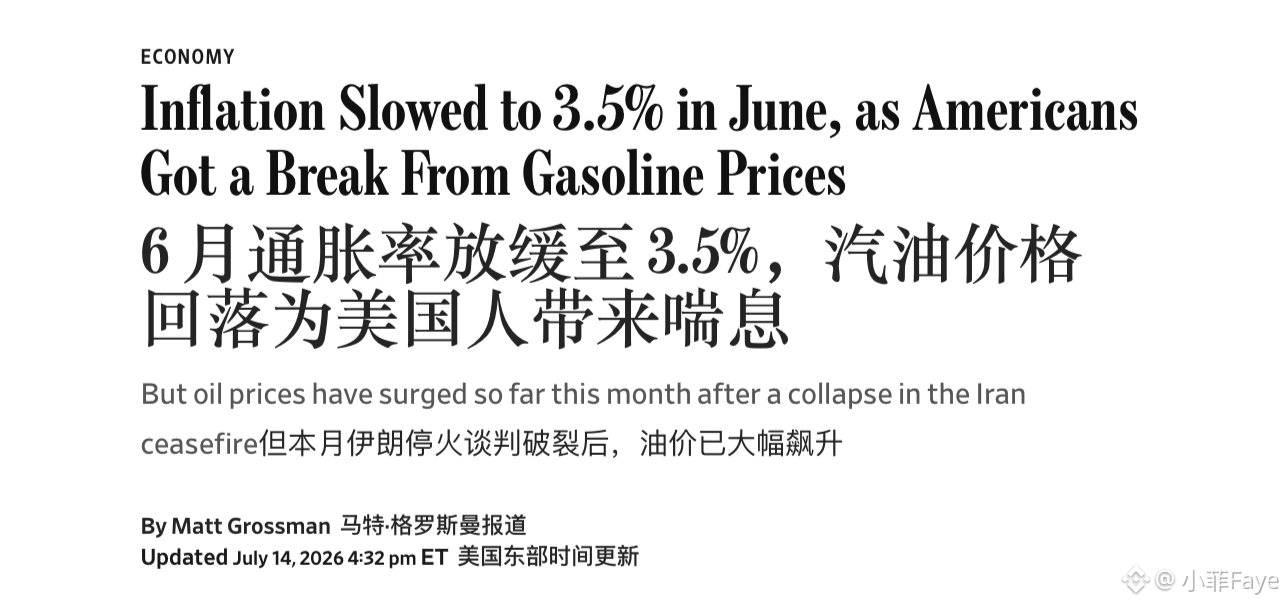
This time, during the U.S. World Cup in June that’s in full swing, the service-sector inflation most worrying to Americans—across services, consumption, transportation, and dining—has not risen 😄
Yesterday, data released by the U.S. Bureau of Labor Statistics on Tuesday showed that in June, the CPI month-on-month fell by 0.4%, the largest single-day drop since April 2020. Year-on-year, it rose by 3.5%, below market expectations of 3.8%, and a sharp retreat from May’s 4.2%. Excluding food and energy, core CPI month-on-month was 0, and it fell to 2.6%; expectations were 2.9%.
After the data was released, the market’s reaction was swift: the yield on the 10-year U.S. Treasury slid to around 4.58%, the U.S. dollar index broke below 101, the Nasdaq rose nearly 1%, and the S&P 500 gained 0.4%. Market expectations for a rate hike in July dropped—from nearly 40% to 17%. Gold has again moved back above $4,000 per ounce.
Big Coin and little coin—especially little coin—have risen clearly. This cooling in inflation this time is mainly because energy prices fell 5.7% month-on-month last month, with gasoline down 9.7%. However, this month, oil prices rebounded by 14% due to renewed tensions from the Iran conflict, and crude oil prices have once again surged to around $86 per barrel.
This time, during the U.S. World Cup in June that’s in full swing, the service-sector inflation most worrying to Americans—across services, consumption, transportation, and dining—has not risen 😄
Yesterday, data released by the U.S. Bureau of Labor Statistics on Tuesday showed that in June, the CPI month-on-month fell by 0.4%, the largest single-day drop since April 2020. Year-on-year, it rose by 3.5%, below market expectations of 3.8%, and a sharp retreat from May’s 4.2%. Excluding food and energy, core CPI month-on-month was 0, and it fell to 2.6%; expectations were 2.9%.
After the data was released, the market’s reaction was swift: the yield on the 10-year U.S. Treasury slid to around 4.58%, the U.S. dollar index broke below 101, the Nasdaq rose nearly 1%, and the S&P 500 gained 0.4%. Market expectations for a rate hike in July dropped—from nearly 40% to 17%. Gold has again moved back above $4,000 per ounce.
Big Coin and little coin—especially little coin—have risen clearly. This cooling in inflation this time is mainly because energy prices fell 5.7% month-on-month last month, with gasoline down 9.7%. However, this month, oil prices rebounded by 14% due to renewed tensions from the Iran conflict, and crude oil prices have once again surged to around $86 per barrel.
Yesterday, data released by the U.S. Bureau of Labor Statistics on Tuesday showed that in June, the CPI month-on-month fell by 0.4%, the largest single-day drop since April 2020. Year-on-year, it rose by 3.5%, below market expectations of 3.8%, and a sharp retreat from May’s 4.2%. Excluding food and energy, core CPI month-on-month was 0, and it fell to 2.6%; expectations were 2.9%.
After the data was released, the market’s reaction was swift: the yield on the 10-year U.S. Treasury slid to around 4.58%, the U.S. dollar index broke below 101, the Nasdaq rose nearly 1%, and the S&P 500 gained 0.4%. Market expectations for a rate hike in July dropped—from nearly 40% to 17%. Gold has again moved back above $4,000 per ounce.
Big Coin and little coin—especially little coin—have risen clearly. This cooling in inflation this time is mainly because energy prices fell 5.7% month-on-month last month, with gasoline down 9.7%. However, this month, oil prices rebounded by 14% due to renewed tensions from the Iran conflict, and crude oil prices have once again surged to around $86 per barrel.
1
861
Log in to explore more content
Join global crypto users on Binance Square
⚡️ Get latest and useful information about crypto.
💬 Trusted by the world’s largest crypto exchange.
👍 Discover real insights from verified creators.
Email / Phone number
Trending Topics
AppleDebutsFoldablePhone
672 views
53 Discussing
#appledebutsfoldablephone iPhone Fold 2026: Apple’s Secret Plan to Kill the Samsung Galaxy Z Fold 8iPhone Fold 2026: Apple’s Secret Plan to Kill the Samsung Galaxy Z Fold 8
Apple is poised to make its long-anticipated entry into the foldable smartphone market with the iPhone Fold, set for release in 2026. This strategic move positions Apple as a direct competitor to Samsung, which has maintained a dominant presence in the foldable segment since the launch of its Galaxy Z Fold series in 2019. By using its globally recognized brand and tightly integrated ecosystem, Apple aims to challenge Samsung’s leadership. However, this ambitious step brings with it critical considerations, including pricing strategies, supply chain readiness, and consumer trust in a first-generation foldable device.$NIL $IDOL $SPORTFUN
Isabella-I
·0 Likes
·4 views
US10YTreasuryYieldHitsHighestSinceNov2023
4,303 views
116 Discussing
USTreasuryToBuyBackUpTo$6BLongDatedDebt
8,693 views
127 Discussing