What caught me was how quickly I stopped caring about the transaction itself and started watching what happened after it. I was digging through Dusk Foundation, $DUSK , #dusk and @Dusk , following recent Phoenix activity in the explorer, and the settlement pattern felt more interesting than the transaction details.
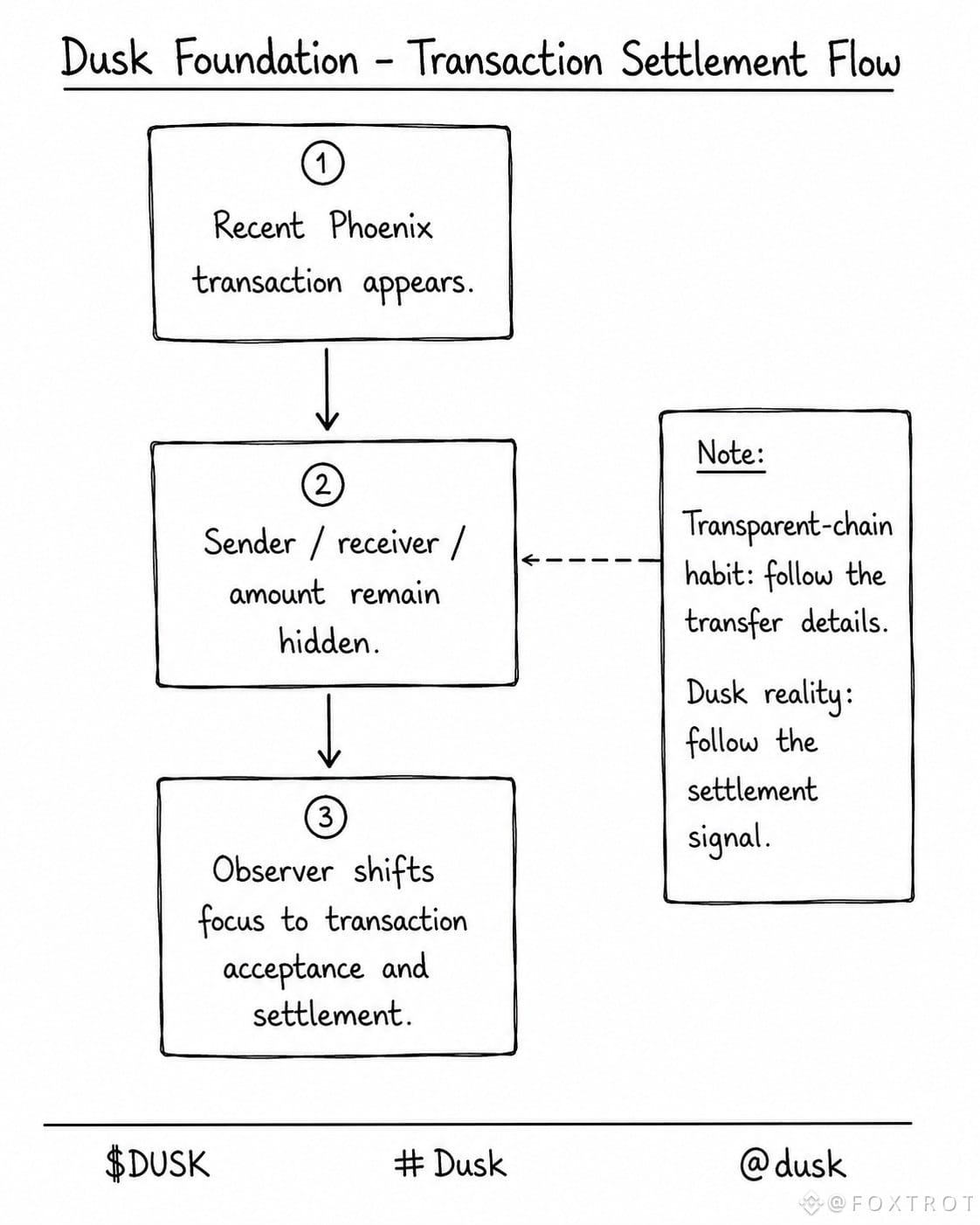
One recent Phoenix transaction showed the usual Dusk quirk: the transaction type is visible, while the sender, receiver and amount are not exposed in the familiar way. What I noticed while following it through settlement was that the useful signal shifts from “who sent what?” to whether the network accepted and finalized the transaction correctly. Dusk’s architecture is built around this separation. The chain can verify the state transition without publishing the private contents.
That sounds obvious when written down. It didn’t feel obvious while I was actually staring at the explorer. I kept expecting the transaction page to give me another clue, then realised I was applying a transparent-chain habit to a privacy-oriented one. Hmm. That changed what I considered “watching a transaction” on Dusk.
Now I’m wondering if this is the real adjustment users have to make: not learning how private transactions work technically, but learning which signals still matter when the usual ones deliberately disappear…
'
One recent Phoenix transaction showed the usual Dusk quirk: the transaction type is visible, while the sender, receiver and amount are not exposed in the familiar way. What I noticed while following it through settlement was that the useful signal shifts from “who sent what?” to whether the network accepted and finalized the transaction correctly. Dusk’s architecture is built around this separation. The chain can verify the state transition without publishing the private contents.
That sounds obvious when written down. It didn’t feel obvious while I was actually staring at the explorer. I kept expecting the transaction page to give me another clue, then realised I was applying a transparent-chain habit to a privacy-oriented one. Hmm. That changed what I considered “watching a transaction” on Dusk.
Now I’m wondering if this is the real adjustment users have to make: not learning how private transactions work technically, but learning which signals still matter when the usual ones deliberately disappear…
'