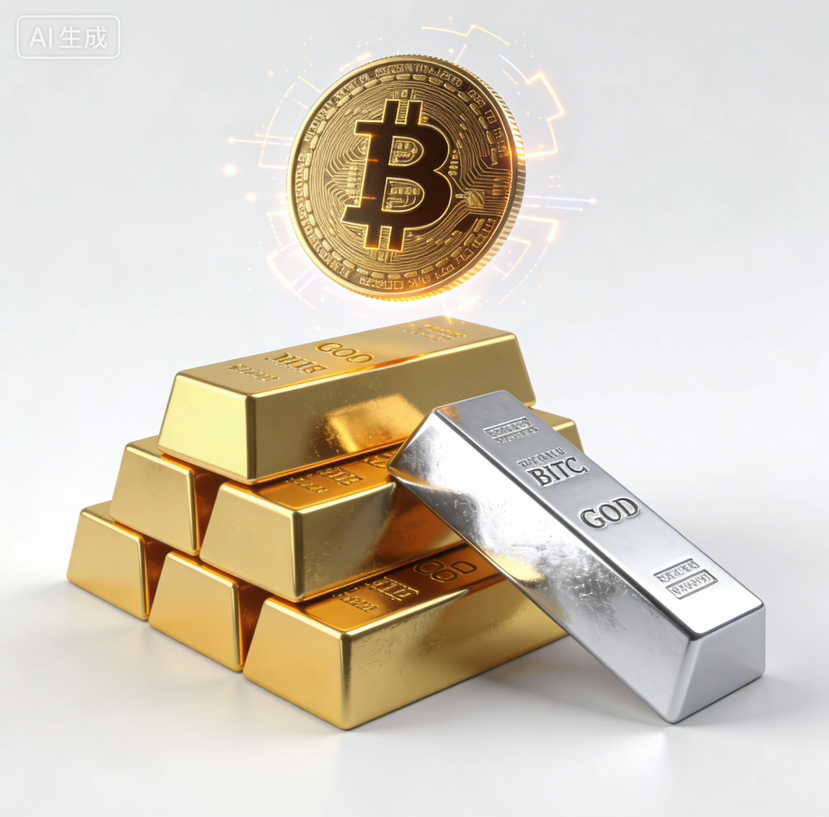
What everyone is currently most entangled with is not the rise and fall of a particular day, but rather three questions intertwined: Is Bitcoin currently undergoing a normal correction, or has it quietly entered a bear market? According to the four-year cycle pattern of Bitcoin, it should theoretically enter a bear market phase in 2026. So why is the U.S. still continuously releasing signals that are 'friendly to crypto'? Additionally, with gold continuing to rise and silver suddenly surging, is all of this actually denying Bitcoin itself?
First, set emotions aside and look at the facts step by step.
The so-called Bitcoin 'four-year cycle' essentially revolves around only one thing—the halving mechanism. Every 210,000 blocks created, the block reward is halved, which occurs roughly every four years. This means that the rate of new Bitcoin production decreases by 50%, and the selling pressure that miners experience from new output gradually diminishes, leading to a tightening supply over the long term. Historically, the past three complete cycles—2012, 2016, and 2020—have indeed exhibited a similar rhythm: approximately 12 to 18 months after the halving, a bull market begins, followed by a bear market phase lasting 1 to 2 years. Because of this, many people naturally deduce the conclusion: if historical patterns continue to hold, then 2026 should be a bear market year according to the 'cycle.'
However, there is a frequently overlooked key fact: the four-year cycle is a supply cycle, not a price cycle. The halving only determines that 'new coins will be fewer' but does not directly dictate that 'prices must rise or fall.' Whether prices enter a bear market truly depends on a more realistic variable—whether there exists sustained and stable capital demand in the market.
Return to the present. From a factual perspective, Bitcoin now aligns more with a 'pullback or high-level fluctuation' rather than a typical bear market. A genuine bear market usually accompanies several very clear signals, such as continuous liquidations of leverage, rapid depletion of market liquidity, and large-scale exits of long-term holders, none of which have comprehensively occurred at this time. On-chain data shows that long-term holders, those with Bitcoin for more than a year, remain relatively stable, which is a significant distinction from the deep bear market of 2022 that was centered around deleveraging. It currently resembles a state of reduced risk appetite; to put it simply, the market is not 'losing faith in Bitcoin,' but rather capital is opting to 'wait and see, take fewer risks.' Therefore, structurally, this appears more as a phased retracement under macro pressure rather than a confirmation of a bear market in the sense of a complete cycle.
So, the question arises: Will 2026 really break the four-year cycle? This is not mere speculation, but has a realistic foundation. An important fact that many people are unwilling to face is that Bitcoin is no longer the Bitcoin of 2016 or 2020. Today's Bitcoin has several previously non-existent variables, including the launch of spot ETFs, the compliance entry of U.S. institutions, its formal inclusion in asset allocation discussions, and a deep binding with macro policies and dollar liquidity. Particularly, the attitude of the U.S. has a substantial impact on the entire cycle structure.
From an objective standpoint, saying that 'the U.S. still has a positive outlook on crypto' is not an emotional judgment. The approval and ongoing operation of Bitcoin spot ETFs is a historic event, signifying that Bitcoin has been formally integrated into the U.S. financial system and is no longer a fringe asset. Meanwhile, the overall direction of U.S. regulation is 'inclusion' rather than 'suppression.' Whether it’s the SEC, CFTC, or discussions at the congressional level, the core keywords are regulation, compliance, and integration into the system, rather than eradication. Against the backdrop of rising pressure from U.S. debt and the long-term depletion of dollar credit, Bitcoin in the U.S. resembles an asset that embodies attributes of risk, financial innovation, and technological competition. This also means that even if 2026 enters an 'adjustment year' according to traditional cycle logic, it is more likely to manifest as a weak bear market, sideways movement, or an extended cycle rather than the deep bear markets of the past.
Now let’s look at gold. The rise in gold is not in opposition to Bitcoin; it reflects a different type of capital demand. The reasons for gold’s strength are very realistic: the global debt level continues to expand, especially the U.S. fiscal deficit and national debt, which suppress long-term confidence; at the same time, expectations for a turning point in real interest rates are forming. Even if interest rates are not immediately lowered, as long as the market believes that tightening will not be infinite, gold holds allocation value; additionally, many central banks have been continuously accumulating gold in recent years, which is publicly available and verifiable data, not driven by sentiment. Essentially, gold represents a defense against the uncertainty of the existing financial system.
As for silver, the logic is not entirely the same as gold. Silver is not only a precious metal but also an important industrial metal. Currently, the core sources of silver demand include the photovoltaic industry—silver paste for photovoltaic cells is a rigid demand, and as global renewable energy installations continue to grow, the long-term use of silver is supported; in the electronics and semiconductor fields, silver’s high conductivity makes it widely used in components such as PCBs, capacitors, and connectors; in new energy vehicles and power systems, silver is also used in critical areas such as charging systems and electronic control modules. At the same time, some countries rely heavily on imports of silver, and with the supply of silver being concentrated and inventory having low elasticity, once demand expectations change, prices can easily be amplified by financial capital. Therefore, the surge in silver prices is essentially a result of the resonance between industrial demand and financial capital.
Looking at everything together, there is actually no contradiction. The current, more realistic state is: gold is defending against uncertainty, silver is amplifying industrial and financial demand, while Bitcoin is waiting for risk appetite to return under macro pressure. This does not mean Bitcoin has failed; rather, different assets play their respective roles at different stages.