📊 Continuing the series about the pitfalls of converting bStocks — today there’s another thing that genuinely surprised me.
Freezing at the smart-contract level.
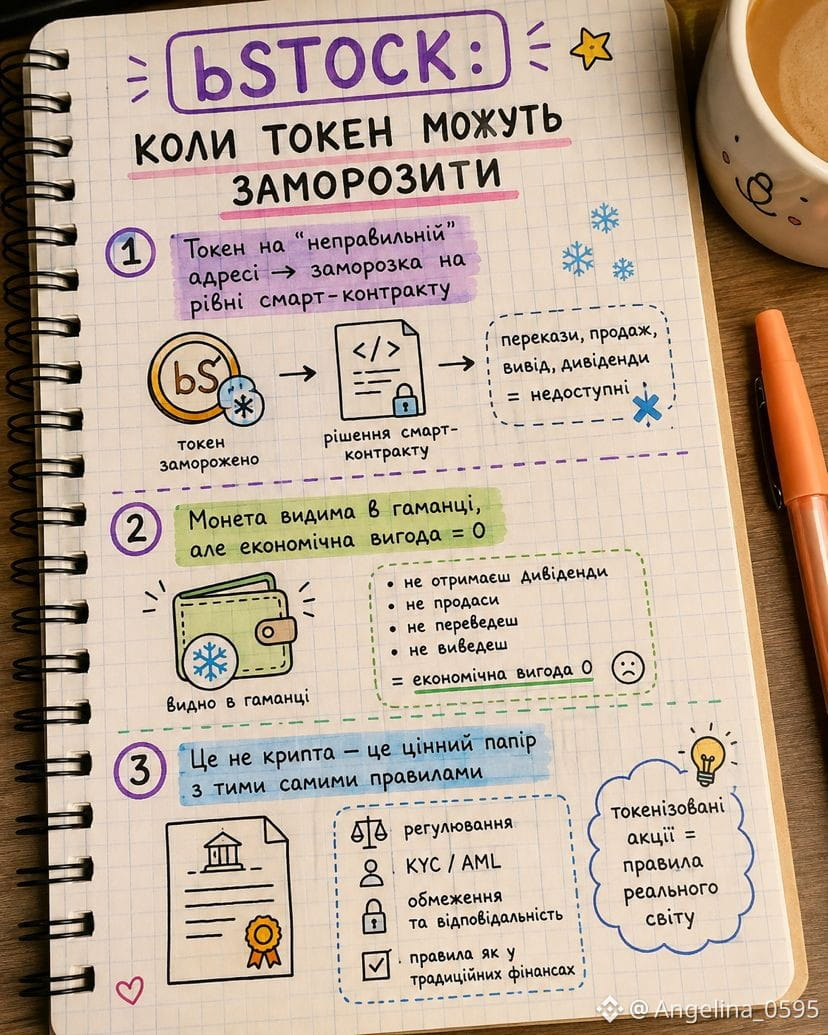
Imagine this: your bStock is technically sitting in your wallet, but if it ends up at an address that violates access rules (a prohibited jurisdiction or a sanctions list) — the token can be frozen, revoked, or nullified right inside the smart contract itself. They won’t block your account, they won’t halt trading — they’ll intervene directly in the token.
So you can see the coin in your wallet, and it’ll look like everything is fine — but in reality, all the economic benefit from it disappears. The token is there, but the usefulness is zero.
That’s why, before withdrawing bStock to an external wallet, they ask you to separately confirm that you understand: this isn’t ordinary crypto — it’s a security, and the same rules that apply to classic shares apply to it too — they’re just written directly into the token’s code now.
For me, the takeaway is warm but honest: bStock really is convenient, but don’t think of it as “just a normal token that my wallet can do whatever it wants with.” Access rules don’t go away, even when the asset is already on the blockchain.
$SPCXB
@BinanceCIS
#bStocksCIS
Freezing at the smart-contract level.
Imagine this: your bStock is technically sitting in your wallet, but if it ends up at an address that violates access rules (a prohibited jurisdiction or a sanctions list) — the token can be frozen, revoked, or nullified right inside the smart contract itself. They won’t block your account, they won’t halt trading — they’ll intervene directly in the token.
So you can see the coin in your wallet, and it’ll look like everything is fine — but in reality, all the economic benefit from it disappears. The token is there, but the usefulness is zero.
That’s why, before withdrawing bStock to an external wallet, they ask you to separately confirm that you understand: this isn’t ordinary crypto — it’s a security, and the same rules that apply to classic shares apply to it too — they’re just written directly into the token’s code now.
For me, the takeaway is warm but honest: bStock really is convenient, but don’t think of it as “just a normal token that my wallet can do whatever it wants with.” Access rules don’t go away, even when the asset is already on the blockchain.
$SPCXB
@BinanceCIS
#bStocksCIS