#dusk $DUSK @Dusk
I used to treat "tokenization" and "native issuance" as interchangeable terms. After reading the Dusk documentation carefully, I realized that was a pretty big mistake.
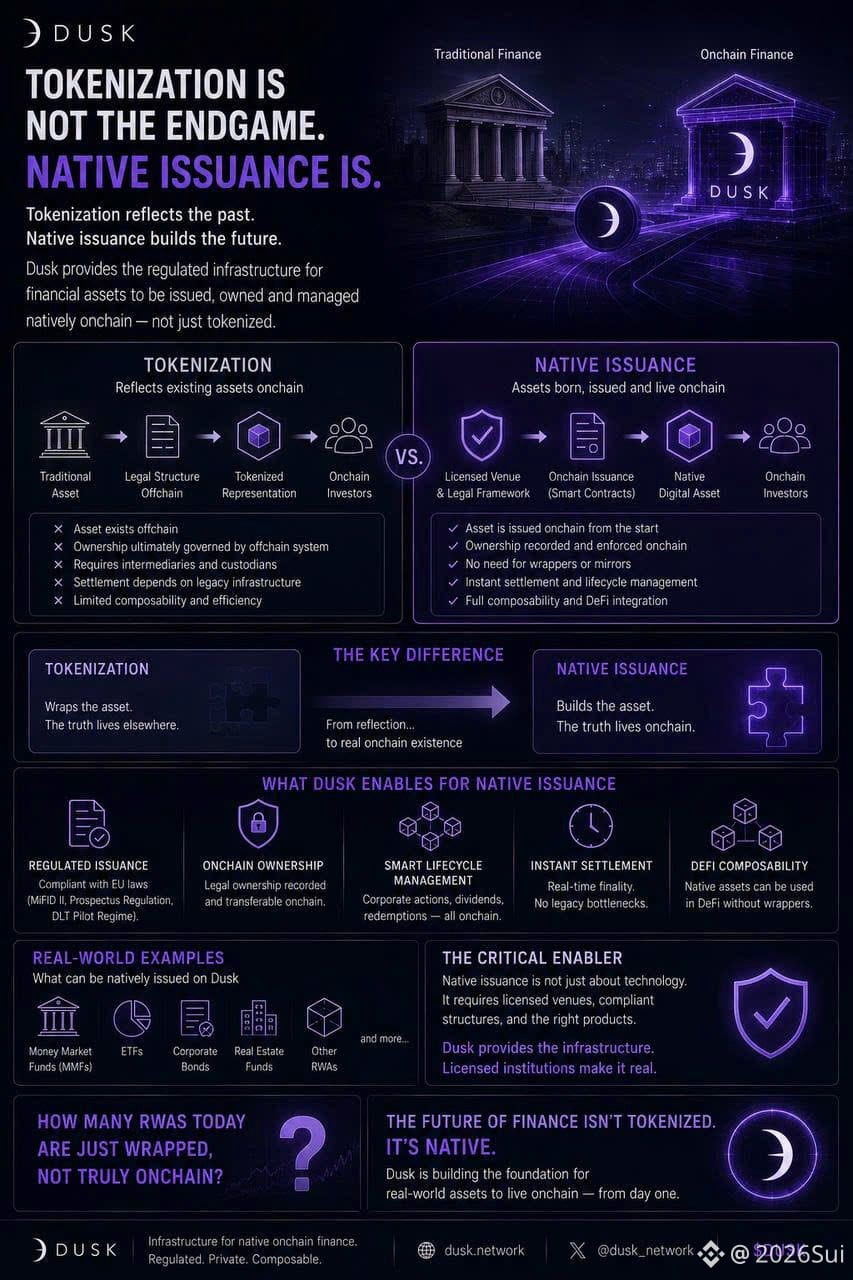
Tokenization is taking an existing asset—stocks, bonds, funds—then wrapping it into an onchain token. The underlying original asset still remains in the legacy system; the chain only reflects it.
Native issuance is different: part of the asset’s lifecycle—from issuance to ownership—is moved directly onto the onchain environment, without needing a middle layer to mirror it.
The issue isn’t whether the technology can support native issuance. The question is whether the issuing organization has the proper licenses and product structure to do it legally. Dusk builds infrastructure so that when the conditions are met—licensed venues, products meeting the required standards—the native issuance process has somewhere to run, instead of stopping at surface-level tokenization.
The question isn’t whether RWA will go onchain. The question is: how many RWAs today are merely wrapped, rather than truly living onchain?
I used to treat "tokenization" and "native issuance" as interchangeable terms. After reading the Dusk documentation carefully, I realized that was a pretty big mistake.
Tokenization is taking an existing asset—stocks, bonds, funds—then wrapping it into an onchain token. The underlying original asset still remains in the legacy system; the chain only reflects it.
Native issuance is different: part of the asset’s lifecycle—from issuance to ownership—is moved directly onto the onchain environment, without needing a middle layer to mirror it.
The issue isn’t whether the technology can support native issuance. The question is whether the issuing organization has the proper licenses and product structure to do it legally. Dusk builds infrastructure so that when the conditions are met—licensed venues, products meeting the required standards—the native issuance process has somewhere to run, instead of stopping at surface-level tokenization.
The question isn’t whether RWA will go onchain. The question is: how many RWAs today are merely wrapped, rather than truly living onchain?