#dusk $DUSK @Dusk
Most EVM privacy designs start with ZK proofs. Dusk took a different route.
I kept digging into Hedger, and the interesting part isn't simply “private transactions.”
It's how Dusk is trying to make confidential EVM finance actually usable.
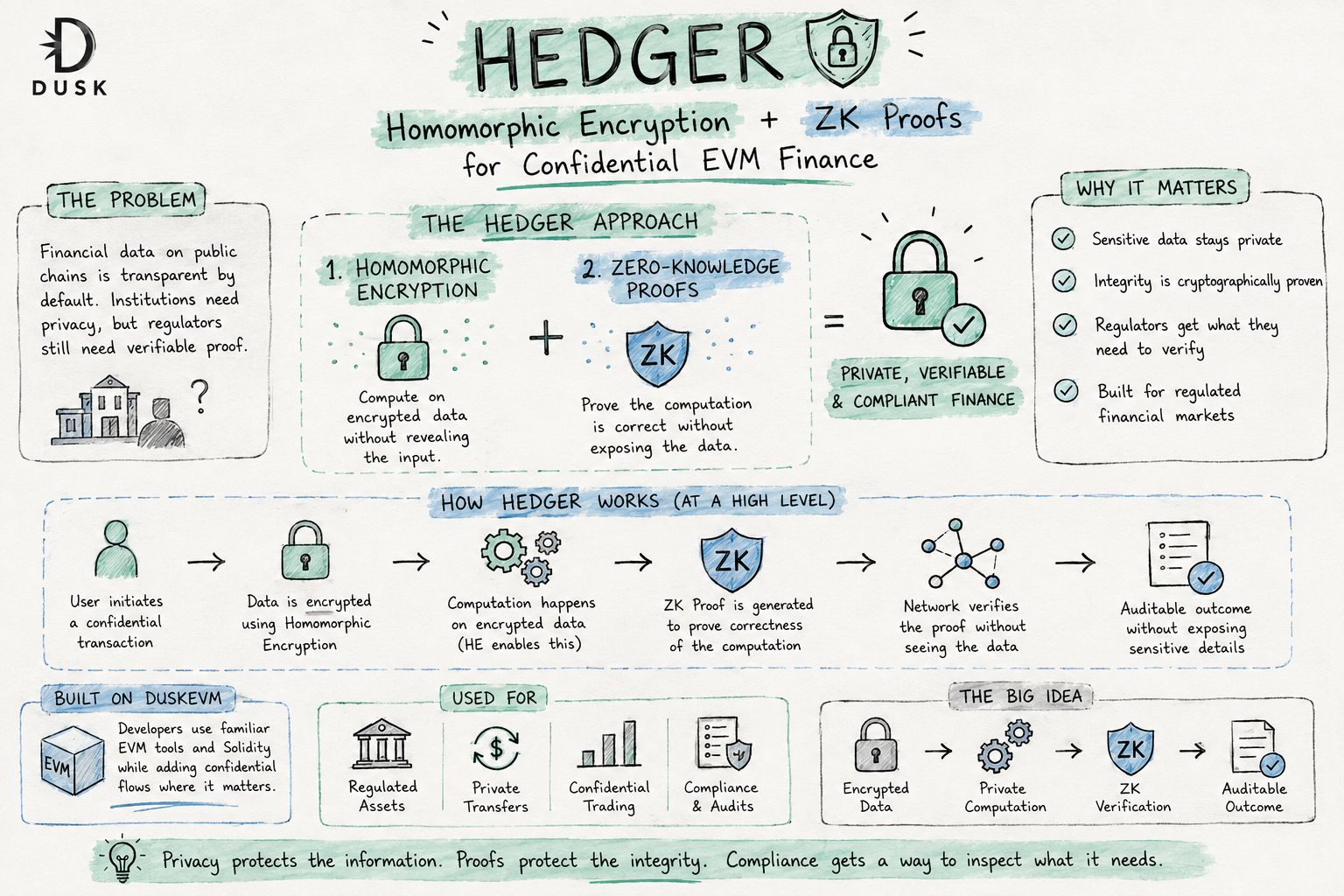
Hedger combines two cryptographic tools:
→ Homomorphic Encryption lets computations happen on encrypted values, so sensitive data doesn't have to be exposed just to process it.
→ Zero-Knowledge Proofs let the network verify that the computation is correct without revealing the underlying inputs.
That combination matters because financial privacy isn't the same as hiding everything.
Think about an institution trading a regulated asset.
It may not want its balance, position size, transfer amount or trading intent visible to everyone.
But regulators still need a way to verify that the rules were followed.
That's the gap Hedger is targeting.
And there's another detail I found important:
Hedger lives on DuskEVM.
So developers can work with the EVM environment and familiar tooling while adding confidential flows where they actually make sense. Dusk describes Hedger as its privacy engine for EVM applications, with support for confidential ownership and transfers and auditable transactions.
This is why I don't see Hedger as just another privacy feature.
The bigger idea is that
encrypted data → private computation → ZK verification → auditable outcome.
For regulated finance, that architecture is much more interesting than simply saying “transactions are private.”
Privacy protects the information.
Proofs protect the integrity.
And compliance gets a way to inspect what it needs.
That's the part of Dusk's EVM architecture I'm watching most closely.
Most EVM privacy designs start with ZK proofs. Dusk took a different route.
I kept digging into Hedger, and the interesting part isn't simply “private transactions.”
It's how Dusk is trying to make confidential EVM finance actually usable.
Hedger combines two cryptographic tools:
→ Homomorphic Encryption lets computations happen on encrypted values, so sensitive data doesn't have to be exposed just to process it.
→ Zero-Knowledge Proofs let the network verify that the computation is correct without revealing the underlying inputs.
That combination matters because financial privacy isn't the same as hiding everything.
Think about an institution trading a regulated asset.
It may not want its balance, position size, transfer amount or trading intent visible to everyone.
But regulators still need a way to verify that the rules were followed.
That's the gap Hedger is targeting.
And there's another detail I found important:
Hedger lives on DuskEVM.
So developers can work with the EVM environment and familiar tooling while adding confidential flows where they actually make sense. Dusk describes Hedger as its privacy engine for EVM applications, with support for confidential ownership and transfers and auditable transactions.
This is why I don't see Hedger as just another privacy feature.
The bigger idea is that
encrypted data → private computation → ZK verification → auditable outcome.
For regulated finance, that architecture is much more interesting than simply saying “transactions are private.”
Privacy protects the information.
Proofs protect the integrity.
And compliance gets a way to inspect what it needs.
That's the part of Dusk's EVM architecture I'm watching most closely.