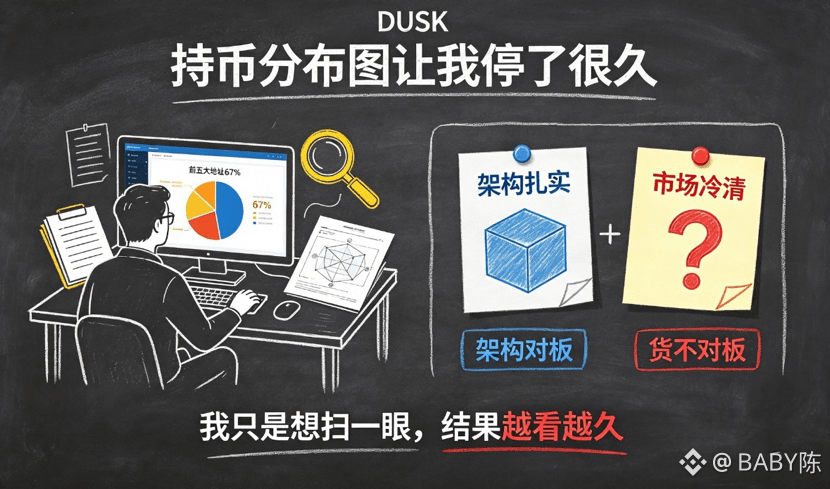
Last night, I only meant to do a routine scan of DUSK’s on-chain data—and ended up staring at it much longer than I expected.
The further I looked, the more DUSK started to feel like a contradiction: technically, it has been refined and hardened enough to be solid, yet on the market side there’s a chilling sense of “it doesn’t quite match the offering.”
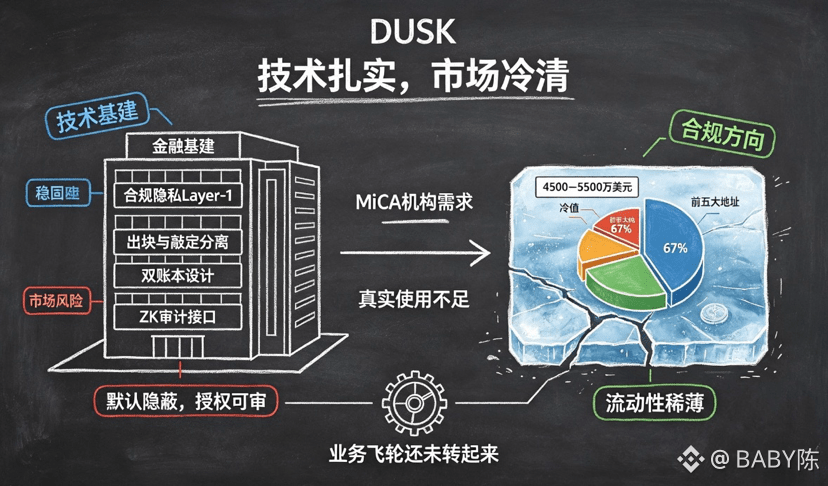
Let’s start with the technicals. DUSK is a compliant privacy Layer-1 with separation between block production and finalization, a dual-ledger design, and ZK audit interfaces. The mainnet has been running stably for 17 months. Under the MiCA framework, those eight words—“default is hidden, authorized can be audited”—really hit the nerve that institutions care about most. Financial applications need privacy, but regulators can’t accept a black box. This positioning makes me revisit its competitive logic: while other projects compete on TPS and TVL, DUSK focuses its effort on “who can see what” and “who can verify what.” If its core users are the securities market and regulated asset issuers, this architecture is more convincing than pure throughput.
But the issue is exactly here.
When people talk about institutional adoption, they usually emphasize the number of partners or the size of pilot programs. DUSK’s real situation is different: the top five addresses hold nearly 67%, ongoing unlocks create sell pressure, and its market cap has hovered around $45–55 million. Liquidity is as thin as a sheet of ice. In the token economy, there’s a lack of scenarios that drive ongoing institutional consumption. On-chain securities issuance has, so far, only reached the tens-of-millions-of-euros scale—there are pilots, sure, but it’s still far from a “business flywheel.”
What makes me stay cautious is that this “European-style compliance” moat may be more fragile than people think. Shifts in regulatory frameworks and policy shocks along the U.S. path could redefine the boundaries of what counts as “compliance” at any time.
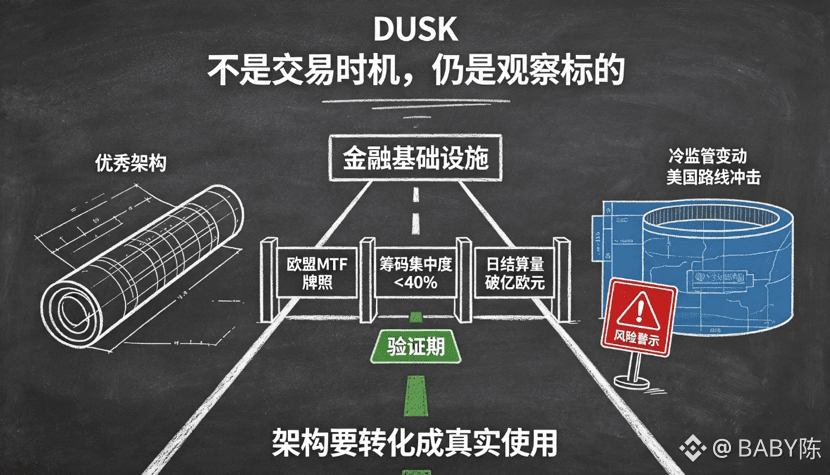
The more I look, the more it seems that DUSK’s value isn’t about becoming another hot public chain—it’s about whether “verifiable privacy” can truly be embedded into financial infrastructure. But for that to work, three things must happen at the same time: the EU MTF license landing, token concentration dropping below 40%, and daily settlement volume breaking 100 million euros.
Right now, it’s still something worth watching, not a timing opportunity to trade. Great architecture needs to be converted into sustained, real usage—and that path is only just at the threshold of verification for DUSK.
#dusk $DUSK @Dusk
The further I looked, the more DUSK started to feel like a contradiction: technically, it has been refined and hardened enough to be solid, yet on the market side there’s a chilling sense of “it doesn’t quite match the offering.”
Let’s start with the technicals. DUSK is a compliant privacy Layer-1 with separation between block production and finalization, a dual-ledger design, and ZK audit interfaces. The mainnet has been running stably for 17 months. Under the MiCA framework, those eight words—“default is hidden, authorized can be audited”—really hit the nerve that institutions care about most. Financial applications need privacy, but regulators can’t accept a black box. This positioning makes me revisit its competitive logic: while other projects compete on TPS and TVL, DUSK focuses its effort on “who can see what” and “who can verify what.” If its core users are the securities market and regulated asset issuers, this architecture is more convincing than pure throughput.
But the issue is exactly here.
When people talk about institutional adoption, they usually emphasize the number of partners or the size of pilot programs. DUSK’s real situation is different: the top five addresses hold nearly 67%, ongoing unlocks create sell pressure, and its market cap has hovered around $45–55 million. Liquidity is as thin as a sheet of ice. In the token economy, there’s a lack of scenarios that drive ongoing institutional consumption. On-chain securities issuance has, so far, only reached the tens-of-millions-of-euros scale—there are pilots, sure, but it’s still far from a “business flywheel.”
What makes me stay cautious is that this “European-style compliance” moat may be more fragile than people think. Shifts in regulatory frameworks and policy shocks along the U.S. path could redefine the boundaries of what counts as “compliance” at any time.
The more I look, the more it seems that DUSK’s value isn’t about becoming another hot public chain—it’s about whether “verifiable privacy” can truly be embedded into financial infrastructure. But for that to work, three things must happen at the same time: the EU MTF license landing, token concentration dropping below 40%, and daily settlement volume breaking 100 million euros.
Right now, it’s still something worth watching, not a timing opportunity to trade. Great architecture needs to be converted into sustained, real usage—and that path is only just at the threshold of verification for DUSK.
#dusk $DUSK @Dusk