#bstockscis
SKHYB, SKHYUSDT and SKHYNIXUSDT: what’s the difference?
If you’re new to Binance and search for SK Hynix, you can easily get confused.
You may see:
$SKHYB
$SKHY USDT
$SKHYNIX USDT
And think:
“These are just three ways to trade the same thing.”
Not exactly.
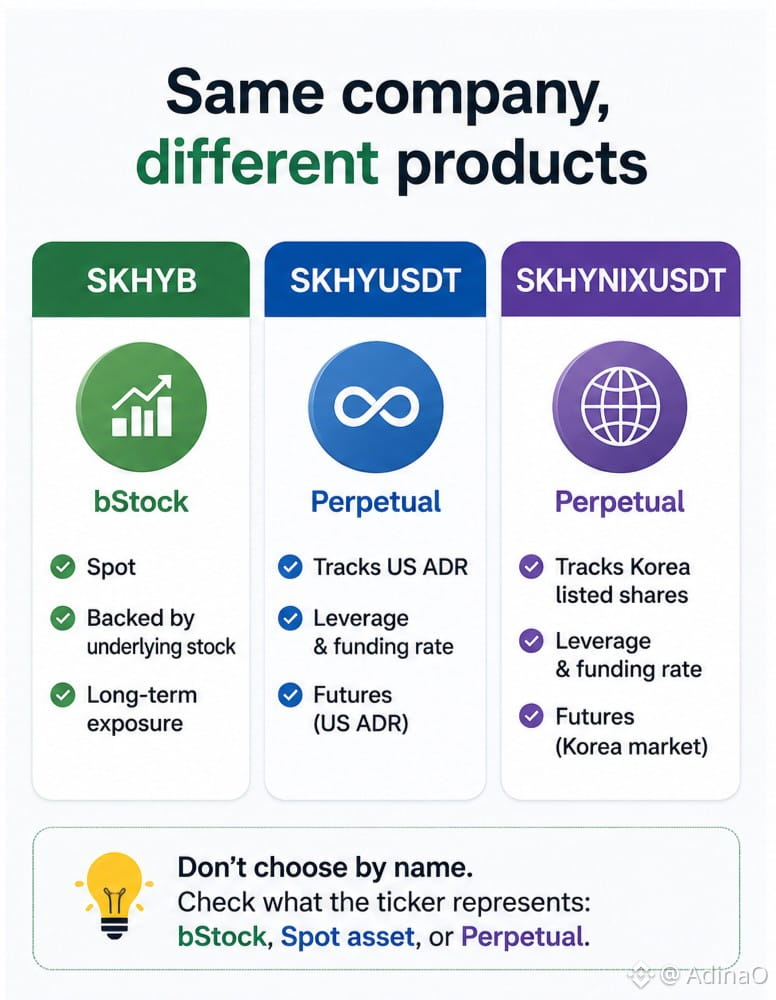
SKHYB is the bStock. It trades on Spot and is backed by the underlying stock, giving you tokenized exposure to SK Hynix.
SKHYUSDT is a perpetual futures contract that tracks the U.S. ADR of SK Hynix. It does not give you ownership of the bStock, and it involves futures mechanics such as leverage and funding rates.
And SKHYNIXUSDT is another perpetual contract, but it tracks SK Hynix shares listed in South Korea.
This creates an important point:
These products can move differently.
Why?
Because they track different listings and markets, with different trading hours, currencies and local market conditions.
So if my goal is long-term tokenized exposure to the stock, I would look at SKHYB.
If I open a leveraged perpetual position, that’s a completely different strategy with a completely different risk level.
My rule for beginners:
Don’t choose an asset just because you recognize the company name.
First check what the ticker actually represents: a bStock, a Spot asset, or a perpetual futures contract.
Same company ≠ same product.
And I think understanding this before your first bStock purchase can prevent a lot of unnecessary confusion.
@BinanceCIS #bstocksсis
SKHYB, SKHYUSDT and SKHYNIXUSDT: what’s the difference?
If you’re new to Binance and search for SK Hynix, you can easily get confused.
You may see:
$SKHYB
$SKHY USDT
$SKHYNIX USDT
And think:
“These are just three ways to trade the same thing.”
Not exactly.
SKHYB is the bStock. It trades on Spot and is backed by the underlying stock, giving you tokenized exposure to SK Hynix.
SKHYUSDT is a perpetual futures contract that tracks the U.S. ADR of SK Hynix. It does not give you ownership of the bStock, and it involves futures mechanics such as leverage and funding rates.
And SKHYNIXUSDT is another perpetual contract, but it tracks SK Hynix shares listed in South Korea.
This creates an important point:
These products can move differently.
Why?
Because they track different listings and markets, with different trading hours, currencies and local market conditions.
So if my goal is long-term tokenized exposure to the stock, I would look at SKHYB.
If I open a leveraged perpetual position, that’s a completely different strategy with a completely different risk level.
My rule for beginners:
Don’t choose an asset just because you recognize the company name.
First check what the ticker actually represents: a bStock, a Spot asset, or a perpetual futures contract.
Same company ≠ same product.
And I think understanding this before your first bStock purchase can prevent a lot of unnecessary confusion.
@BinanceCIS #bstocksсis