Last weekend’s meal, especially the anesthesiologist’s line—“Where’s the manual?”—really left me speechless for quite a while. On the way home, I kept thinking: if everyone who pays first asked, “Do I really understand what this is?” then the crypto circle would probably be at least half as quiet.
So last night, when I came across the GitHub of @Dusk , I deliberately calmed down and went through its commit history page by page.
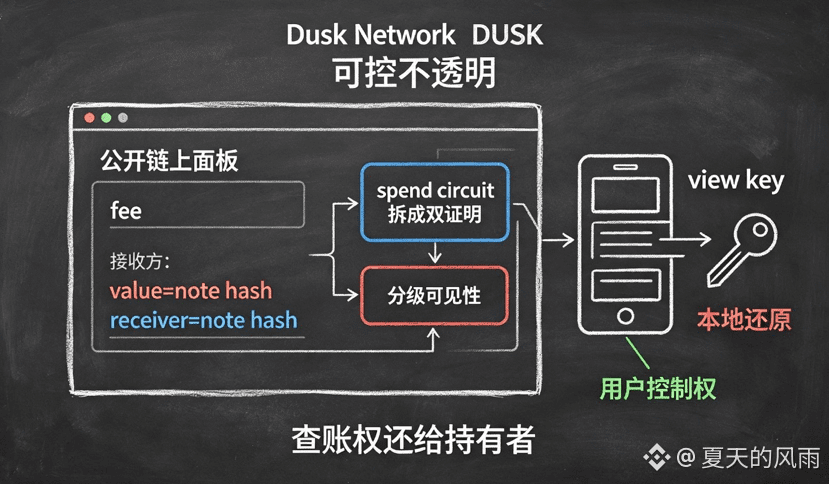
The refactor in April caught my attention— they split Phoenix Note’s spend circuit into two separate proofs. What does that mean? Sacrificing a bit of gas in exchange for “graded visibility.” The testnet results were: on the public panel, it only shows the fee; the value and receiver are compressed into the note hash, so outsiders can’t tell who sent how much to whom at all. But the official wallet can reconstruct the full transaction details locally using a view key. And that key is derived purely on the client side—it doesn’t go through any server, and there’s no backdoor.
When I got to this point, I basically understood it. $DUSK didn’t take the path of “regulator-friendly backdoor coins.” Instead, it strips auditing authority out of the consensus layer and hands it back to the holder themselves—positioned as a social tool rather than a compliance tool. If you want to show someone your transaction history, give them a view key; if you don’t, no one can pry it open.
This positioning is called “controllable but not transparent.” It fits scenarios like on-chain securities and dark-pool order books—cases that require privacy but can’t be completely unregulated. But the problem is also here: compliance folks feel you’re not transparent enough, while privacy absolutists feel you’re doing this extra step for no reason. It’s not good for either side.
Whether it succeeds is hard to predict. But at least it didn’t copy the standard answers from op/zk, and it didn’t leave room for any centralized backdoor. In this industry, people who actually dare to write the problem-solving steps themselves deserve to be marked.
Looking back, if every project team were willing to lay out its design logic the way a drug’s instruction manual is laid out, a lot of bad stuff would probably be avoided. I read Dusk’s “manual,” and the logic is internally consistent. As for whether it’s worth investing in—that’s another matter. At least this time, I didn’t blindly guess.
#dusk $DUSK @Dusk
So last night, when I came across the GitHub of @Dusk , I deliberately calmed down and went through its commit history page by page.
The refactor in April caught my attention— they split Phoenix Note’s spend circuit into two separate proofs. What does that mean? Sacrificing a bit of gas in exchange for “graded visibility.” The testnet results were: on the public panel, it only shows the fee; the value and receiver are compressed into the note hash, so outsiders can’t tell who sent how much to whom at all. But the official wallet can reconstruct the full transaction details locally using a view key. And that key is derived purely on the client side—it doesn’t go through any server, and there’s no backdoor.
When I got to this point, I basically understood it. $DUSK didn’t take the path of “regulator-friendly backdoor coins.” Instead, it strips auditing authority out of the consensus layer and hands it back to the holder themselves—positioned as a social tool rather than a compliance tool. If you want to show someone your transaction history, give them a view key; if you don’t, no one can pry it open.
This positioning is called “controllable but not transparent.” It fits scenarios like on-chain securities and dark-pool order books—cases that require privacy but can’t be completely unregulated. But the problem is also here: compliance folks feel you’re not transparent enough, while privacy absolutists feel you’re doing this extra step for no reason. It’s not good for either side.
Whether it succeeds is hard to predict. But at least it didn’t copy the standard answers from op/zk, and it didn’t leave room for any centralized backdoor. In this industry, people who actually dare to write the problem-solving steps themselves deserve to be marked.
Looking back, if every project team were willing to lay out its design logic the way a drug’s instruction manual is laid out, a lot of bad stuff would probably be avoided. I read Dusk’s “manual,” and the logic is internally consistent. As for whether it’s worth investing in—that’s another matter. At least this time, I didn’t blindly guess.
#dusk $DUSK @Dusk