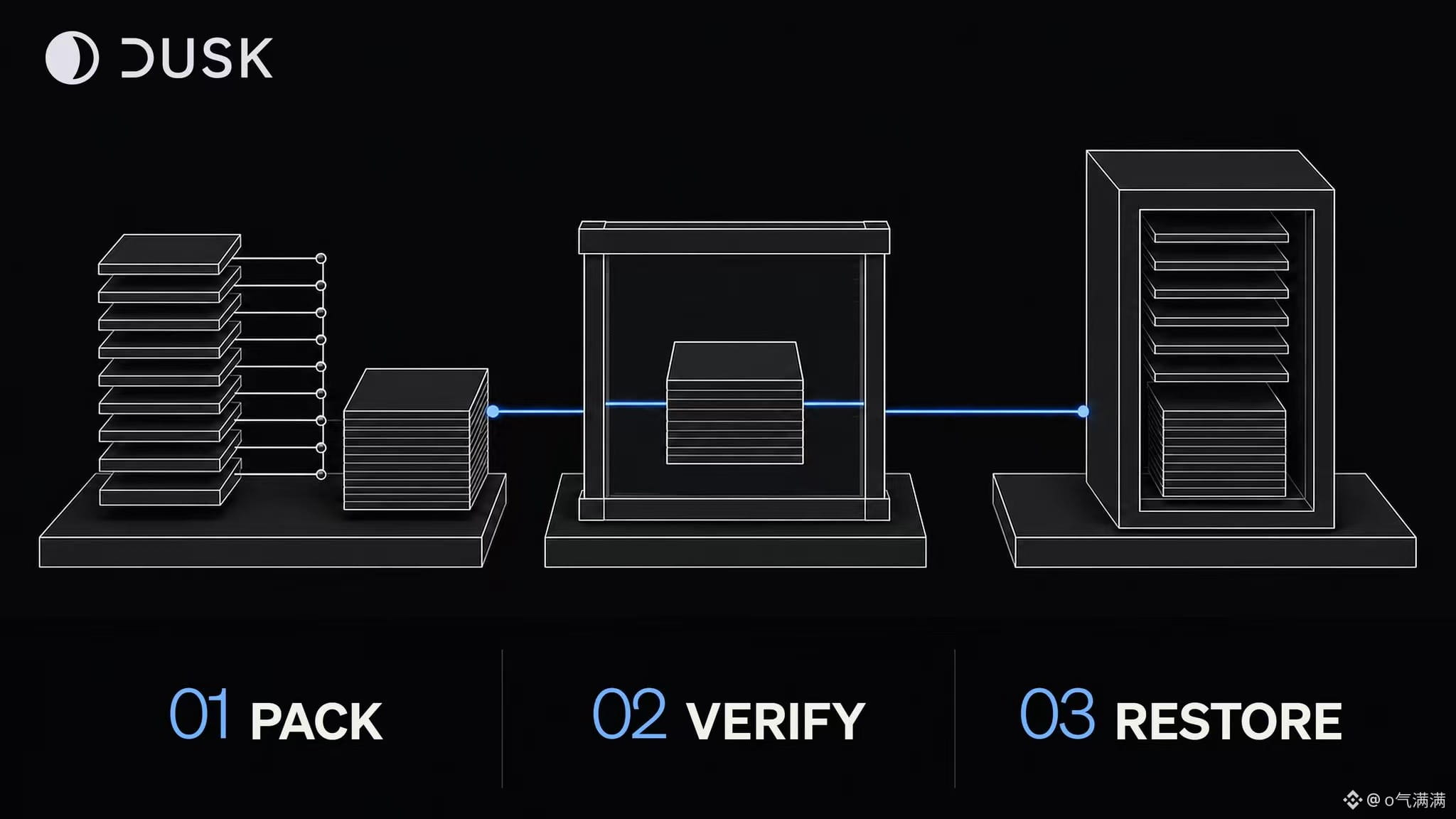
This weekend I had dinner with a few friends who do traditional finance and we talked about on-chain assets. What they care about isn’t speed or fees—it’s whether the data can truly be kept hidden. Once the public ledger grows beyond a certain scale, it becomes difficult to continue using it, and that contradiction made me dig back into Dusk’s materials. It builds confidentiality into the underlying architecture and contract standards. Through XSC and privacy smart contracts, data remains encrypted, while the network can still verify that transactions are valid and that the system state is normal. @Dusk ’s design is more thorough than patching things later, but what ultimately decides the outcome is whether there is enough real financial activity willing to come in. $DUSK
The technical feasibility already has a shape; the real challenge is whether the market is ready to pay for privacy. On-chain finance defaults to transparency. Many people treat transparency as a source of trust—once you hide key data, you have to rebuild trust. Dusk replaces openness with verifiable confidentiality, so the network can’t see the contents yet can still prove that the rules are running. The direction is reasonable, but that doesn’t mean it will be adopted right away. #dusk Infrastructure value only becomes apparent when capital starts flowing—developers, liquidity, and long-term incentives are the hard metrics. A proposal isn’t the same as a need; the market will vote on whether privacy is a standard feature or just for a few niche scenarios. What I care about most is: when real funds require confidentiality, can it become the dependable underlying infrastructure? Whether privacy will turn into a core capability still depends on how things play out over the next few years. $BTC
The technical feasibility already has a shape; the real challenge is whether the market is ready to pay for privacy. On-chain finance defaults to transparency. Many people treat transparency as a source of trust—once you hide key data, you have to rebuild trust. Dusk replaces openness with verifiable confidentiality, so the network can’t see the contents yet can still prove that the rules are running. The direction is reasonable, but that doesn’t mean it will be adopted right away. #dusk Infrastructure value only becomes apparent when capital starts flowing—developers, liquidity, and long-term incentives are the hard metrics. A proposal isn’t the same as a need; the market will vote on whether privacy is a standard feature or just for a few niche scenarios. What I care about most is: when real funds require confidentiality, can it become the dependable underlying infrastructure? Whether privacy will turn into a core capability still depends on how things play out over the next few years. $BTC