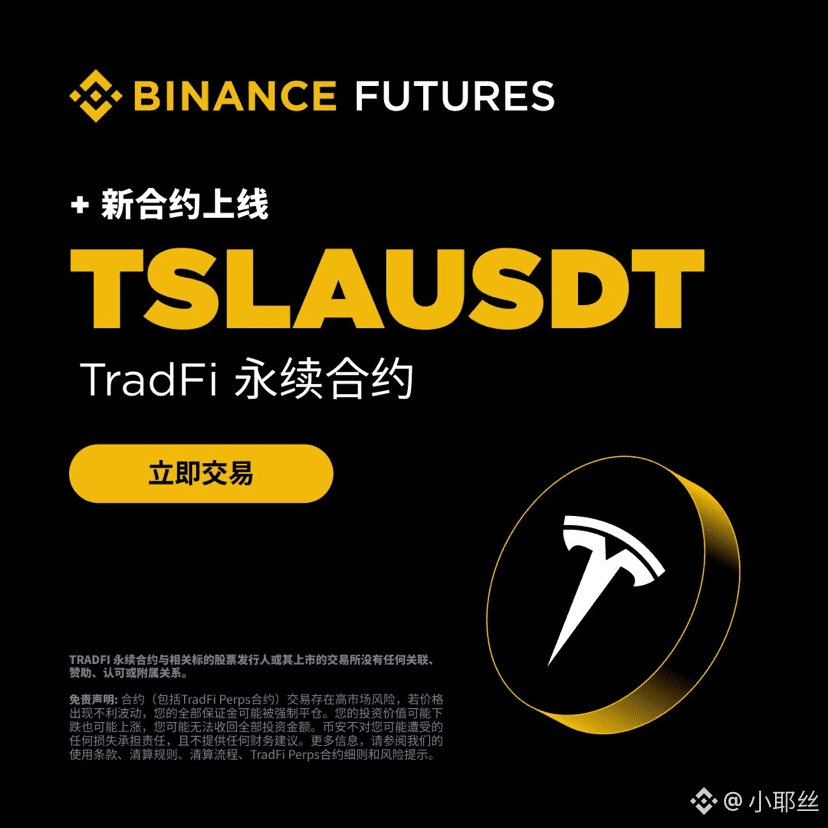
Just saw the announcement, Binance is going to launch Tesla (TSLA) perpetual contracts on January 28th. Maximum leverage of 5 times, directly bringing Musk's 'God car' into the crypto scene to party.
The equity tokens back then insisted on being linked to actual stocks, and even involved dividends and voting rights, which in the eyes of regulators is 'illegal securities'. The current perpetual contracts, to put it plainly, are just playing derivatives. Binance's moat and compliance experience in derivatives is evidently much more mature than simply tokenization back then. This 'curved rescue' avoids the most sensitive issue of securities issuance.
Let's look at the current environment: After Trump took office, America's attitude towards crypto has done a complete 180. The New York Stock Exchange is set to launch 24/7 tokenized trading, and giants like Nasdaq, JPMorgan, and Goldman Sachs are all laying out plans for RWA (Real World Assets).
Previously, we had to fight for traditional finance's meal, but now traditional finance is begging to integrate blockchain technology. Binance restarting U.S. stock targets at this time is perfectly timed, and this is capitalizing on policy dividends.
Honestly, 5 times leverage might seem a bit 'health-conscious' for those seasoned in playing contracts. But this signal is still significant.
Many future traders of U.S. stocks wishing to play TSLA volatility might come directly to Binance, without waiting for U.S. stock market openings, trading 24/7 at any time. Previously, RWA was trading U.S. bonds, now directly trading the leading U.S. stocks. If TSLA succeeds, how far can Nvidia, Apple, and Google be?
This kind of product can directly bring traditional asset event-driven activities (like when Elon Musk tweets) into the crypto market, providing more hedging and arbitrage opportunities for funds.
Binance's return to the U.S. stock market is essentially a bold exploration by crypto giants under the high walls of compliance, probing the boundaries of traditional finance. @币安广场
#创作者大奖
The equity tokens back then insisted on being linked to actual stocks, and even involved dividends and voting rights, which in the eyes of regulators is 'illegal securities'. The current perpetual contracts, to put it plainly, are just playing derivatives. Binance's moat and compliance experience in derivatives is evidently much more mature than simply tokenization back then. This 'curved rescue' avoids the most sensitive issue of securities issuance.
Let's look at the current environment: After Trump took office, America's attitude towards crypto has done a complete 180. The New York Stock Exchange is set to launch 24/7 tokenized trading, and giants like Nasdaq, JPMorgan, and Goldman Sachs are all laying out plans for RWA (Real World Assets).
Previously, we had to fight for traditional finance's meal, but now traditional finance is begging to integrate blockchain technology. Binance restarting U.S. stock targets at this time is perfectly timed, and this is capitalizing on policy dividends.
Honestly, 5 times leverage might seem a bit 'health-conscious' for those seasoned in playing contracts. But this signal is still significant.
Many future traders of U.S. stocks wishing to play TSLA volatility might come directly to Binance, without waiting for U.S. stock market openings, trading 24/7 at any time. Previously, RWA was trading U.S. bonds, now directly trading the leading U.S. stocks. If TSLA succeeds, how far can Nvidia, Apple, and Google be?
This kind of product can directly bring traditional asset event-driven activities (like when Elon Musk tweets) into the crypto market, providing more hedging and arbitrage opportunities for funds.
Binance's return to the U.S. stock market is essentially a bold exploration by crypto giants under the high walls of compliance, probing the boundaries of traditional finance. @币安广场
#创作者大奖