The most underrated thing when comparing bStocks isn’t price.
It’s liquidity at the moment when you really need to exit.
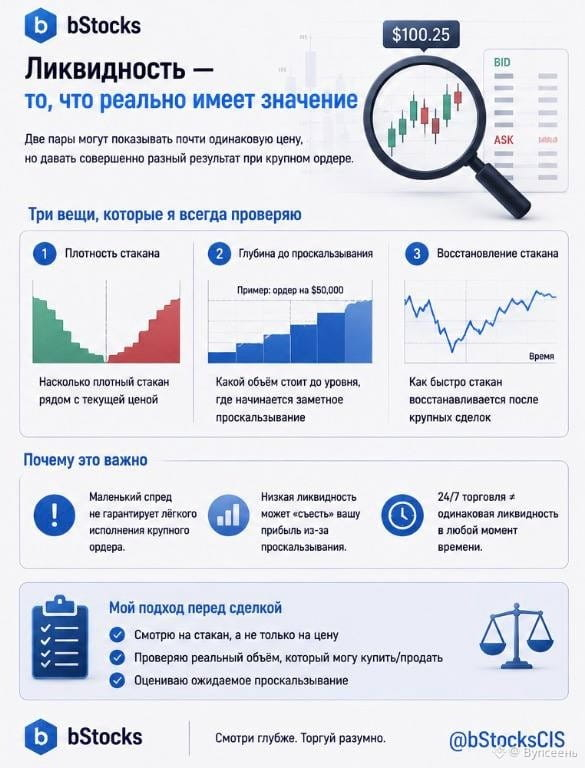
Two pairs can show nearly the same price, but produce completely different results with a large order.
I’d look at three things:
how tight the order book is near the current price;
what volume sits up to the level where noticeable slippage begins;
how quickly the order book recovers after large trades.
The last point is especially interesting.
If one large order instantly eats through several levels and the orders come back slowly, a nice-looking price on the screen still tells you nothing about real executability.
So when it comes to bStocks, I’m increasingly not only looking at “what price is it trading at?”, but at “what price will I realistically be able to buy or sell the required volume for?”.
#bStocksCIS @BinanceCIS
It’s liquidity at the moment when you really need to exit.
Two pairs can show nearly the same price, but produce completely different results with a large order.
I’d look at three things:
how tight the order book is near the current price;
what volume sits up to the level where noticeable slippage begins;
how quickly the order book recovers after large trades.
The last point is especially interesting.
If one large order instantly eats through several levels and the orders come back slowly, a nice-looking price on the screen still tells you nothing about real executability.
So when it comes to bStocks, I’m increasingly not only looking at “what price is it trading at?”, but at “what price will I realistically be able to buy or sell the required volume for?”.
#bStocksCIS @BinanceCIS