


I think the market is now seriously underestimating $MORPHO.
If you look only at the token price, MORPHO may just be another DeFi governance token.
But if you view it as an “on-chain lending infrastructure company,” the numbers are already at an entirely different level.
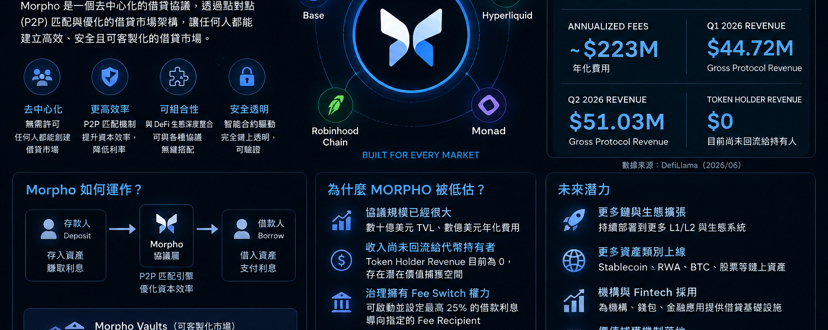
Morpho’s current TVL is about $7.5–$7.6 billion.
Of that, Ethereum is about $3.6 billion and Base about $3.1 billion; it has also expanded into ecosystems such as Hyperliquid, Robinhood Chain, and Monad.
More importantly, it’s the scale of its business.
Morpho generated about $26 million in fees over the past 30 days; its current annualized fees are about $220 million.
2026 Q1 Gross Protocol Revenue: about $44.72M.
2026 Q2 goes even further to about $51.03M.
This is no longer a DeFi project that’s still waiting for PMF.
It already has billions of dollars in capital being used, real borrowing demand, and annualized fees on the order of hundreds of millions of dollars.
But what really gets me to start paying attention to the $MORPHO —is rather its biggest “drawback” right now.
Morpho Token Holder Revenue is still 0 for now.
That is to say:
Morpho’s protocol scale has been established, but these economic activities are currently not flowing back to MORPHO holders at large scale.
Many people therefore think:
“Then isn’t MORPHO just a governance token?”
Now, looking at it, this skepticism is entirely reasonable.
But the problem is—
Morpho Governance itself has the power to enable the Fee Switch.
The official documentation clearly states that governance can start and adjust the fee switch; the maximum can be set to 25% of the interest paid by borrowers, and designate the Fee Recipient.
This is exactly what I think is the most worth paying attention to about MORPHO.
What the market sees now is:
$7.5B TVL + ~$220M in annualized Fees + Token Holder Revenue = 0
But assuming that in the future Morpho’s ecosystem continues to expand, while governance begins directing part of the protocol’s economic value to the Treasury, buybacks, staking, or other Token Value Capture mechanisms—
Then the market’s valuation method for MORPHO could change completely.
It might be from:
“a governance token without cash flow”
gradually becomes:
“the assets that control the value of large on-chain lending networks.”
The valuation multiples these two narratives can support are completely different.
And one of Morpho’s biggest advantages is that it doesn’t necessarily need to eat the entire DeFi lending market itself.
It’s more like it’s building a permissionless lending infrastructure.
so that different vaults, asset managers, wallets, fintech, and even other protocols can directly build their own lending markets.
If, in the future, on-chain assets continue to expand from crypto-native assets into:
Stablecoin
RWA
Tokenized Stocks
BTC
institutional on-chain assets
Then what’s truly valuable might not be only the “biggest lending app.”
it could also be that layer underneath—
infrastructure that anyone can use to build lending markets.
this is what I’m looking at right now

the $MORPHO approach.
Of course, its biggest risk is also very obvious:
Protocol success ≠ token success.
If Morpho TVL keeps increasing, and Fees keep increasing, but MORPHO can never establish effective Value Capture, then even very impressive protocol data doesn’t necessarily translate into coin price.
So what I’m truly betting on isn’t “MORPHO is cheap right now.”
but rather:
Morpho has already built up its business scale, but the token economic value may not be fully unlocked yet.
If one day these two things truly connect—
I think the market will only start to re-understand how much Morpho is actually worth.
This is also why, in DeFi right now,
one of the most undervalued targets worth tracking consistently, in my view.