#dusk $DUSK @Dusk
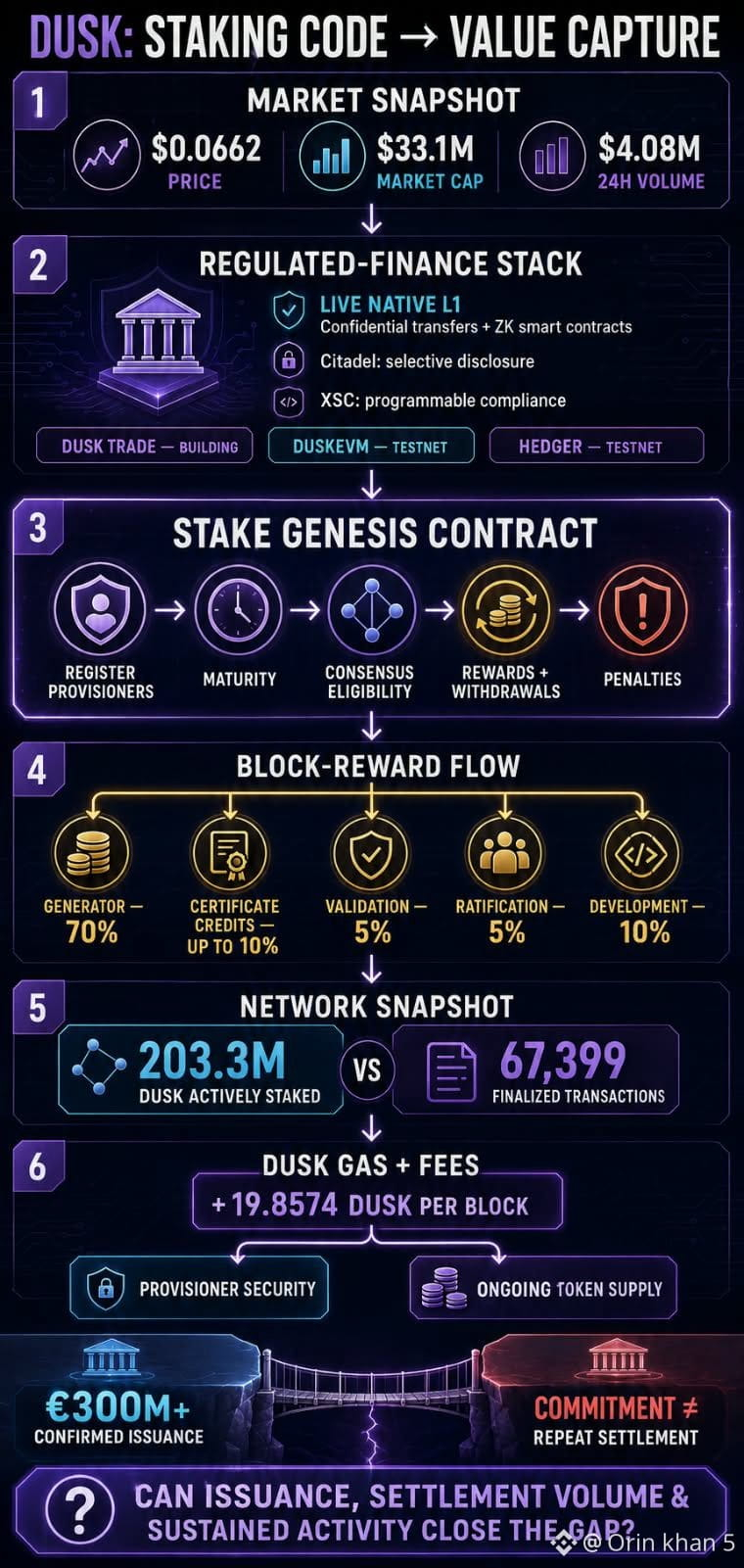
I opened DUSK’s chart to confirm a price, then ended up in the staking code. DUSK was near $0.0662, with a $33.1 million market cap and $4.08 million in 24-hour volume.
The larger proposition is regulated finance with fewer public leaks: confidential transfers and ZK smart contracts on the live native L1, Citadel-style selective disclosure, and XSC-style programmable compliance. Dusk Trade is still being built; DuskEVM and Hedger are testnets, not production adoption.
What held me was the Stake genesis contract. It records provisioners, matures stakes before consensus eligibility, credits rewards, processes withdrawals, and applies penalties. Generators receive 70% of each block reward plus up to 10% for certificate credits; validation and ratification committees receive 5% each, and 10% funds development. At my snapshot, node data showed 203.3 million DUSK actively staked but only 67,399 finalized transactions.
DUSK pays gas and secures this machinery. Rewards are probabilistic, funded by transaction fees and a current emission of 19.8574 DUSK per block. That keeps provisioners working, but adds ongoing supply. Meanwhile, €300 million-plus confirmed issuance is a commitment figure, not disclosed repeat settlement, and compliant venues may not need to hold large DUSK balances.
Technical quality and token value capture are related, not identical; holders absorb inflation, execution risk, and adoption time. Can verifiable issuance, repeat settlement volume, and sustained network activity eventually close the gap between Dusk’s roadmap and today’s numbers?