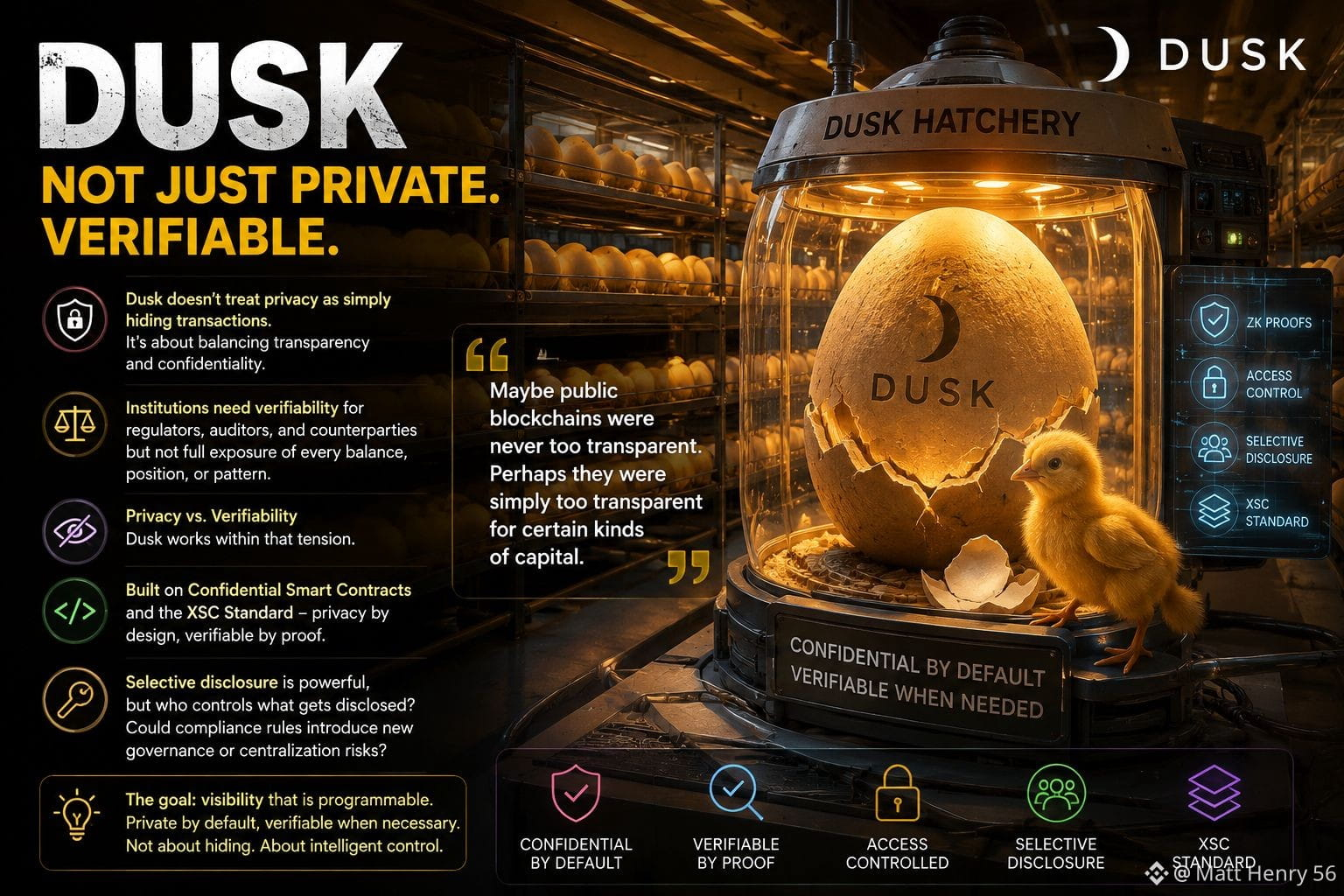
One thing about dusk that caught my attention is that it doesn’t treat privacy as simply hiding transactions.
For financial institutions, the real problem may be more nuanced. A blockchain needs enough transparency for regulators, auditors, and counterparties to verify what is happening. But institutions may not want every balance, position, transaction pattern, or exposure visible to everyone.
That creates an interesting tension: privacy vs. verifiability.
Dusk’s approach built around confidential smart contracts and the XSC standard, is an attempt to work within that tension.
But privacy, confidentiality, zero-knowledge proofs, access control, and selective disclosure are not the same thing. The important question is how these pieces work together in practice.
Selective disclosure sounds useful, but it also raises a harder question: who controls what gets disclosed?
If compliance rules require controlled access, could that introduce new governance or centralization risks?
This is where Dusk becomes interesting. The goal isn’t simply to hide financial activity, but to make visibility more programmable: private by default, while still allowing authorized parties to verify specific information when necessary.
The real test will be implementation. Who controls disclosure, how flexible are the rules, and can the system avoid creating another centralized gatekeeper?
Maybe public blockchains were never too transparent. Perhaps they were simply too transparent for certain kinds of capital.
@Dusk #dusk $DUSK