
While reviewing Dusk’s architecture documentation, I noticed it recently upgraded to a three-layer modular design. Compared with the old “everything-in-one-pot” architecture, this setup is much clearer.
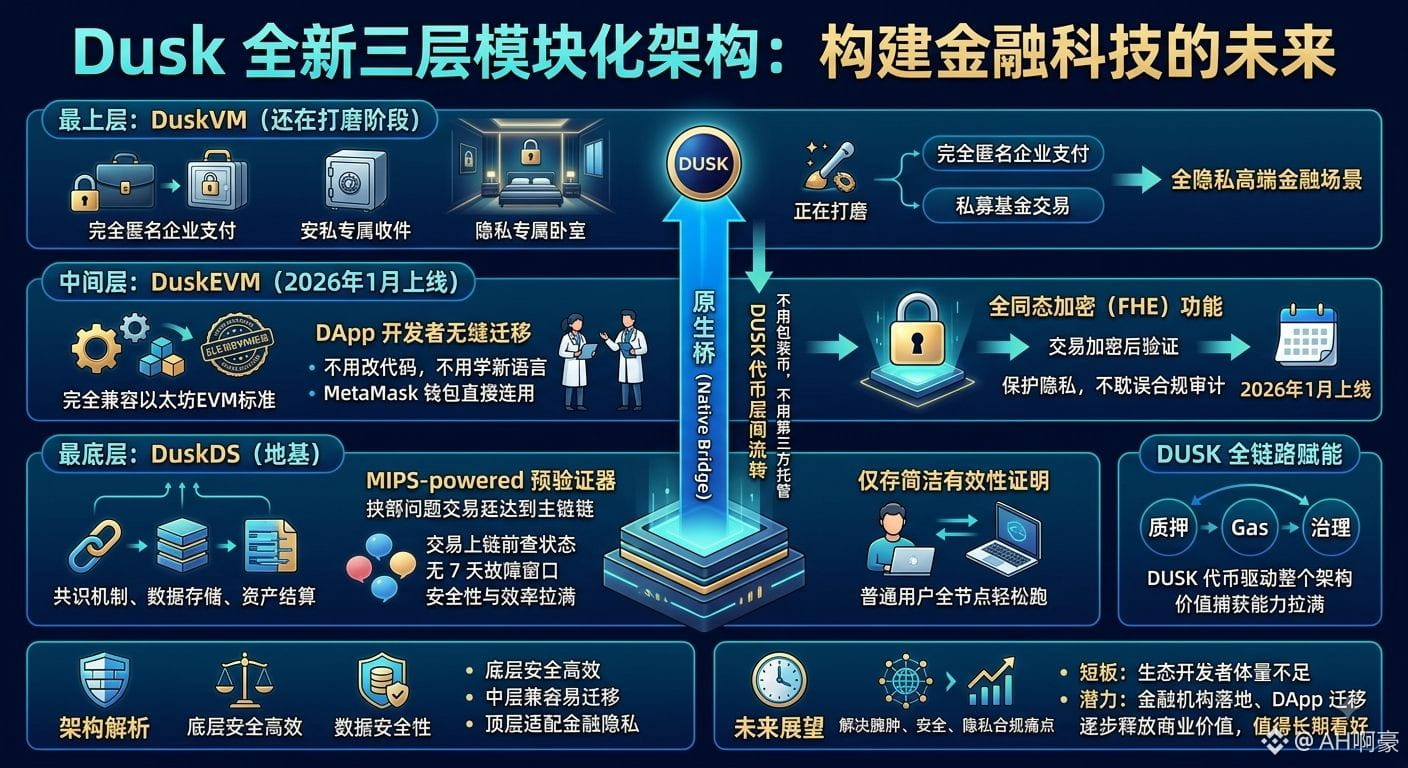
The bottom layer is called DuskDS. Think of it as the foundation: it handles the consensus mechanism, data storage, and asset settlement. There’s a particularly interesting design here—MIPS-powered pre-verifiers that check the transaction status before it’s even put on-chain. So there’s no 7-day failure window like Optimism, with both security and efficiency pushed to the limit. Also, DuskDS stores only succinct, effective proofs, so ordinary users don’t need high-end computers to run full nodes.
The middle layer is DuskEVM, scheduled to go live in January 2026. It fully complies with the Ethereum EVM standard. If you have a DApp on Ethereum that you want to migrate, developers don’t have to change code or learn a new language—just connect with MetaMask and it works. More importantly, it adds fully homomorphic encryption. After encrypting the transaction data, you can verify it without decrypting—protecting privacy while still not interfering with compliance audits.
The top layer is called DuskVM and is still being refined. Going forward, it will be a privacy-dedicated “private room,” specifically for fully anonymous enterprise payments and private fund transactions. The three layers are connected via native bridges. When DUSK tokens move between layers, you don’t need to wrap tokens, and you don’t have to rely on third-party custodians. The entire architecture is driven by DUSK. Staking, Gas, and governance are all tied together like one rope, locking the three layers firmly in place. @Dusk
The technical foundation really is solid. But no matter how beautiful the three-layer architecture looks, in the end it still depends on whether developers are willing to come and whether institutions dare to use it.
Personally, I think: Dusk’s new three-layer modular architecture addresses common pain points in public chains—bulky design, weak security, and the inability to balance privacy with compliance. The design is forward-looking with its step-by-step progression: security and efficiency at the base, easier migration in the middle, and tailored adaptation for high-end financial privacy scenarios at the top. Meanwhile, the mechanism enabled by native tokens across the full chain maximizes the token’s value-capture ability. A high-quality technical architecture is the core underpinning for a project’s long-term growth. The only shortcoming at this stage is that the ecosystem’s developer base isn’t large enough. As financial institutions roll out and DApps migrate one after another, this top-tier technical architecture will gradually unlock real commercial value. Its potential is definitely worth a long-term positive outlook. #dusk $DUSK
The bottom layer is called DuskDS. Think of it as the foundation: it handles the consensus mechanism, data storage, and asset settlement. There’s a particularly interesting design here—MIPS-powered pre-verifiers that check the transaction status before it’s even put on-chain. So there’s no 7-day failure window like Optimism, with both security and efficiency pushed to the limit. Also, DuskDS stores only succinct, effective proofs, so ordinary users don’t need high-end computers to run full nodes.
The middle layer is DuskEVM, scheduled to go live in January 2026. It fully complies with the Ethereum EVM standard. If you have a DApp on Ethereum that you want to migrate, developers don’t have to change code or learn a new language—just connect with MetaMask and it works. More importantly, it adds fully homomorphic encryption. After encrypting the transaction data, you can verify it without decrypting—protecting privacy while still not interfering with compliance audits.
The top layer is called DuskVM and is still being refined. Going forward, it will be a privacy-dedicated “private room,” specifically for fully anonymous enterprise payments and private fund transactions. The three layers are connected via native bridges. When DUSK tokens move between layers, you don’t need to wrap tokens, and you don’t have to rely on third-party custodians. The entire architecture is driven by DUSK. Staking, Gas, and governance are all tied together like one rope, locking the three layers firmly in place. @Dusk
The technical foundation really is solid. But no matter how beautiful the three-layer architecture looks, in the end it still depends on whether developers are willing to come and whether institutions dare to use it.
Personally, I think: Dusk’s new three-layer modular architecture addresses common pain points in public chains—bulky design, weak security, and the inability to balance privacy with compliance. The design is forward-looking with its step-by-step progression: security and efficiency at the base, easier migration in the middle, and tailored adaptation for high-end financial privacy scenarios at the top. Meanwhile, the mechanism enabled by native tokens across the full chain maximizes the token’s value-capture ability. A high-quality technical architecture is the core underpinning for a project’s long-term growth. The only shortcoming at this stage is that the ecosystem’s developer base isn’t large enough. As financial institutions roll out and DApps migrate one after another, this top-tier technical architecture will gradually unlock real commercial value. Its potential is definitely worth a long-term positive outlook. #dusk $DUSK