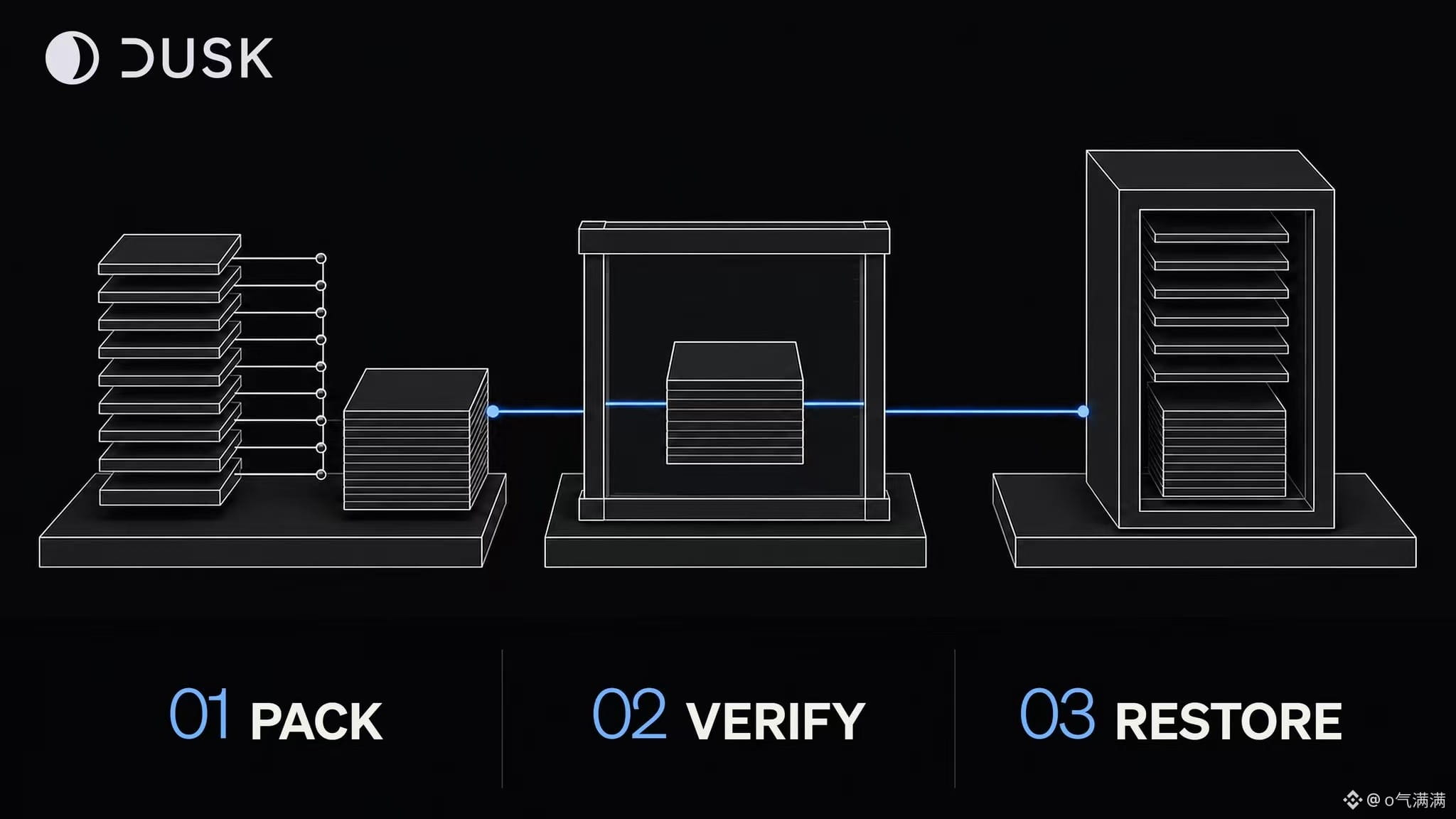
Recently, while sorting through compliant privacy-focused Layer-1s, I stopped at Dusk’s on-chain data in the browser, staring for a long time at the more than 200 million locked DUSK. That scale made me start looking at its positioning again. Dusk is not simply trying to be a privacy chain for hiding transactions; rather, it is attempting to build a foundational network for financial infrastructure, one where confidentiality, regulatory auditability, and deterministic settlement can exist at the same time. The XSC standard on-chain is specifically designed to support confidential smart contracts, while DUSK simultaneously serves as both the fee token and the staking asset. $DUSK $BTC
What is even more noteworthy is @Dusk its economic design. #dusk The initial supply is 500 million tokens, and another 500 million will be gradually released over the next 36 years through a geometrically decaying issuance schedule. Staking is therefore written directly into the long-term supply curve, rather than being just a short-term bootstrapping tool. However, large-scale staking can only show that capital is willing to safeguard network security; it cannot prove that sufficient real financial activity has already emerged on-chain. For projects targeting regulated markets, the key has always been whether the institutional side can continuously contribute transaction and settlement demand. Whether privacy capabilities and staking economics can truly be converted into stable business traffic is the core question that will determine whether this chain can operate sustainably over the long term.
What is even more noteworthy is @Dusk its economic design. #dusk The initial supply is 500 million tokens, and another 500 million will be gradually released over the next 36 years through a geometrically decaying issuance schedule. Staking is therefore written directly into the long-term supply curve, rather than being just a short-term bootstrapping tool. However, large-scale staking can only show that capital is willing to safeguard network security; it cannot prove that sufficient real financial activity has already emerged on-chain. For projects targeting regulated markets, the key has always been whether the institutional side can continuously contribute transaction and settlement demand. Whether privacy capabilities and staking economics can truly be converted into stable business traffic is the core question that will determine whether this chain can operate sustainably over the long term.