Message, Technicals, and Sentiment: a 3D breakdown of next week’s gold price trend
I. News/Market Drivers: the bulls have solid foundations—watch out for short-term negative shocks
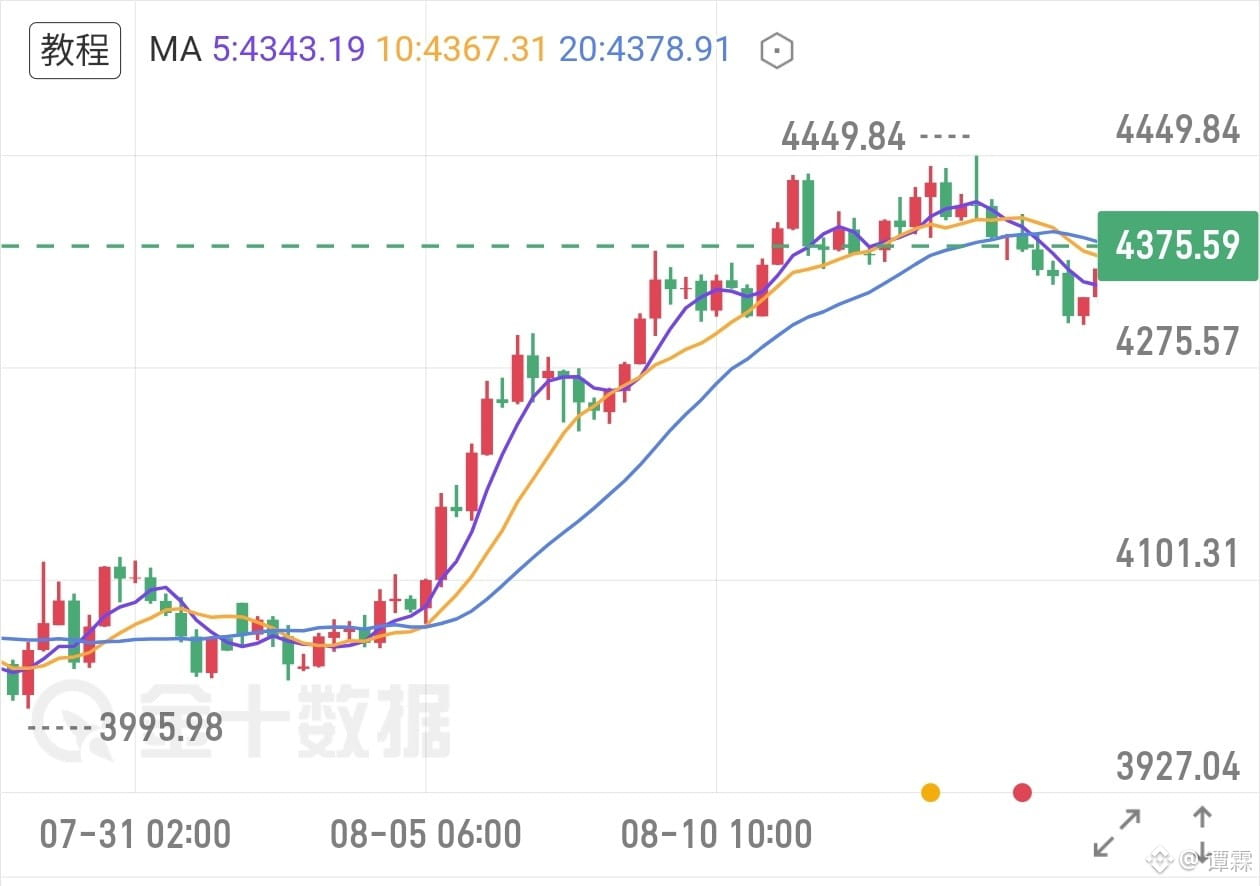
In this cycle, gold has rallied from 4000 to 4450. The key driver is the sharp cooling of expectations for Fed rate hikes. Recently, CPI, PPI, and retail data have continued to weaken. Market expectations for a September rate hike have dropped significantly, while the dollar and US Treasury yields have eased—providing strong bullish support for gold.
However, there are two risks to watch next week: first, if Fed officials deliver hawkish remarks, gold could see short-term choppy trading and a sudden plunge; second, if Michigan inflation expectation data rebounds, it could revive rate-hike expectations and weigh on gold prices.
The long-term positives remain unchanged: central banks globally and in China continue buying gold, and support at the market’s base is firm—so the room for a deep decline is limited.
II. Technicals: the big-picture uptrend remains intact, but short-term pullbacks are likely for repair
On the weekly chart, a major bullish breakout confirms the medium-term uptrend. The level 4300 completes a top-to-bottom reversal and has become a key strong support—if it holds, the bullish structure is likely to continue.
But in the short term, the market is clearly overbought. Gold has tested 4450 twice and failed, with heavier selling pressure overhead. Combined with daily and weekly overbought conditions, there is also a demand for profit-taking.
For short-term support, watch 4340–4360 (the short-term bull-bear boundary). The core line for strength vs. weakness is 4310. On the upside, initial resistance to watch is 4400. If price can hold above it, gold may retest 4450 again. After a breakout, the next target shifts toward 4500.
III. Sentiment: institutions are firmly bullish—retail is overheated, so beware of a shakeout
Current market sentiment is clearly split: institutions are continuously adding to long positions, and most Wall Street analysts are optimistic about further upside. Big-money longs have a clear, confident stance.
However, in the short term, retail investors are chasing highs with overheated enthusiasm. Gold’s August rise has been substantial, and a highly consistent bullish outlook often triggers the main players’ shakeout. The odds favor a pullback first for a washout, followed by a continuation higher.
Next week’s core trading approach
Overall approach: don’t chase; don’t guess the top. Pull back to buy on dips, reduce exposure when rallying.
1. When price pulls back and stabilizes around 4340–4360, consider scaling into long positions; keep defense below 4310.
2. In the rebound range of 4400–4430, don’t chase longs. You may reduce positions somewhat to take profit.
3. If there is a valid breakdown below 4310, the short-term correction may deepen—adjust the trading plan promptly.
The trading focus is on timing and key price levels: follow the trend to go long on dips and avoid the risk of chasing highs.
$XAU
I. News/Market Drivers: the bulls have solid foundations—watch out for short-term negative shocks
In this cycle, gold has rallied from 4000 to 4450. The key driver is the sharp cooling of expectations for Fed rate hikes. Recently, CPI, PPI, and retail data have continued to weaken. Market expectations for a September rate hike have dropped significantly, while the dollar and US Treasury yields have eased—providing strong bullish support for gold.
However, there are two risks to watch next week: first, if Fed officials deliver hawkish remarks, gold could see short-term choppy trading and a sudden plunge; second, if Michigan inflation expectation data rebounds, it could revive rate-hike expectations and weigh on gold prices.
The long-term positives remain unchanged: central banks globally and in China continue buying gold, and support at the market’s base is firm—so the room for a deep decline is limited.
II. Technicals: the big-picture uptrend remains intact, but short-term pullbacks are likely for repair
On the weekly chart, a major bullish breakout confirms the medium-term uptrend. The level 4300 completes a top-to-bottom reversal and has become a key strong support—if it holds, the bullish structure is likely to continue.
But in the short term, the market is clearly overbought. Gold has tested 4450 twice and failed, with heavier selling pressure overhead. Combined with daily and weekly overbought conditions, there is also a demand for profit-taking.
For short-term support, watch 4340–4360 (the short-term bull-bear boundary). The core line for strength vs. weakness is 4310. On the upside, initial resistance to watch is 4400. If price can hold above it, gold may retest 4450 again. After a breakout, the next target shifts toward 4500.
III. Sentiment: institutions are firmly bullish—retail is overheated, so beware of a shakeout
Current market sentiment is clearly split: institutions are continuously adding to long positions, and most Wall Street analysts are optimistic about further upside. Big-money longs have a clear, confident stance.
However, in the short term, retail investors are chasing highs with overheated enthusiasm. Gold’s August rise has been substantial, and a highly consistent bullish outlook often triggers the main players’ shakeout. The odds favor a pullback first for a washout, followed by a continuation higher.
Next week’s core trading approach
Overall approach: don’t chase; don’t guess the top. Pull back to buy on dips, reduce exposure when rallying.
1. When price pulls back and stabilizes around 4340–4360, consider scaling into long positions; keep defense below 4310.
2. In the rebound range of 4400–4430, don’t chase longs. You may reduce positions somewhat to take profit.
3. If there is a valid breakdown below 4310, the short-term correction may deepen—adjust the trading plan promptly.
The trading focus is on timing and key price levels: follow the trend to go long on dips and avoid the risk of chasing highs.
$XAU