I almost skipped a sentence in the Dusk documentation because it sounded like it was introducing yet another privacy-focused blockchain. Later, I realized that what’s actually interesting isn’t the word “privacy” itself—it’s where Dusk puts privacy.
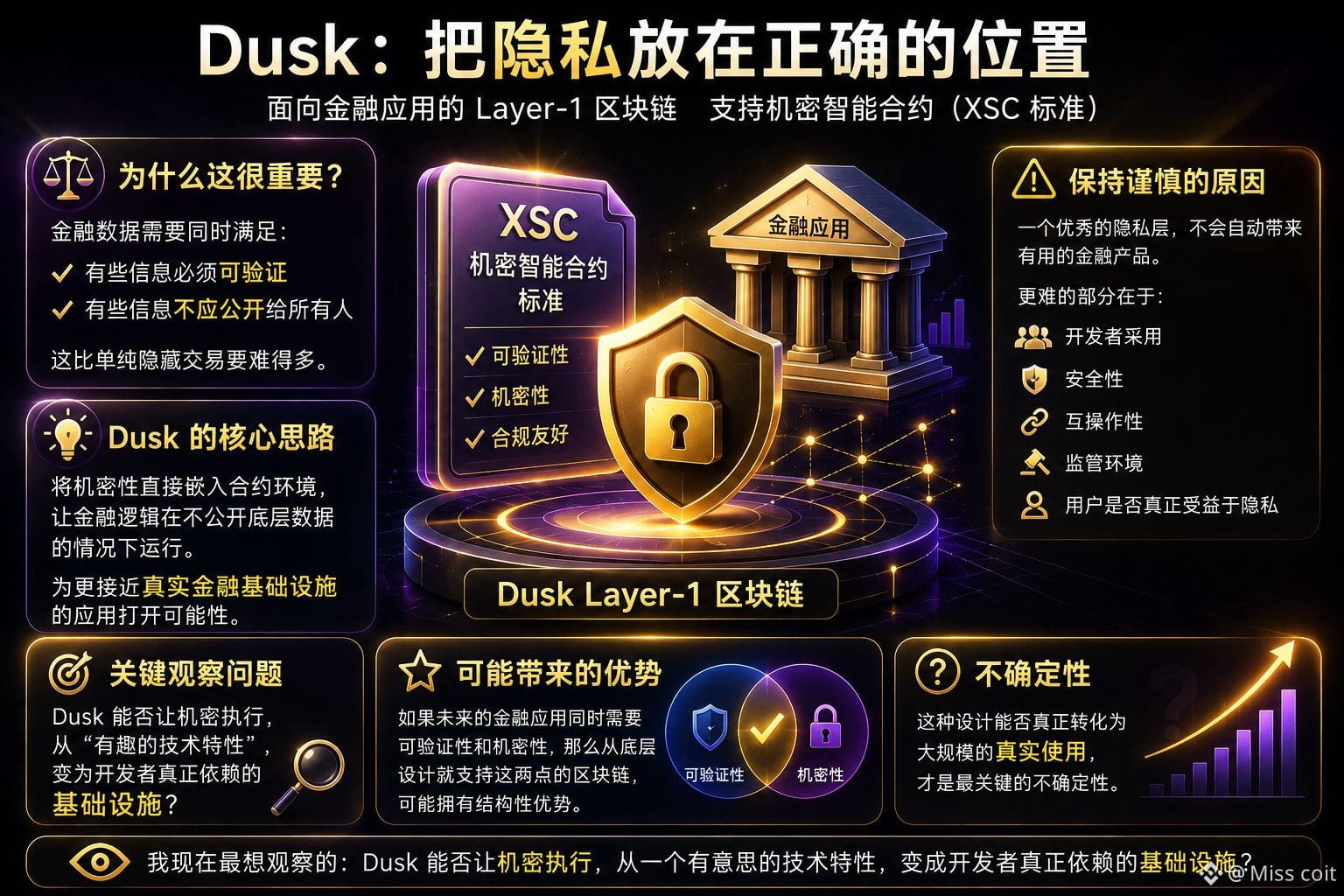
Dusk is a Layer-1 blockchain focused on financial applications, and it supports confidential smart contracts via the Confidential Security Contract (XSC) standard.
This point is important.
Because financial data has a very specific requirement: some information must be verifiable, while some should not be publicly available to everyone.
That’s much harder than simply hiding transactions.
I think the most worth watching aspect of Dusk is that it tries to build confidentiality directly into the contract environment. If financial logic can run without exposing all underlying data, developers may have more room to build applications that are closer to real financial infrastructure—not just transparent DeFi experiments.
But this is also where I stay cautious.
A beautifully designed privacy layer doesn’t automatically produce truly useful financial products. The harder part is still ahead: developer adoption, security, interoperability, the regulatory environment, and whether users can truly derive value from data confidentiality.
So I won’t simply assume that “privacy equals upside potential.”
I’m more focused on a specific question.
If future financial applications need both verifiability and confidentiality, then a blockchain that bakes both of these into its design from the ground up may have some advantages.
The real uncertainty is whether this kind of design can become real in actual usage.
What I most want to observe right now is whether Dusk can turn confidential execution from an interesting technical feature into infrastructure that developers genuinely rely on?@Dusk #dusk $DUSK