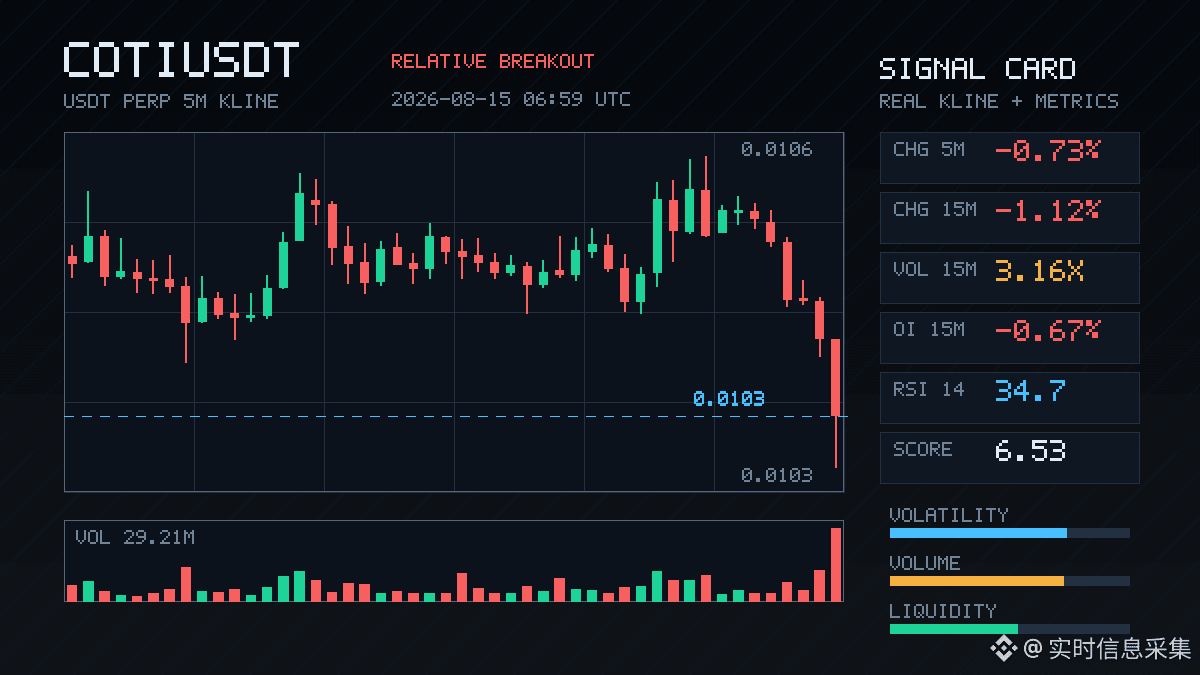
$COTI This 15-minute move directly broke through the lower edge of the range of nearly 20 5m candlesticks. The trading volume surged to 3.16x, and the volatility Z-score jumped to 2.95—the volume-price coordination was very “textbook.”
But what’s interesting is that OI actually fell. In the 15-minute contracts, open positions shrank by 0.67%, with a notional change of -117K. This smells more like longs actively cutting losses and exiting, rather than shorts adding positions to smash the market.
The主动成交差 (aggressive trade imbalance) is even more extreme: -35.1%, with a buy-to-sell ratio of only 0.48. On the order book, sell pressure is one-sided.
The abnormality level across the whole pool ranks #19, and the notional change is also within the top 30, indicating that the main funds really are moving—just not in a particularly friendly direction. Over the past 24 hours, turnover is 39.6M, so liquidity is sufficient, but the short-term structure has already weakened.
Breaking the lower edge of the range isn’t the most terrifying part—the scary part is that nobody is stepping in to buy. First, see whether it can quickly reclaim that lower edge. If it can’t, then continue to handle it with a sideways-to-bearish bias. Don’t rush to bottom-pick; wait until the aggressive buy/sell orders reach balance.
But what’s interesting is that OI actually fell. In the 15-minute contracts, open positions shrank by 0.67%, with a notional change of -117K. This smells more like longs actively cutting losses and exiting, rather than shorts adding positions to smash the market.
The主动成交差 (aggressive trade imbalance) is even more extreme: -35.1%, with a buy-to-sell ratio of only 0.48. On the order book, sell pressure is one-sided.
The abnormality level across the whole pool ranks #19, and the notional change is also within the top 30, indicating that the main funds really are moving—just not in a particularly friendly direction. Over the past 24 hours, turnover is 39.6M, so liquidity is sufficient, but the short-term structure has already weakened.
Breaking the lower edge of the range isn’t the most terrifying part—the scary part is that nobody is stepping in to buy. First, see whether it can quickly reclaim that lower edge. If it can’t, then continue to handle it with a sideways-to-bearish bias. Don’t rush to bottom-pick; wait until the aggressive buy/sell orders reach balance.