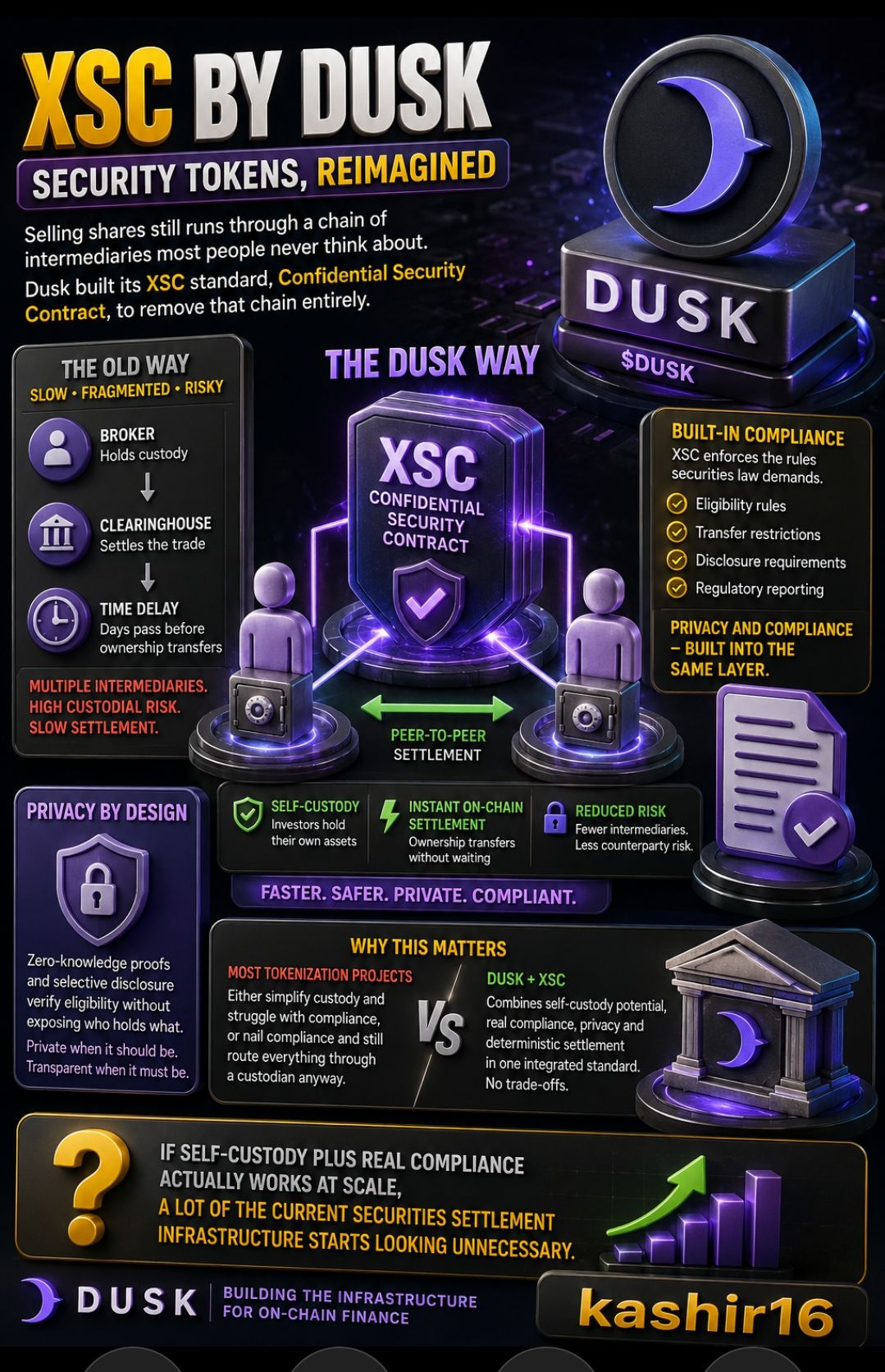
#dusk $DUSK Selling and settling securities still involves a surprisingly fragmented stack: brokers, custodians, venues, settlement systems and plenty of back-office reconciliation.
Dusk's XSC standard takes a different approach.
XSC, short for Confidential Security Contracts, puts much of the asset's logic directly into the smart contract. Eligibility rules, transfer restrictions, ownership workflows, settlement and other security-related functions can be handled as part of the on-chain asset lifecycle rather than being scattered across separate systems.
The part I find most interesting isn't actually the privacy.
It's what happens when the asset itself becomes programmable.
Instead of treating a security token as nothing more than a digital wrapper around an old process, Dusk is trying to put the rules around that asset into the infrastructure itself. Who can hold it, who can transfer it, what restrictions apply and what information needs to be disclosed can become part of the workflow.
And then there's the privacy layer.
Dusk combines confidential transactions, zero-knowledge proofs and selective disclosure so regulated workflows don't have to choose between keeping sensitive information private and providing evidence to authorized parties when required.
That's where $DUSK becomes interesting to me.
The bigger thesis isn't simply "put securities on a blockchain."
It's whether blockchain infrastructure can eventually combine ownership, compliance, privacy and deterministic settlement into one coordinated workflow.
If that model works at scale, tokenization could become more than putting traditional assets on-chain.
It could mean rebuilding how those assets actually move.
Would investors eventually prefer programmable ownership and settlement over today's fragmented infrastructure?
@Dusk $DUSK #dusk
Dusk's XSC standard takes a different approach.
XSC, short for Confidential Security Contracts, puts much of the asset's logic directly into the smart contract. Eligibility rules, transfer restrictions, ownership workflows, settlement and other security-related functions can be handled as part of the on-chain asset lifecycle rather than being scattered across separate systems.
The part I find most interesting isn't actually the privacy.
It's what happens when the asset itself becomes programmable.
Instead of treating a security token as nothing more than a digital wrapper around an old process, Dusk is trying to put the rules around that asset into the infrastructure itself. Who can hold it, who can transfer it, what restrictions apply and what information needs to be disclosed can become part of the workflow.
And then there's the privacy layer.
Dusk combines confidential transactions, zero-knowledge proofs and selective disclosure so regulated workflows don't have to choose between keeping sensitive information private and providing evidence to authorized parties when required.
That's where $DUSK becomes interesting to me.
The bigger thesis isn't simply "put securities on a blockchain."
It's whether blockchain infrastructure can eventually combine ownership, compliance, privacy and deterministic settlement into one coordinated workflow.
If that model works at scale, tokenization could become more than putting traditional assets on-chain.
It could mean rebuilding how those assets actually move.
Would investors eventually prefer programmable ownership and settlement over today's fragmented infrastructure?
@Dusk $DUSK #dusk