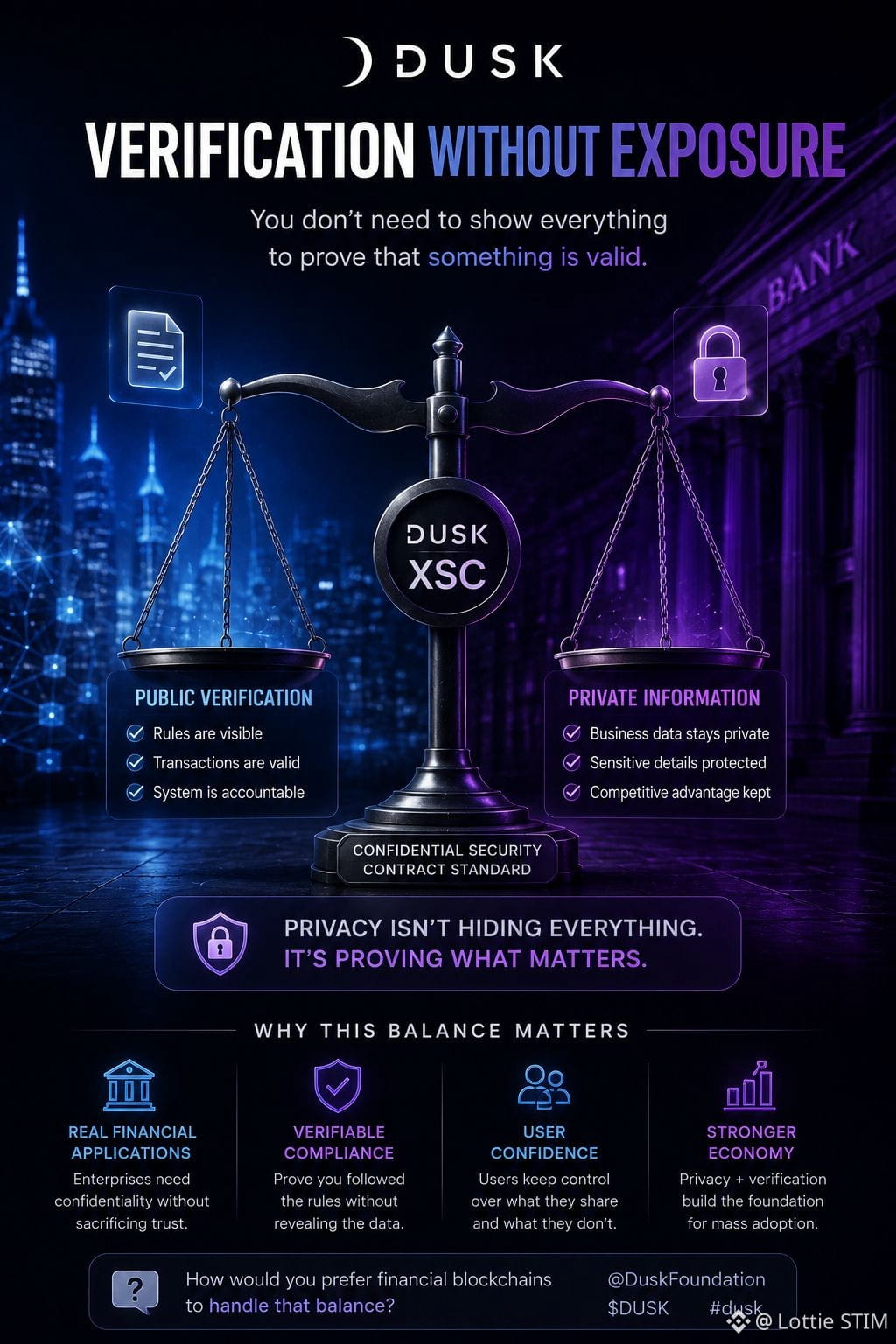
I used to think a private blockchain would always have to give up some level of verification.
It seemed logical to me. If people can't see the information, how can they know the system is doing what it should?
But the more I read about blockchain and financial use cases, the more I realized it doesn't have to be that simple.
You don't need to show everyone everything just to prove that something is valid.
That's the part of Dusk that I find genuinely interesting. Its focus on financial applications and confidential smart contracts through the Confidential Security Contract (XSC) standard made me look at blockchain privacy from a different angle.
For example, a company might want to prove that a financial process followed the required rules without exposing sensitive business information to competitors. Those two needs don't necessarily have to conflict.
I'm still learning the technical details, so I don't want to make Dusk sound like it has solved every privacy challenge. But I think the question it's exploring is important.
Maybe privacy isn't about hiding everything.
Maybe it's about keeping sensitive information private while making the right things verifiable.
If blockchain is going to become part of real financial systems, that balance could be far more important than simply choosing between “public” and “private.”
How would you prefer financial blockchains to handle that balance?
#dusk $DUSK @Dusk
It seemed logical to me. If people can't see the information, how can they know the system is doing what it should?
But the more I read about blockchain and financial use cases, the more I realized it doesn't have to be that simple.
You don't need to show everyone everything just to prove that something is valid.
That's the part of Dusk that I find genuinely interesting. Its focus on financial applications and confidential smart contracts through the Confidential Security Contract (XSC) standard made me look at blockchain privacy from a different angle.
For example, a company might want to prove that a financial process followed the required rules without exposing sensitive business information to competitors. Those two needs don't necessarily have to conflict.
I'm still learning the technical details, so I don't want to make Dusk sound like it has solved every privacy challenge. But I think the question it's exploring is important.
Maybe privacy isn't about hiding everything.
Maybe it's about keeping sensitive information private while making the right things verifiable.
If blockchain is going to become part of real financial systems, that balance could be far more important than simply choosing between “public” and “private.”
How would you prefer financial blockchains to handle that balance?
#dusk $DUSK @Dusk