#dusk $DUSK @Dusk
I've been watching a friend's small trading desk struggle with something most people never think about: every exchange they used demanded full transparency, yet every private wallet they tried got flagged or delisted somewhere down the line. That's the quiet contradiction crypto never really solved. Fully transparent chains satisfy auditors but expose every transfer to competitors and strangers. Fully private chains protect users but scare off the institutions that keep liquidity flowing. Pick one, and you lose something important.
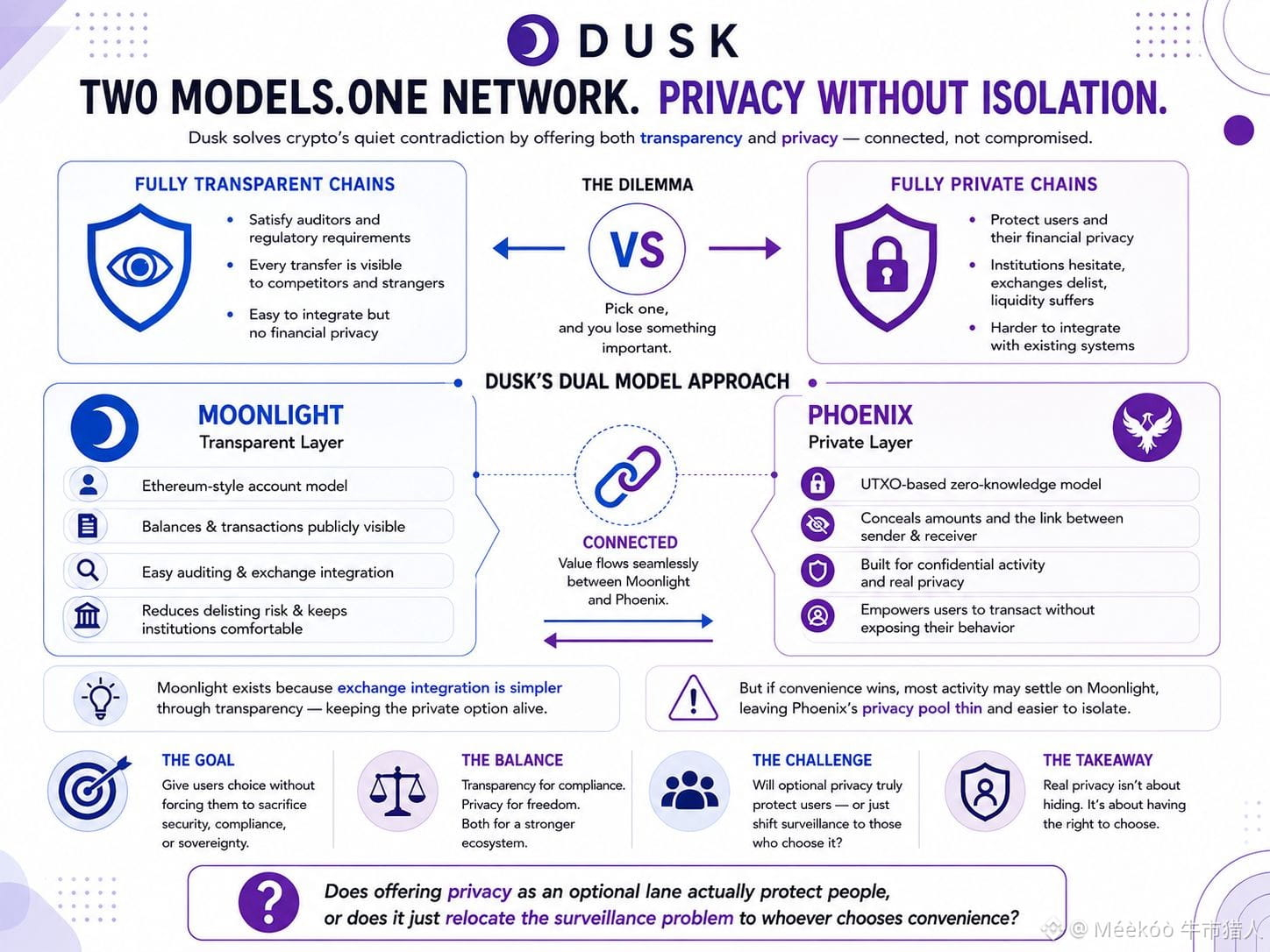
Earlier privacy projects mostly chose a side and hoped regulators would eventually adjust. Many didn't, and exchanges pulled support instead. Dusk took a different route by running two separate transaction models rather than forcing one architecture to do everything. Moonlight works like an Ethereum-style account system, with balances and transaction details publicly visible and easy to audit, while Phoenix is a UTXO-based, zero-knowledge model built for confidential activity, concealing amounts and the link between sender and receiver. The two connect, so value can move back and forth between Phoenix notes and Moonlight balances. The public model exists largely because integration with exchanges is simpler through a transparent option, which helps avoid delisting risk while keeping the private model intact.
Still, convenience tends to win. If most activity settles on Moonlight because it's easier to plug into exchanges, Phoenix's privacy pool could stay thin, making shielded transactions easier to isolate rather than harder to trace.
Does offering privacy as an optional lane actually protect people, or does it just relocate the surveillance problem to whoever chooses convenience?
$AKE
$ACE
I've been watching a friend's small trading desk struggle with something most people never think about: every exchange they used demanded full transparency, yet every private wallet they tried got flagged or delisted somewhere down the line. That's the quiet contradiction crypto never really solved. Fully transparent chains satisfy auditors but expose every transfer to competitors and strangers. Fully private chains protect users but scare off the institutions that keep liquidity flowing. Pick one, and you lose something important.
Earlier privacy projects mostly chose a side and hoped regulators would eventually adjust. Many didn't, and exchanges pulled support instead. Dusk took a different route by running two separate transaction models rather than forcing one architecture to do everything. Moonlight works like an Ethereum-style account system, with balances and transaction details publicly visible and easy to audit, while Phoenix is a UTXO-based, zero-knowledge model built for confidential activity, concealing amounts and the link between sender and receiver. The two connect, so value can move back and forth between Phoenix notes and Moonlight balances. The public model exists largely because integration with exchanges is simpler through a transparent option, which helps avoid delisting risk while keeping the private model intact.
Still, convenience tends to win. If most activity settles on Moonlight because it's easier to plug into exchanges, Phoenix's privacy pool could stay thin, making shielded transactions easier to isolate rather than harder to trace.
Does offering privacy as an optional lane actually protect people, or does it just relocate the surveillance problem to whoever chooses convenience?
$AKE
$ACE