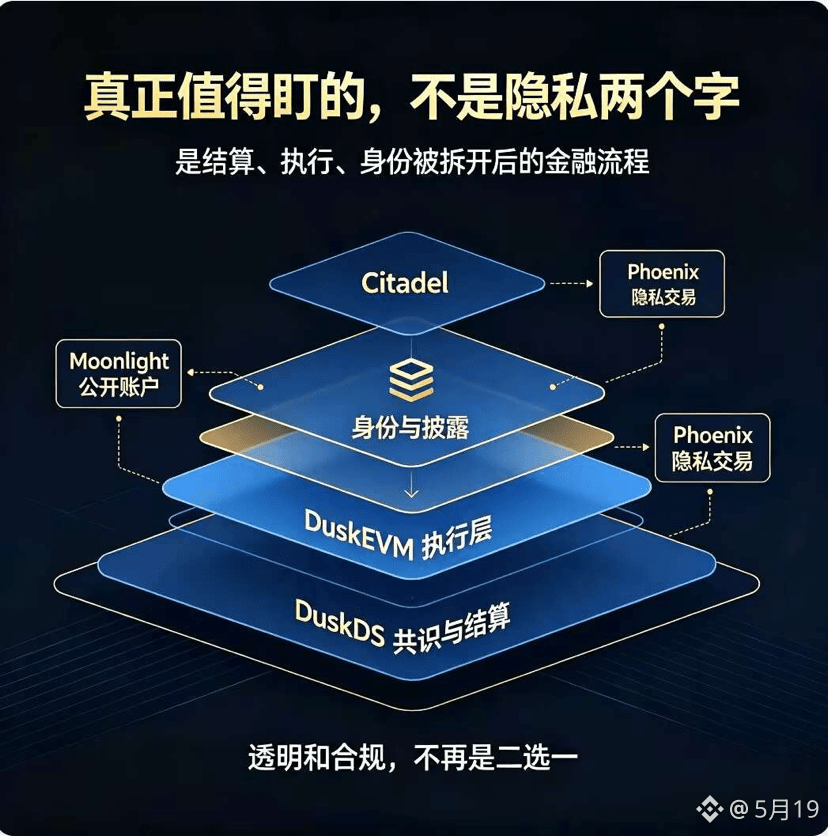
I spent a few hours re-reading the Dusk architecture diagram. What truly matters to me isn’t privacy, but the design of settlement, execution, and layered identity—this detail is far more important than the label of a “privacy chain.”
I’ve compared many public chains, and most of them blur privacy, transactions, and compliance together. Dusk, however, separates them clearly: DuskDS carries consensus, finality, and the dual-account model; DuskEVM is responsible for execution; Citadel enables selective disclosure of identity. Institutions don’t have to choose between privacy and regulation.
I’m especially focused on Succinct Attestation, which achieves deterministic finality after three-phase confirmation. For securities trading, a deal can’t be rolled back—speed matters more.
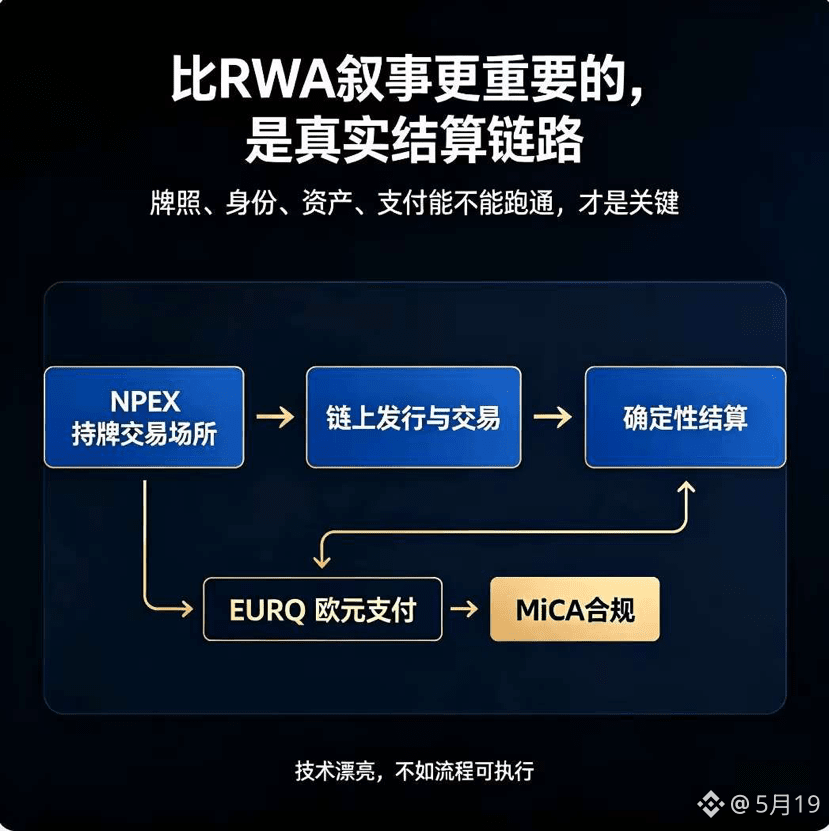
I then continued reviewing the progress on partnerships, and the NPEX track is more worth watching than the vague RWA narrative. By working together with a Dutch licensed MTF to bring regulated securities on-chain, and adding EURQ compliant euro payments, the entire workflow is built under the MiCA framework.
So when I look at it now, researching $DUSK shouldn’t be about whether the privacy technology is flashy anymore. It should be about whether this architecture can connect identity, assets, and transactions into a complete, executable financial process.
I believe that, in the future, institutions going on-chain will compete on full end-to-end deployment capability. In summary, that’s the core reason Dusk is most worth continued tracking.
#dusk $DUSK @Dusk
I’ve compared many public chains, and most of them blur privacy, transactions, and compliance together. Dusk, however, separates them clearly: DuskDS carries consensus, finality, and the dual-account model; DuskEVM is responsible for execution; Citadel enables selective disclosure of identity. Institutions don’t have to choose between privacy and regulation.
I’m especially focused on Succinct Attestation, which achieves deterministic finality after three-phase confirmation. For securities trading, a deal can’t be rolled back—speed matters more.
I then continued reviewing the progress on partnerships, and the NPEX track is more worth watching than the vague RWA narrative. By working together with a Dutch licensed MTF to bring regulated securities on-chain, and adding EURQ compliant euro payments, the entire workflow is built under the MiCA framework.
So when I look at it now, researching $DUSK shouldn’t be about whether the privacy technology is flashy anymore. It should be about whether this architecture can connect identity, assets, and transactions into a complete, executable financial process.
I believe that, in the future, institutions going on-chain will compete on full end-to-end deployment capability. In summary, that’s the core reason Dusk is most worth continued tracking.
#dusk $DUSK @Dusk