
@Dusk
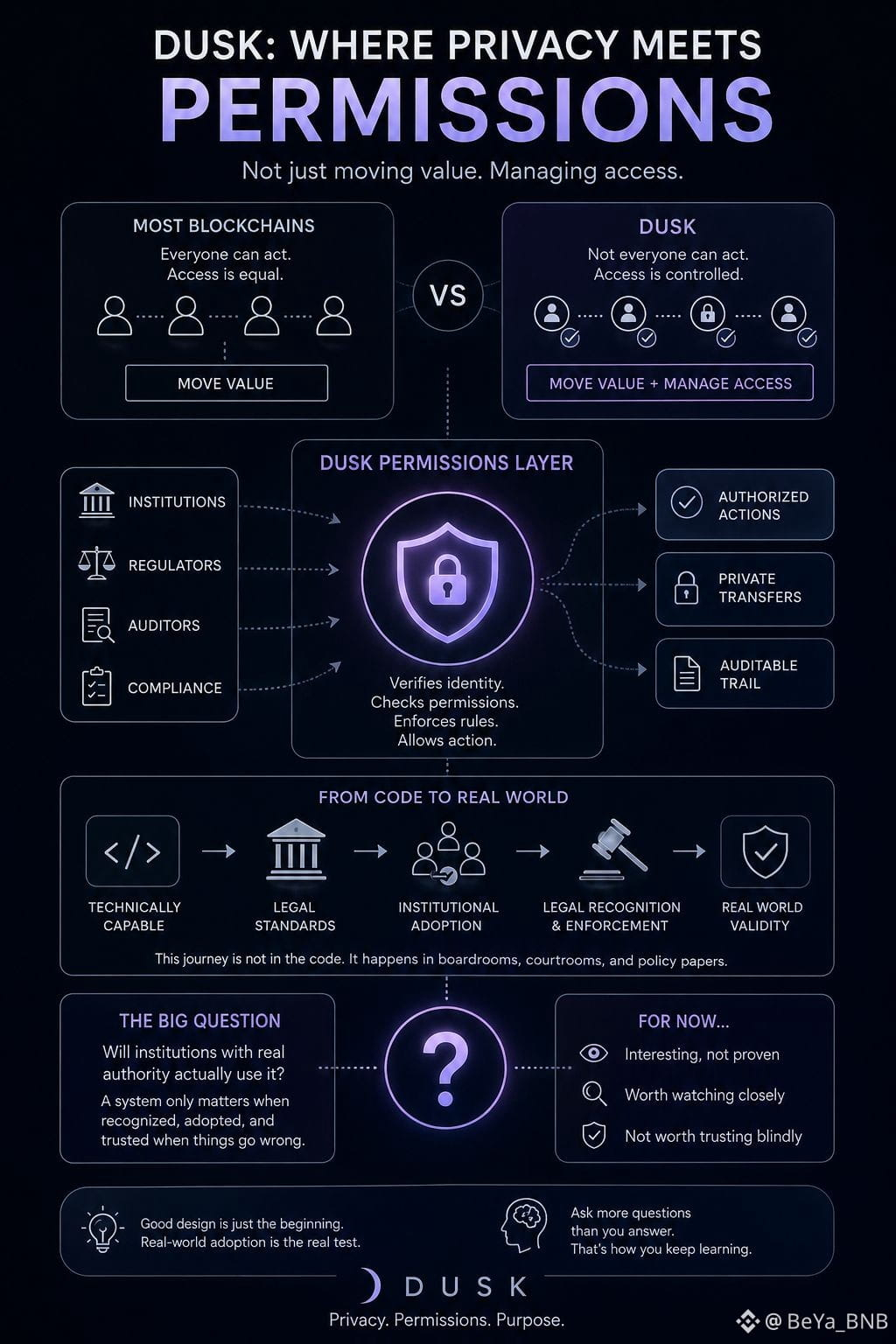
One detail in Dusk's design caught my attention: buried in there is a permissions layer that decides who gets to act on the network and who doesn't almost like built-in credentials.
That's an odd thing to find interesting, but it stuck with me. Most blockchain projects only care about moving value. Dusk adds a layer for identity and permissions, closer to how a bank or exchange actually works, where access isn't automatically equal for everyone. Its private transfers still leave room for authorized checks. That feels less like a rejection of institutions and more like an attempt to hand them a tool they might actually use.
Still, I keep asking one question: does anyone with real authority actually plan to use this? A system like that only matters once an institution recognizes it, adopts it, and stands behind it when things go wrong. None of that lives in the code. Building something technically capable of meeting legal standards is one step; getting judges, auditors, or governments to treat it as valid is a slower, separate fight and plenty of well-built systems never clear it.
So for now I'm calling this interesting, not proven. Worth watching closely, not worth trusting blindly. The space between good design and real-world adoption is where most projects quietly disappear.
Honestly, digging into projects like this reminds me how little I actually understand about where law and technology meet and I'm fine with that. There's always another layer to learn. Asking more questions than you answer will always serve you better than trusting a system just because it sounds well designed.
@Dusk $DUSK #dusk
One detail in Dusk's design caught my attention: buried in there is a permissions layer that decides who gets to act on the network and who doesn't almost like built-in credentials.
That's an odd thing to find interesting, but it stuck with me. Most blockchain projects only care about moving value. Dusk adds a layer for identity and permissions, closer to how a bank or exchange actually works, where access isn't automatically equal for everyone. Its private transfers still leave room for authorized checks. That feels less like a rejection of institutions and more like an attempt to hand them a tool they might actually use.
Still, I keep asking one question: does anyone with real authority actually plan to use this? A system like that only matters once an institution recognizes it, adopts it, and stands behind it when things go wrong. None of that lives in the code. Building something technically capable of meeting legal standards is one step; getting judges, auditors, or governments to treat it as valid is a slower, separate fight and plenty of well-built systems never clear it.
So for now I'm calling this interesting, not proven. Worth watching closely, not worth trusting blindly. The space between good design and real-world adoption is where most projects quietly disappear.
Honestly, digging into projects like this reminds me how little I actually understand about where law and technology meet and I'm fine with that. There's always another layer to learn. Asking more questions than you answer will always serve you better than trusting a system just because it sounds well designed.
@Dusk $DUSK #dusk