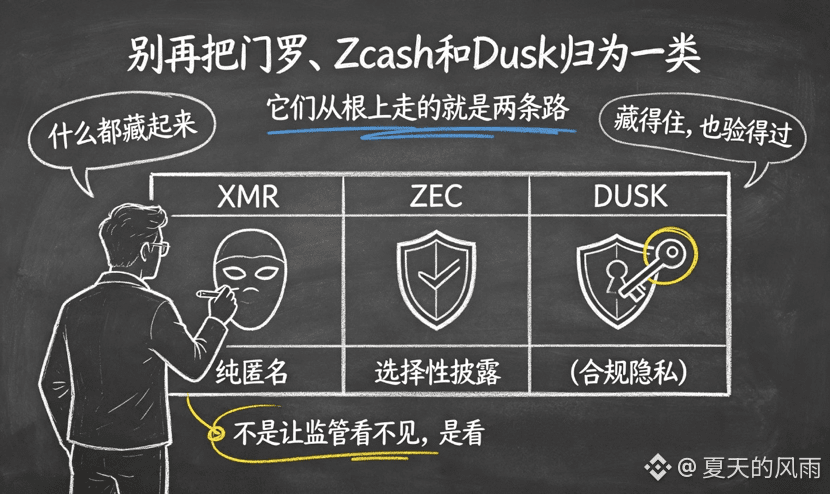
When people bring up @Dusk , many immediately group Monero, Zcash, and them together into the same privacy track. But as I slowly work through it, I realize they are taking entirely different paths at their root.
Privacy coins like Monero aim to make everything about a transaction invisible to the outside world. What @DuskNetwork is trying to achieve is something else: transaction details can be hidden, but compliance proofs can still be produced. It’s not about blinding regulators’ eyes—it’s about enabling verification that the transaction itself is compliant, even if you can’t see the full transaction plaintext. That starting point alone creates a clear gap.
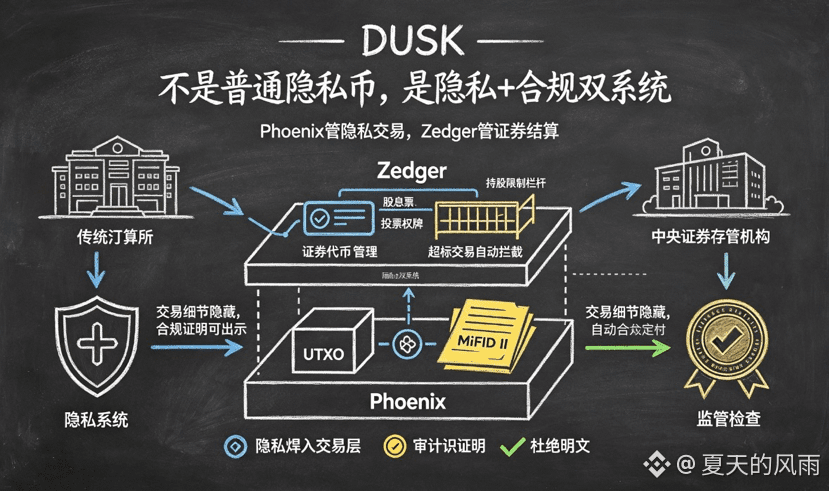
If you break down its technical architecture, it’s actually a very clear two-layer division of labor. The underlying Phoenix is built on UTXO plus zero-knowledge proofs, embedding privacy capabilities directly into the very bottom layer of the transaction, so plaintext transaction data is fundamentally not leaked outward. The upper layer, Zedger, is specifically aimed at the security token use case—used to handle complex rules that traditional finance would have, such as dividend distribution, shareholder voting rights, and limits on ownership ratios. Once a trader’s holdings touch the regulatory maximum, the on-chain rules automatically block the transaction that exceeds the limit, without requiring manual review one by one.
What’s interesting is that it is also the world’s first securities settlement model that does not need to rely on a trusted third party to align with MiFID II requirements. Many people might think at first glance that a dual-system architecture combining a privacy layer with a securities layer looks bulky and cumbersome. But the more I think about it, the more it seems this might be the unavoidable cost of trying to hold both privacy and compliance at the same time.
I also have a different view: $DUSK ’s real target competitor likely isn’t public chains like Ethereum or Solana. Instead, it is aiming at traditional clearing houses and central securities depositories that generate tens of billions in revenue every year from clearing and custody.
Of course, no matter how grand the idea is, it still has to pass the test of reality. Traditional financial institutions have deeply rooted trading habits and entrenched vested-interest barriers that cannot be shaken in a short time by a single on-chain model. Whether long-term operation of this dual-system approach will introduce new vulnerabilities across layers also needs time to verify. Whether this roadmap can actually pry open a gap in the traditional clearing market—I’ll keep observing.
The above is only my personal view, and I may be wrong. Before investing, everyone should do your own research (DYOR).
#dusk $DUSK @Dusk
Privacy coins like Monero aim to make everything about a transaction invisible to the outside world. What @DuskNetwork is trying to achieve is something else: transaction details can be hidden, but compliance proofs can still be produced. It’s not about blinding regulators’ eyes—it’s about enabling verification that the transaction itself is compliant, even if you can’t see the full transaction plaintext. That starting point alone creates a clear gap.
If you break down its technical architecture, it’s actually a very clear two-layer division of labor. The underlying Phoenix is built on UTXO plus zero-knowledge proofs, embedding privacy capabilities directly into the very bottom layer of the transaction, so plaintext transaction data is fundamentally not leaked outward. The upper layer, Zedger, is specifically aimed at the security token use case—used to handle complex rules that traditional finance would have, such as dividend distribution, shareholder voting rights, and limits on ownership ratios. Once a trader’s holdings touch the regulatory maximum, the on-chain rules automatically block the transaction that exceeds the limit, without requiring manual review one by one.
What’s interesting is that it is also the world’s first securities settlement model that does not need to rely on a trusted third party to align with MiFID II requirements. Many people might think at first glance that a dual-system architecture combining a privacy layer with a securities layer looks bulky and cumbersome. But the more I think about it, the more it seems this might be the unavoidable cost of trying to hold both privacy and compliance at the same time.
I also have a different view: $DUSK ’s real target competitor likely isn’t public chains like Ethereum or Solana. Instead, it is aiming at traditional clearing houses and central securities depositories that generate tens of billions in revenue every year from clearing and custody.
Of course, no matter how grand the idea is, it still has to pass the test of reality. Traditional financial institutions have deeply rooted trading habits and entrenched vested-interest barriers that cannot be shaken in a short time by a single on-chain model. Whether long-term operation of this dual-system approach will introduce new vulnerabilities across layers also needs time to verify. Whether this roadmap can actually pry open a gap in the traditional clearing market—I’ll keep observing.
The above is only my personal view, and I may be wrong. Before investing, everyone should do your own research (DYOR).
#dusk $DUSK @Dusk