Last night I didn’t look at the candlestick chart first. I had the Dusk wallet and the node status page side by side, watching a small transfer from submission all the way to confirmation. The most intuitive feeling wasn’t “fast”—it was that you don’t have to guess: once the block is approved, the outcome is definitive. There’s no need to enter the bookkeeping and then pray nothing gets reorganized. Financial settlement likes this kind of boredom, because the worst fear during delivery is the ledger suddenly saying, “That one just doesn’t count.”
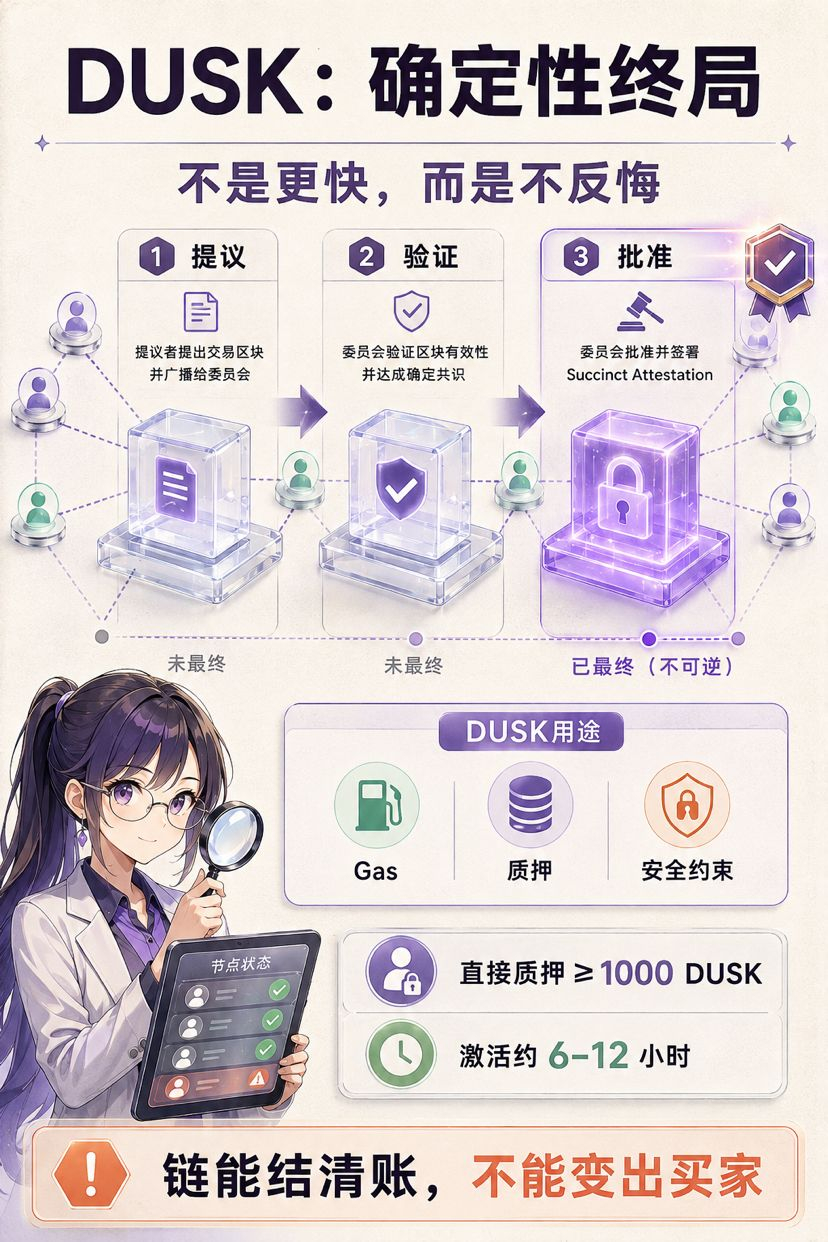
The number @Dusk that deserves the most attention, in my view, is Succinct Attestation. It breaks consensus into three phases: proposal, verification, and approval. A committee is selected randomly based on staking quality. Once approval is complete, the block is finalized. $DUSK isn’t just a market code: it pays Gas, participates in staking, and ties rewards together with the cost of making mistakes. Direct staking starts at a minimum of 1,000 coins; newly staked funds typically activate after 1–2 epochs, about 6–12 hours. Rewards depend on actual participation, not on fixed periodic deposits. Going offline may incur soft penalties, while malicious acts like conflicting signatures can burn part of your stake.
After repeatedly checking stake-info, my conclusion is: Dusk’s core is preparation for regulated assets—not just privacy, but also a predictable settlement foundation. A deterministic finality is suitable for securities and RWA to reduce reconciliation, but nodes need to stay online long-term, remain synchronized, and be upgraded. The 1,000-coin threshold also raises the direct cost of participation. Deterministic finality doesn’t mean the market has liquidity: a chain can clear the books, but it can’t conjure buyers. Going forward, I want to see real transaction fees, the active staking rate, and Dusk Trade actually taking shape. If usage doesn’t last, no matter how elegant the consensus is, it still only settles an empty ledger with certainty. #dusk #BTC #ETH