
Editor’s note
The old houses with blue brick walls bear the marks of wear and the passage of time, engraving the bustling years of generations; they preserve warm memories of neighbors standing by one another. With new buildings rising from the ground, they place people’s hopes for a better, more livable life and carry a brand-new promise for the city’s iterative upgrades. As urban renewal efforts in Shanghe County move deeper, the reconstruction and renovation work for old residential areas across the jurisdiction has been fully launched. A series of housing projects that take into account cultural preservation, people’s well-being, and urban quality are being implemented in an orderly and solid manner on this fertile land.
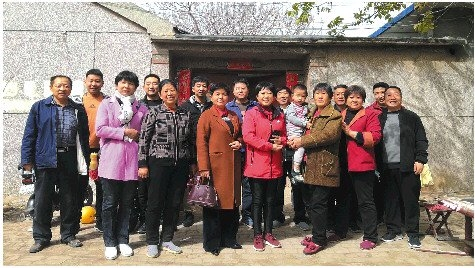
Before the relocation of the Dongjiu Distillery area, Guo Peizhi and his old neighbors left a group photograph in front of the bungalow homes in the staff quarters. In their smiles were both anticipation and reluctance to say goodbye; today, the old neighbors gather again in the newly built Koningli community. As light and shadow shift, they witness a transformation and upgrade of urban renewal in Shanghe County, and they also tell a heartfelt story of how warmth and care between neighbors endure.
Reporter: Wang Beiyi
A Reunion Again—Neighborly Warmth Arrives as Promised
Kangningli Community in Shanghe County. The apartment buildings are brand-new and well-ordered. The gray exterior facades glow softly in the sunlight. In the greenbelts, roses are blooming in full splendor; the hedges have been trimmed neatly and evenly; and winding paths made of permeable paving stones run through the area. In the children’s playground, several kids shriek and play together. Nearby, in the gazebo, a few elderly people fan themselves and play chess leisurely.
During the midsummer “Sanfu” period, the sun is scorching. But Guo Peizhi can’t spare a thought for the heat. He arrives early and waits at the entrance of the residential compound, finding a patch of shade to stand in place, yet his gaze never leaves the main gate for a moment.
“Here it comes! Here it comes!” he muttered to himself. In the distance, several electric bikes rolled in. The riders and the passengers on the back seats were all familiar old faces. Guo Peizhi strode forward, his eyes creasing into joy.
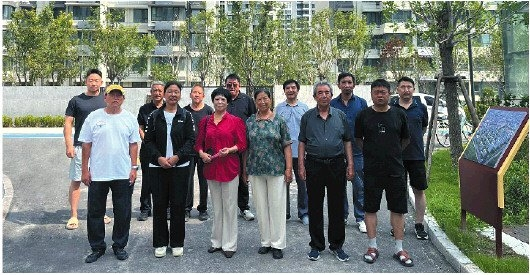
Today, the old neighbors gather again in Kangningli Community—only to take a new group photo together.
“Back then, my youngest grandchild was still little. Now he’s in primary school.” Guo Peizhi looked at the neighbors around him, filled with emotion. As an old Party member, when the shantytown renovation was launched, he took the initiative to sign the agreement and relocate first. He was praised as a model by everyone in the area. Now, after the relocation, in his new home, he again took the lead at once to organize neighborhood gatherings—bringing together the scattered neighborly bonds and renewing the warmth.
Looking back in time, at that time when the shantytown renovation and urban renewal work for the Qixuanca comprehensive area (Phase Seven) was being accelerated across the board, the relocation and acceptance work for the Dongjiuchang plot was in full swing. On the eve of relocation, a dozen or so old neighbors gathered in front of Guo Peizhi’s bungalow, where he had lived for over twenty years, and they left behind an old photograph. In the picture, Guo Peizhi’s wife holds their toddler grandchild learning to talk; beside them are more than a dozen faces squeezed together. Their smiles are a blend of expectation and reluctance.
After the photos were taken, the old neighbors bid each other farewell and agreed to continue their neighborly connections again in the resettlement community. With time passing and new homes completed, recently, this neighborly promise was fulfilled at Kangningli Community.
Gathering Strength and Refreshing the “Speed” of Shantytown Renovation
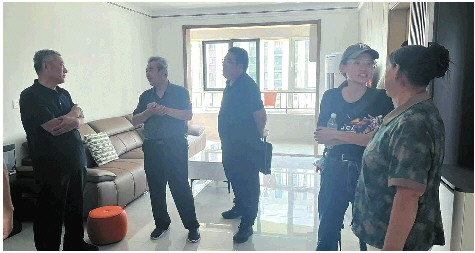
Chen Huanchun’s new home has three bedrooms and two living rooms, with over 100 square meters, bright and transparent.
In the living room, newly purchased sofas and a coffee table are set out. Sunlight streams through the floor-to-ceiling windows, making the floor shine. In the kitchen, the brand-new gas stove and range hood have not even been unpacked yet. The bathroom has been divided into wet and dry areas, and it comes with a water heater and a toilet, all in place. “We used to live in small, one-story houses all our lives. How could we ever dare to imagine we’d be able to live in a place with conditions this good?” Looking around his brand-new home, Chen Huan chun’s eyes are filled with joy and anticipation.
If you rewind the time back to before the relocation, what’s actually on the minds of the old neighbors is not so much “ease and delight.”
The courtyard was built back when the factory renovated housing. Most of them moved in around 1997. Kids were born here, and grandchildren and granddaughters learned to walk here. The old neighbors used to carry bowls to visit each other. If anyone in a nearby home made dumplings, they would want their neighbors to share a bowl too. Back then, the big courtyard of the residential compound connected with one another. Today, if your water pipe leaks, I’ll take my wrench over. Tomorrow, if no one is watching your child, the aunt next door would take the child home without even asking questions and have them eat. Such days—if you say “move,” who could bear to give them up?
But everyone also knows that the days in this old house can’t go on much longer. The oldest residential compound is most afraid of rain—once the rain gets even a bit heavier, water will pool in the yard. The muddy ground can swallow shoes whole. Rainwater seeps along the wall base into the house, and in the corners mold stains appear year after year. Winter is even worse. Without centralized heating, burning coal stoves is dirty and stifling. At night, even after wrapping up in multiple layers of blankets, people are still so cold they can only huddle up into a tight ball.
To truly improve residents’ living conditions and advance urban renewal, the Shanghe County old urban district shantytown renovation headquarters joined forces with the relocation units to coordinate and push forward with concerted efforts. They took multiple measures to make solid work on residents’ thoughts and full force to speed up shantytown renovation and urban renewal. From signing agreements to relocation and acceptance, the relocation and acceptance process for more than 80 households in the Dongjiuchang plot took only 15 days—an unprecedented speed for shantytown renovation and urban renewal in Shanghe County.
“Cities need to develop, and life will keep getting better. We’ve got to look ahead.” Guo Peizhi didn’t tell the neighbors too many grand truths. He simply took the lead and signed the agreement himself.
“Old Guo already signed—what are we still hesitating about?” Seeing this “good-hearted helper” who has taken care of everyone’s water and sanitation fees for years as a volunteer, Chen Huanchun and the other neighbors’ wavering “scale” in their hearts gradually steadied.
Quality Improves, and the City’s Everyday “Fireworks” Continue
Real urban renewal is never just tearing down the old and building the new, or simply refreshing the city’s appearance. It is an all-round transformation that balances improving the city’s quality with preserving the warmth of people’s lives.
The Central Conference on Urban Work clearly calls for promoting development that is driven by the city’s “inner strengths,” better meeting residents’ rigid housing needs and diversified improvement needs, and placing even greater emphasis on people first and on intensive, efficient governance. In recent years, Shanghe County has pushed shantytown renovation and urban renewal work forward in depth. The county CPC committee and the county government have always regarded resettlement housing construction as an important task for safeguarding people’s livelihoods and promoting urban development—a top priority project. Focusing on key links such as funding assurance and construction organization, through methods such as on-site research and meeting-based scheduling, they have made every effort to solve a series of bottlenecks and tough issues encountered in project advancement.
During the project advancement process, the county’s old urban district shantytown renovation command center gave full play to its roles in overseeing, coordinating, and providing service support. It assisted and guided the construction units in firmly focusing on all tasks, including resettlement housing construction and completion acceptance. It worked together with the Qixuanca Street Subdistrict to handle the selection of housing and move-in procedures. Based on ensuring construction safety and project quality, it scheduled work in reverse (counting back from the deadline), fought “like a battle with maps,” and pushed overlapping tasks forward. It firmly fulfilled the people’s livelihood commitments made to the resettled residents. Since 2016, the county has implemented 11 shantytown renovation projects in total, completing relocation and renovation for more than 10,000 households. More than a dozen resettlement communities have risen from the ground, and tens of thousands of residents have realized their “dream of living in peace and contentment.” Currently, except for phase seven and phase eight resettlement housing, which are in the final comprehensive finishing stage, all other projects have been completed and delivered.
As Shanghe County advances urban modernization and upgrades its quality level, it has always adhered to the philosophy of “the people build the city, and the city serves the people.” It not only refreshes the city’s appearance, improves urban functions, and addresses the shortfalls in people’s livelihoods, but also works to preserve urban memories, continue neighborly warmth, and protect everyday “city life” with its lively warmth and human touch. Kangningli Community has mature supporting facilities and is convenient and livable. Within a 1-kilometer straight-line living circle, there are several supermarkets such as Hongrun, Aiqinhai, and Zhongrun. There are also multiple schools including the Third Kindergarten, the Fifth Primary School, Wenchang, Hongde, and No. 2 Middle School. Daily life is convenient and worry-free; quality schools are just a stone’s throw away. It can be said to be a people’s-need “residential and education-friendly school district home.”
What makes the old neighbors even more reassured is that, to benefit the public to the greatest extent possible, whether it is state-owned land resettlement communities (such as Delinfu and Kangningli) or collective-land resettlement communities (such as Jinfufu and Beiguanxinju), Shanghe County always coordinates the overall resettlement layout. It adheres to the principle of “keeping the best locations for relocated residents,” allowing old neighbors to settle nearby so that their community ties are not broken and warmth continues.
Now in Shanghe, visible improvements in quality of life are taking place—low, cramped houses are turning into bright, spacious apartment buildings; muddy dirt roads are being transformed into permeable, green pathways; and coal-fired heating has become centralized heating. What is unseen is also being carefully preserved—human warmth that makes people feel cared for is continuing quietly in the new home community as neighbors look out at one another and help each other in a tender way.
“Come on, stand properly—look at the camera!” the photographer raised his camera. Guo Peizhi stood in the middle, and beside him were still those familiar faces. Only the background had changed: the low, cramped bungalows were replaced by brand-new apartment buildings, and the muddy courtyard had become beautiful roads and scenery.
With a quick “click” of the shutter, another “five-year plan” for the future is captured and fixed in the image.