$BNB I've been looking at $DUSK lately, and the more I watch it, the more it doesn’t feel like a typical public blockchain.
Privacy and compliance—put together they’re inherently contradictory. Most projects pick a side; Dusk just doesn’t. It uses zero-knowledge proofs to hide transaction details, while also providing regulators with an interface upfront. Sounds messy, and it’s definitely harder to do. But if RWA is truly going to go on-chain, it seems like you can’t get around this step.
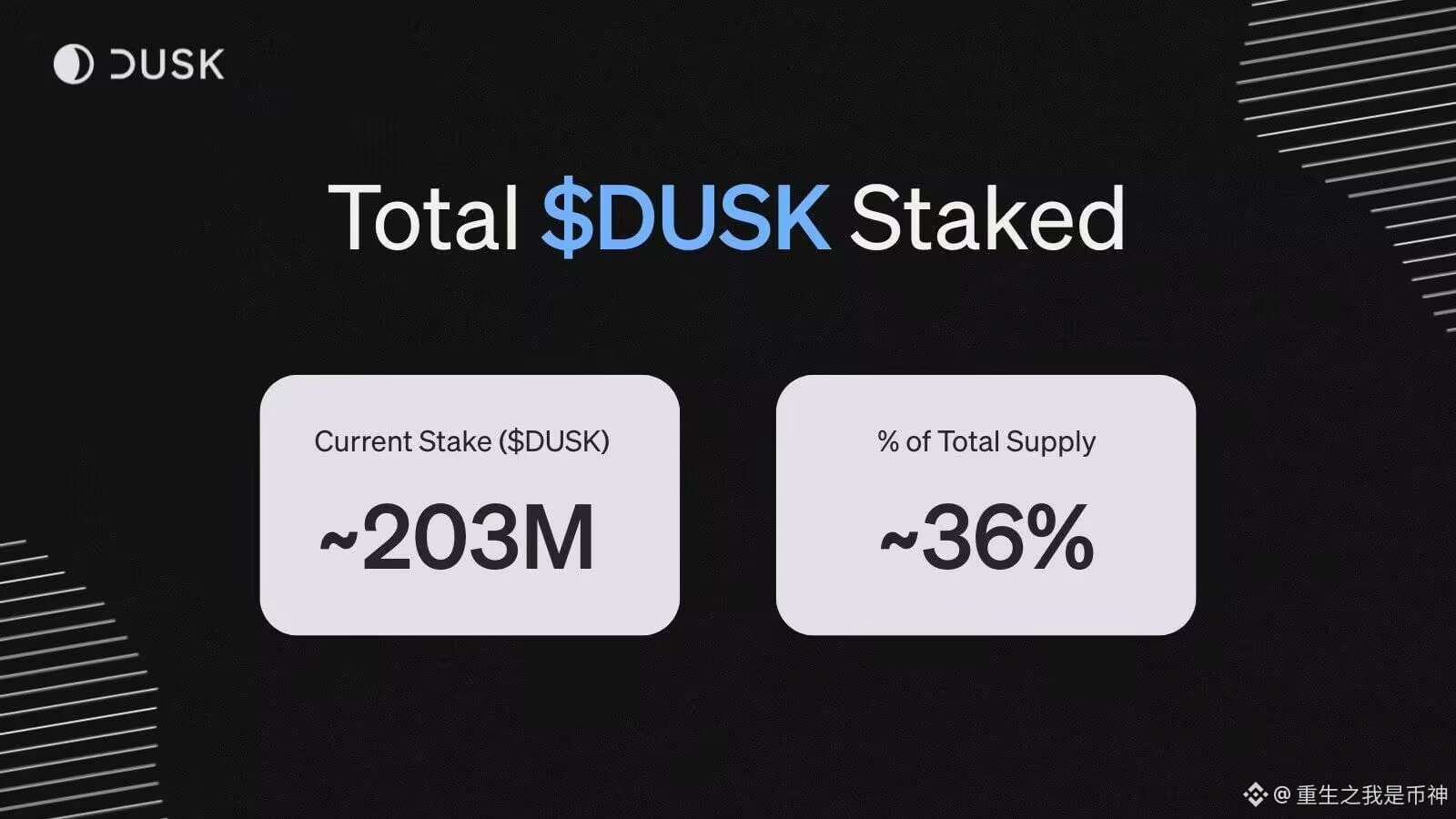
I’ve skimmed some of its technical documentation. Building its own virtual machine, while planning to be compatible with the EVM—clearly it’s trying to reduce the migration cost for developers. That trade-off feels pragmatic, with no faith-based burden. The barrier to running a node isn’t high either—ordinary people can participate in block production. Decentralization isn’t just something it says; it’s actually there. The staking data is also truthful—no wild pumping, no collapse. It just moves forward steadily. Honestly, I like this kind of pace. Things that come fast also go fast.
$DUSK ’s use case is pretty clear as well: staking, fees, and participating in consensus—no forced gimmicks. The tokenomics are clean, and in today’s market that’s become a rare quality.
The most memorable part is how it handles security tokens. Issuance, transfer, settlement—the whole set of logic has been rebuilt according to compliance requirements… That kind of work is exhausting, and the market might not immediately buy into it.
Sometimes I think what Dusk is really betting on is a judgment: institutions will ultimately accept on-chain privacy. If it’s right, the ceiling is very high. If it’s wrong… well, let’s not jump to conclusions for now.
Yeah, maybe I also have a bias filter for the privacy track.
But at least for now, #dusk is one of the few assets I’m willing to keep my eyes on long-term. The problem it solves is real—that much you can’t fake. @Dusk #dusk $DUSK
Privacy and compliance—put together they’re inherently contradictory. Most projects pick a side; Dusk just doesn’t. It uses zero-knowledge proofs to hide transaction details, while also providing regulators with an interface upfront. Sounds messy, and it’s definitely harder to do. But if RWA is truly going to go on-chain, it seems like you can’t get around this step.
I’ve skimmed some of its technical documentation. Building its own virtual machine, while planning to be compatible with the EVM—clearly it’s trying to reduce the migration cost for developers. That trade-off feels pragmatic, with no faith-based burden. The barrier to running a node isn’t high either—ordinary people can participate in block production. Decentralization isn’t just something it says; it’s actually there. The staking data is also truthful—no wild pumping, no collapse. It just moves forward steadily. Honestly, I like this kind of pace. Things that come fast also go fast.
$DUSK ’s use case is pretty clear as well: staking, fees, and participating in consensus—no forced gimmicks. The tokenomics are clean, and in today’s market that’s become a rare quality.
The most memorable part is how it handles security tokens. Issuance, transfer, settlement—the whole set of logic has been rebuilt according to compliance requirements… That kind of work is exhausting, and the market might not immediately buy into it.
Sometimes I think what Dusk is really betting on is a judgment: institutions will ultimately accept on-chain privacy. If it’s right, the ceiling is very high. If it’s wrong… well, let’s not jump to conclusions for now.
Yeah, maybe I also have a bias filter for the privacy track.
But at least for now, #dusk is one of the few assets I’m willing to keep my eyes on long-term. The problem it solves is real—that much you can’t fake. @Dusk #dusk $DUSK